Home › East Asian Civilization › Unit 1
Vedic India (about 1500–500 B.C.E.)
East Asian Civilization · Unit 1 · Civilization Packet
1. At a glance
| Question | Answer |
|---|---|
| When? | About 1500–500 B.C.E. (from about 3,500 to 2,500 years ago) |
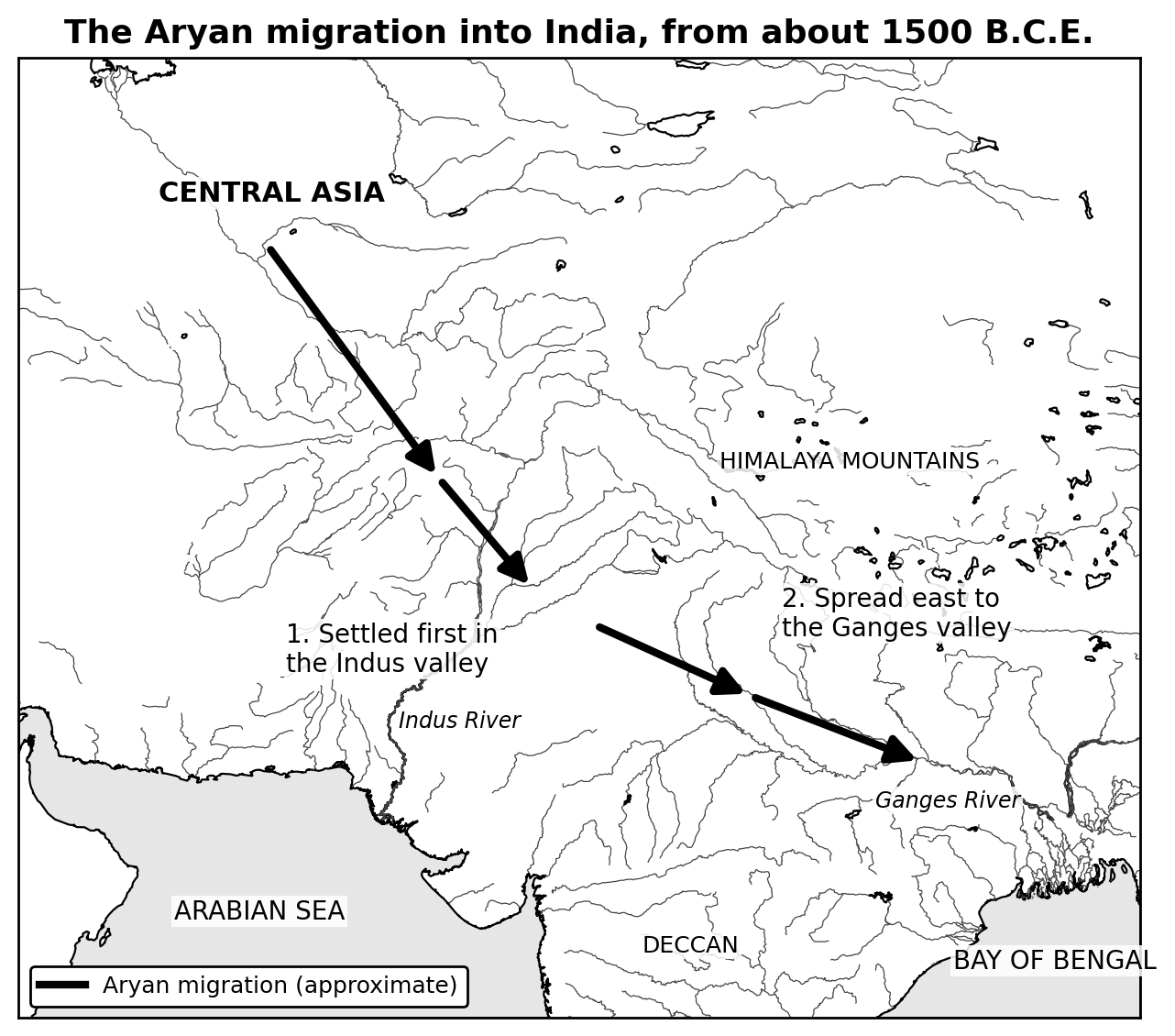
| Where? | First the Indus River valley, then east to the Ganges River valley |
| Who? | The Aryans, herders who migrated from central Asia |
| Government | Small kingdoms |
| Language | Sanskrit, an Indo-European language |
| Known for | The Vedas; the caste system; samsara, dharma and karma; the start of Buddhism |
| How do we know? | Mostly from words: sacred texts memorized and recited for centuries before they were written down |
Do not confuse: the Harappans built planned cities and left writing we cannot read. The Aryans left almost no cities, but they left words we can read.
2. SPICE-T: Vedic India
SPICE-T = Social, Political, Interactions, Cultural, Economic, Technology.
S — Social
The Aryans divided society into a caste system. You were born into your caste, you married inside it, and your children were born into it too. You could not change it.
| Rank | Caste | Who they were |
|---|---|---|
| 1 (top) | Brahmins | Priests, who knew the sacred words and performed the rituals |
| 2 | Kshatriya | Warriors and rulers |
| 3 | Vaisyas | Merchants and farmers |
| 4 (bottom) | Shudras | Laborers |
A famous hymn, the Purusha Sukta, describes society as one giant body: priests from the mouth, warriors from the arms, merchants and farmers from the thighs, laborers from the feet. The hymn makes the ranking sound natural, as if the gods arranged it.
P — Political
- The Aryans set up small kingdoms in the river valleys, not one big empire.
- The kshatriya (warriors and rulers) fought and governed.
- The brahmins held great power too, because only they could perform the sacrifices.
I — Interactions
- Migration: the Aryans came from central Asia. They settled first in the Indus valley, then spread east to the Ganges.
- They arrived around the time the Harappan cities fell silent (about 3,500 years ago).
- Sanskrit belongs to the Indo-European family of languages, with ancient Greek, Latin and English. Look-alike words show this: "mother" is matr in Sanskrit, meter in Greek, mater in Latin.
C — Cultural
- The Vedas: long sacred poems in Sanskrit. Priests memorized them and passed them on out loud for hundreds of years before anyone wrote them down. This is why we call the time the Vedic Period.
- The Vedic religion: many gods of nature (sky, fire, storm, dawn). No temples. Priests made offerings (sacrifices) into a sacred fire and sang the Vedas. The ritual had to be perfect, so only brahmins could perform it.
- The wheel and the ledger:
- Samsara: the cycle of birth, death and rebirth, pictured as a wheel.
- Dharma: duty. In the Vedic system, your dharma depended on the caste you were born into.
- Karma: the record of your actions, like a ledger. Good karma → a higher rebirth; bad karma → a lower rebirth, or even as an animal.
- Moksha: release from the wheel for good.

Credit: Unknown author, Wikimedia Commons, public domain
- The root of Hinduism: the Vedas are holy books for Hindus today, but the Aryans were not yet Hindus. The Vedic religion was the root from which Hinduism slowly grew over more than a thousand years. Later Hindus told of the Trimurti: Brahma creates the world, Vishnu preserves it, Shiva destroys it.
- Buddhism (about 2,500 years ago): see the section below.
E — Economic
- The Aryans were first herders who moved with their cattle.
- In the river valleys they settled and farmed.
- The vaisyas (merchants and farmers) grew the food and carried the trade.
T — Technology
- The Aryans built few cities and left few buildings.
- Their greatest "technology" was memory: priests passed on long sacred texts word for word, by voice, for centuries.
3. A new path: the Buddha and Buddhism
About 2,500 years ago, a rich prince named Siddhartha Gautama lived in his father's palace in northern India. Outside the walls he saw sickness, old age and death. He gave up everything and searched for six years. Then he sat under a tree and thought until he understood. People called him the Buddha, a title that means "the awakened one". His teachings are called Buddhism.
The Four Noble Truths:
- To live is to suffer.
- Suffering is caused by wanting.
- If the wanting stops, the suffering stops.
- There is a way to stop the wanting: the Eightfold Path.
The Eightfold Path (the Middle Way): right view, right intention, right speech, right action, right livelihood, right effort, right mindfulness, right concentration.
Same word, new meaning: the Buddha kept the word dharma, but changed who it belonged to.
| Vedic system | Buddhism | |
|---|---|---|
| Dharma means… | Your duty, which depends on your caste | The Eightfold Path |
| Who can follow it? | Different for each caste | The same for everyone: it is universal |
| Getting off the wheel | Moksha | Nirvana: the end of wanting, and so the end of rebirth |
| Needs a priest? | Yes: brahmins perform the sacrifice | No: no priest, no sacrifice |
Why it spread: Buddhism began, in part, as a reaction against the caste structure. It was popular first with lower-caste people, for whom the old "gate" had been closed. Yet the Buddha himself was born a prince in the warrior caste. Later, traders and monks carried Buddhism along the trade roads to China, then Korea and Japan.
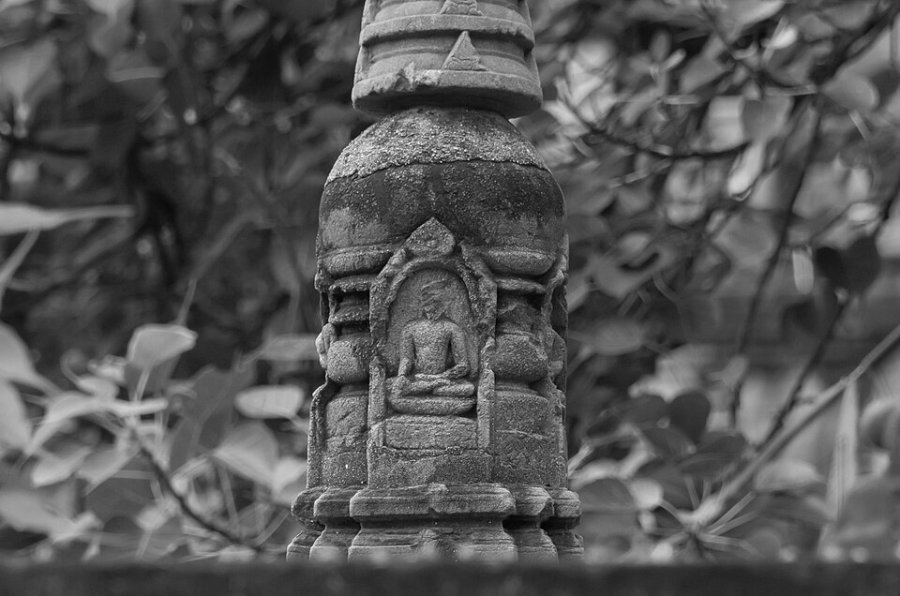
Credit: Sumitsurai, Wikimedia Commons, CC BY-SA 4.0
4. Big ideas
- Words, not walls. The Aryans left almost no cities. We know them through their words: the Vedas and the Sanskrit language.
- A society ranked by birth. The caste system placed everyone in a group for life, and the Vedas made that order sound natural.
- The wheel and the ledger. Samsara, dharma and karma explained why people were born where they were, and how they could rise or fall in the next life.
- A seed, not the tree. The Vedic religion was the root of Hinduism, not the same thing.
- A door in the wheel. The Buddha offered a path to nirvana that was the same for everyone, with no priest and no caste. It became one of Asia's great religions.
5. Key sources: how do we know what we know?
| Source | Who made it? When? | Insider or outsider? | What it tells us | Be careful! |
|---|---|---|---|---|
| The Rig Veda (including the Purusha Sukta) | Aryan priests, about 3,000+ years ago | Insider | Vedic gods, rituals and the four castes | Composed by brahmins, the caste at the top. Would the shudras have described society the same way? |
| The Upanishads (for example, the Brihadaranyaka Upanishad) | Later Vedic thinkers | Insider | Ideas about karma: "As a person acts, so he becomes." | Written by believers. |
| The Buddha's first teaching (in a deer park near Benares) | The Buddha's students memorized it | Insider | The Middle Way and the Eightfold Path | Written down hundreds of years after he died. |
| Cognate words (matr, meter, mater, mother) | Language evidence | n/a | Sanskrit is related to Greek, Latin and English | It shows a shared origin, not exactly where or when people moved. |
Remember: almost nothing was written down at the time. Every source was memorized, written down much later, and written by believers. Historians must read them with great care.
6. Timeline and vocabulary
| Date (approximate) | What happened |
|---|---|
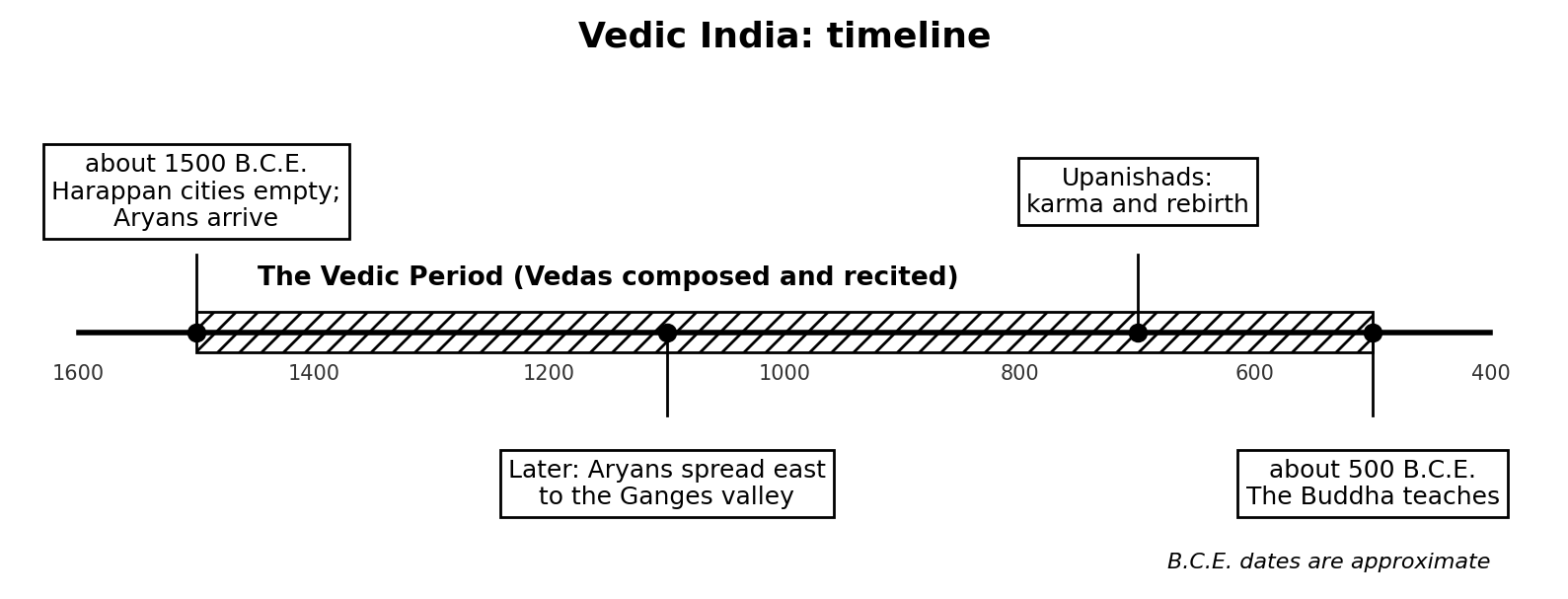
| About 1500 B.C.E. | Harappan cities empty; the Aryans arrive in the Indus valley |
| About 1500–500 B.C.E. | The Vedic Period: the Vedas are composed and recited |
| Later | The Aryans spread east to the Ganges valley and set up small kingdoms |
| About 800–500 B.C.E. | The Upanishads: ideas about karma and rebirth |
| About 500 B.C.E. (2,500 years ago) | Siddhartha Gautama, the Buddha, teaches in northern India |
| Centuries later | Buddhism spreads to China, then Korea and Japan |
| Word | Meaning |
|---|---|
| migration | The movement of a whole people to a new home |
| Sanskrit | The language of the Vedas |
| Indo-European | A family of related languages, including Sanskrit, Greek, Latin and English |
| Vedas | Sacred poems of the Aryans, composed in Sanskrit |
| caste system | A ranking of society into groups you are born into |
| brahmins | Priests, the top caste |
| kshatriya | Warriors and rulers |
| sacrifice | An offering to the gods, placed into a sacred fire |
| samsara | The cycle of birth, death and rebirth |
| dharma | Duty (Vedic); the Eightfold Path (Buddhism) |
| karma | The record of a person's actions |
| moksha / nirvana | Release from the cycle of rebirth (Vedic / Buddhist word) |
| Buddha | A title meaning "the awakened one" |
| universal | Belonging to everyone, with no exceptions |
7. Connections
Before: the Indus Valley (Harappans)
| SPICE-T | Indus Valley (Harappans) | Vedic India (Aryans) |
|---|---|---|
| Cultural | Writing no one can read | The Vedas in Sanskrit, which can be read |
| Technology | Planned brick cities with drains | Almost no cities |
| Interactions | Little evidence of war | Warlike herders who migrated from central Asia |
Later: the Mauryan Empire (Unit 2)
The Mauryan emperor Ashoka became a Buddhist and spread Buddhism across India and beyond.
Across Asia
Buddhism, born in Vedic India, later reached China (during the Period of Disunion, Unit 3) and then Korea and Japan.
8. Where students lose marks on this topic
| Mistake | Fix |
|---|---|
| Saying the Aryans were Hindus | Not yet. The Vedic religion was the root of Hinduism, which grew much later. |
| Saying "English comes from Sanskrit" | They are related (both Indo-European). Neither comes from the other. |
| Saying the Buddha threw away the word dharma | He kept the word but changed its meaning: the Eightfold Path, the same for everyone. |
| Saying the Buddha was born poor or low-caste | He was a prince in the warrior caste. |
| Mixing up moksha and nirvana | Moksha = Vedic word for release. Nirvana = Buddhist word for release. Same wheel, different door. |
| Mixing up Buddhism and Hinduism on a source question | Caste and sacrifice = Vedic/Hindu. Four Noble Truths and the Eightfold Path = Buddhist. |
| Choosing a true fact that is not in the source | Find the words in the source that prove your answer. |
Self-check
Cover the answers. Can you answer these in complete sentences?
- Where did the Aryans come from, and which two rivers did they settle by?
- Name the four castes from top to bottom.
- How do samsara, dharma and karma work together?
- Were the Aryans Hindus? Explain.
- What are the first two Noble Truths?
- How was Buddhist dharma different from Vedic dharma?
Check your answers (click to open)
- The Aryans came from central Asia. They settled first in the Indus River valley and later spread east to the Ganges River valley.
- From top to bottom, the castes were the brahmins, the kshatriya, the vaisyas and the shudras.
- A person must do their dharma, or duty. Their karma records how well they did it, and that karma decides where they are reborn on the wheel of samsara.
- No, the Aryans were not yet Hindus. The Vedic religion was the root from which Hinduism slowly grew over more than a thousand years.
- The first Noble Truth is that to live is to suffer. The second is that suffering is caused by wanting.
- In the Vedic system, dharma was a duty that depended on a person's caste. In Buddhism, dharma means the Eightfold Path, and it is the same for everyone.