Home › East Asian Civilization › Unit 1
Zhou China (1046–256 B.C.E.)
East Asian Civilization · Unit 1 · Civilization Packet
1. At a glance
| Question | Answer |
|---|---|
| When? | 1046–256 B.C.E.: almost 800 years, longer than any other Chinese dynasty |
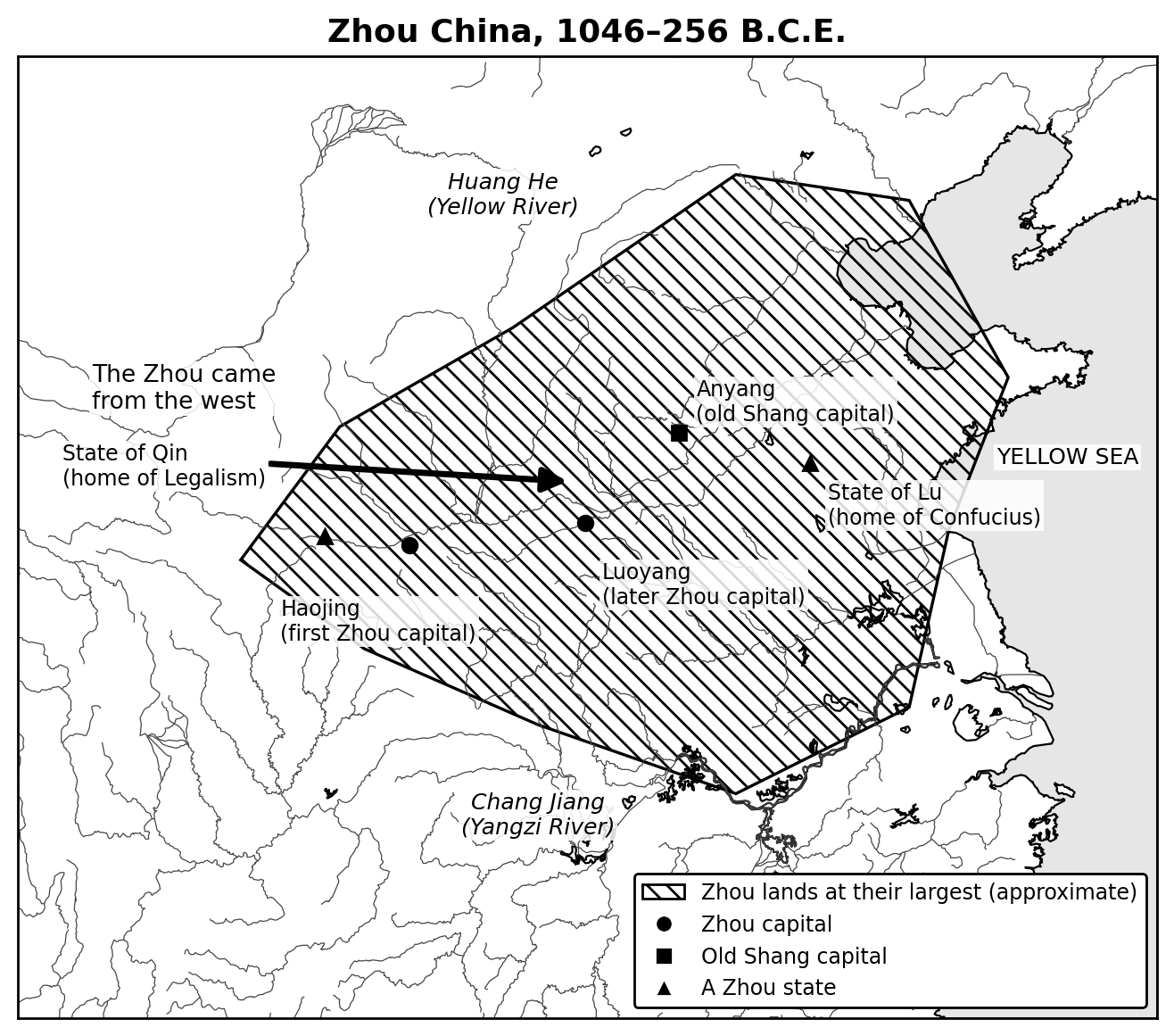
| Where? | They began west of the Shang, then ruled the Huang He valley and beyond |
| Who? | The Zhou Dynasty, who defeated the Shang in about 1046 B.C.E. |
| Big idea 1 | The Mandate of Heaven: Heaven gives a just ruler the right to rule |
| Big idea 2 | Fengjian: the king gave land to relatives and loyal lords |
| Big idea 3 | The Hundred Schools of Thought: Confucianism, Daoism and Legalism |
| How do we know? | Zhou writings (including bronze inscriptions and the Classic of Documents), and the books of the thinkers. For the first time, we hear ancient people arguing. |
2. The Mandate of Heaven
The Zhou took power by force. Why should people obey them instead of the old Shang kings? The Zhou needed to justify their new power.
- Heaven (in Chinese, Tian) was the highest power in the sky.
- The Zhou said Heaven chooses one just ruler and gives him the right to rule. This right is the Mandate of Heaven.
- A good king keeps the mandate. If a king becomes cruel, Heaven takes it away and gives it to a better ruler.
- The Zhou said the last Shang king was cruel, so Heaven gave the mandate to them.
How could people tell a ruler had lost the mandate? Signs: floods, famine, earthquakes and rebellions.
The Dynastic Cycle
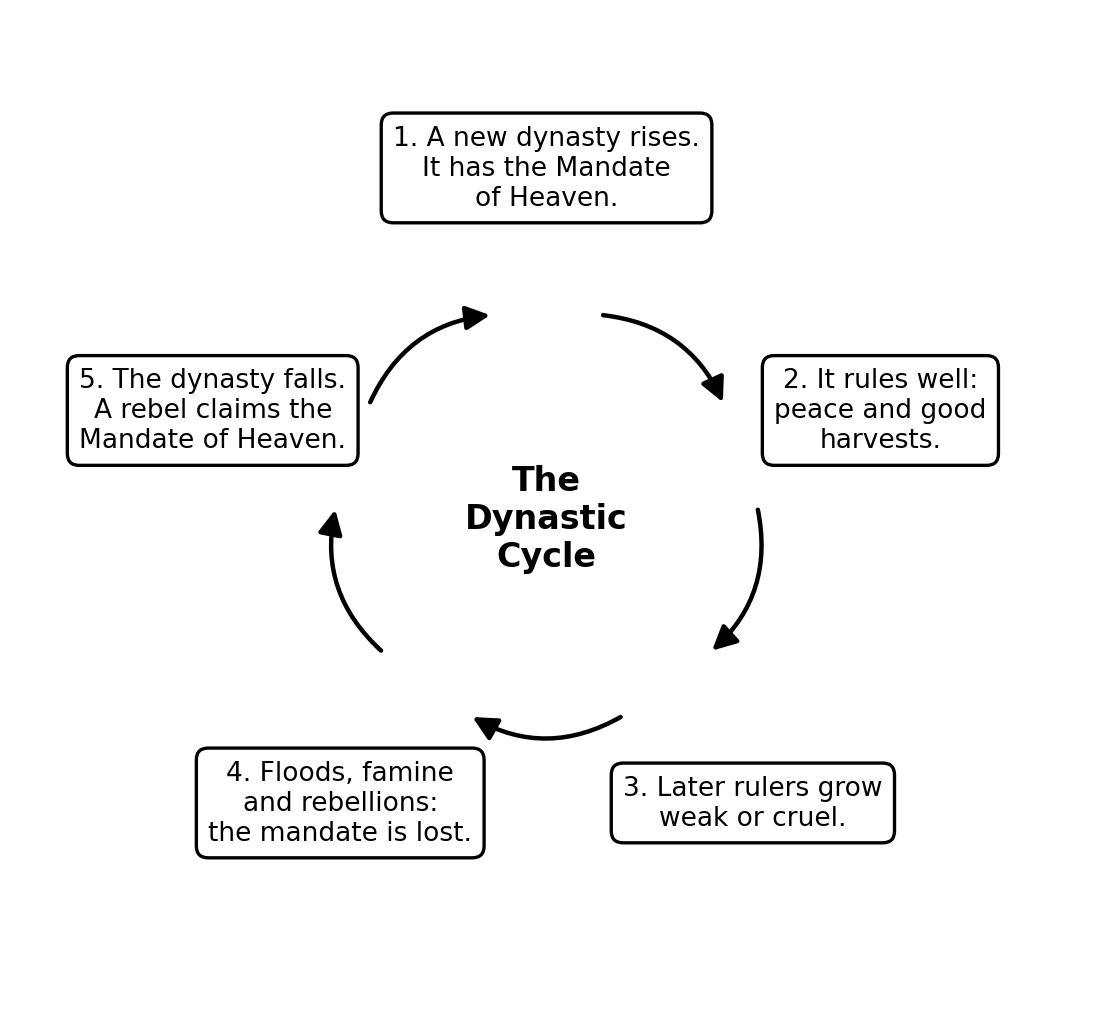
- A new dynasty rises. It has the Mandate of Heaven.
- It rules well: peace and good harvests.
- Later rulers grow weak or cruel.
- Floods, famine and rebellions appear: signs the mandate is lost.
- The dynasty falls. A rebel claims the Mandate of Heaven, starts a new dynasty, and the cycle begins again.
Be careful: the Mandate of Heaven was the Zhou's own explanation: the winners telling everyone why their conquest was right. It is not a neutral report. It is an argument. Historians read it as both a belief and a justification.
3. SPICE-T: Zhou China
SPICE-T = Social, Political, Interactions, Cultural, Economic, Technology.
S — Social
- At the top: the king. Below him: the lords who ruled the states, then officials and warriors, then the farmers, who were most of the people.
- Confucius taught five relationships: ruler and subject, father and son, husband and wife, elder brother and younger brother, friend and friend. In each pair, both people owe each other something.
- Filial piety: a son owes his father respect and obedience. The father owes the son care and a good example.
P — Political
- The problem: the Zhou kingdom was enormous. There were no fast roads and no quick messengers. One king in one capital could not rule it all.
- The solution: fengjian. The king gave land to his relatives and to nobles he trusted. Each became the ruler of his own state. In return they promised loyalty, sent soldiers when the king called for war, sent gifts of grain and bronze, and performed rituals for the royal ancestors.
- "Feudalism" or "fengjian"? In class we use the word feudalism for a system like this, where land is given in exchange for loyalty. Fengjian is the Zhou's own version, and its Chinese name. Either word is accepted on the SAQ.
- It worked, for a while. The Zhou ruled more of China than anyone before them.
- Then it turned: decentralization. Generations passed. The lords' sons had never met the king. Their states grew rich, raised their own armies and made their own laws. Power drained away from the centre. By about 500 B.C.E., the Zhou king was little more than a name.
I — Interactions
- The Zhou defeated the Shang in about 1046 B.C.E.
- Later, the states fought each other: survive, or be swallowed. Historians call the last, most violent part of the Zhou period the Warring States period (about 475–221 B.C.E.).
- In 221 B.C.E. the State of Qin conquered all the others. (That story is in Unit 2.)
C — Cultural
The Hundred Schools of Thought. The warring kings needed better ideas than their neighbors, so they listened to anyone with an answer. Teachers walked from court to court. Under all their arguing lay one question: where does order come from? Three answers won out:
| Confucianism | Daoism | Legalism | |
|---|---|---|---|
| Teacher | Confucius (Kongfuzi), from the State of Lu | Laozi | Shang Yang and Han Fei, both from the State of Qin |
| Order comes from… | Good relationships and good example | Living in harmony with nature; following the Dao (the way) | Clear laws, certain rewards and punishments |
| People are… | Able to learn to be good | Best when they stop struggling | Naturally selfish |
| A wise ruler… | Sets a good example | Does less, not more | Controls people |
| Picture it | A family | Water flowing around a rock | A strict judge |
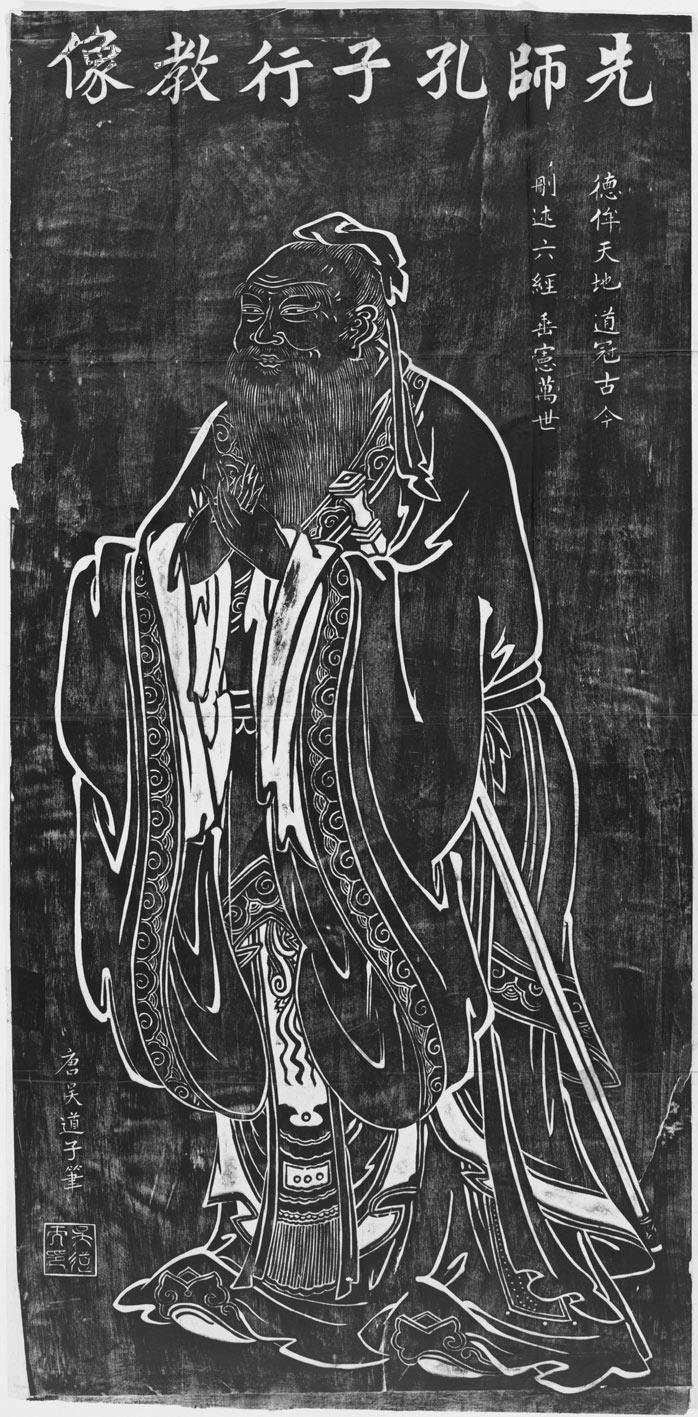
Credit: After Wu Daozi, Wikimedia Commons, public domain
E — Economic
- Most people were farmers. Under fengjian, the lords' land came with the people living on it.
- Lords sent the king gifts of grain and bronze.
- In the later Zhou period, states began to use coins for trade.
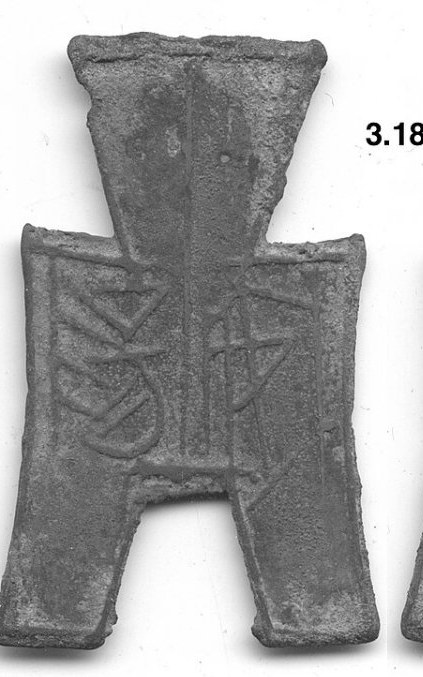
Credit: Scott Semans, Wikimedia Commons, CC BY 3.0
T — Technology
- Bronze vessels with long inscriptions cast inside them recorded gifts of land and titles.
- Later in the Zhou period, people began to make iron tools and weapons. Iron farm tools helped grow more food.
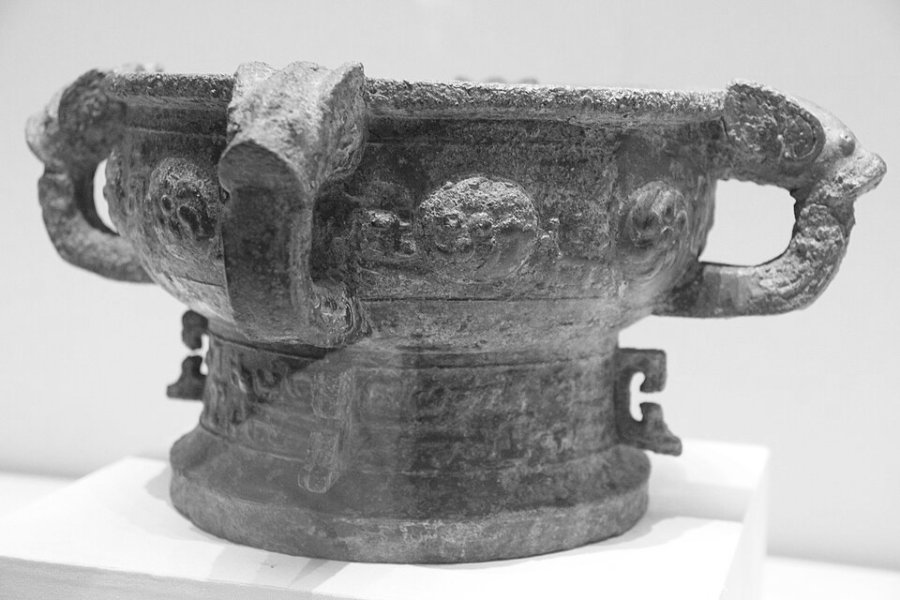
Credit: Gary Todd, Wikimedia Commons, CC0 (public domain)
4. Big ideas
- Permission to rule. The Mandate of Heaven turned a conquest into a duty given by Heaven. For the next 3,000 years, almost every Chinese dynasty used it, and every rebel used it too.
- The solution became the problem. Fengjian let the king rule more land, but over many generations the lords grew stronger than the king.
- Chaos made thinkers. Because the states were desperate, rulers listened to new ideas. Confucianism, Daoism and Legalism were all born in the Zhou period.
- Listen to them argue. For the first time in this course, ancient people wrote down rival ideas on purpose.
5. Key sources: how do we know what we know?
| Source | Who made it? When? | Insider or outsider? | What it tells us | Be careful! |
|---|---|---|---|---|
| Classic of Documents (Shangshu) | Zhou writers, about 1000 B.C.E. | Insider (Zhou) | The Mandate of Heaven: "the fate of Shang is a mirror" | Written by the winners. It is an argument, not a neutral report. |
| Bronze inscriptions (for example, the Yi Hou Ze gui) | Zhou nobles, about 3,000 years ago | Insider | The king granted land, people and gifts to a noble | One noble's proud record. It does not show nobles who later turned against the king. |
| The Analects | Confucius's students, after he died | Insider (followers) | Confucius's sayings | Confucius spoke; his students wrote it down later. |
| The Daodejing | Said to be by Laozi | Insider | The Dao; living like water | Some historians doubt Laozi was one real person. |
| The Han Feizi and Book of Lord Shang | Legalist thinkers of Qin | Insider | Laws, rewards and punishments | Of the three, Han Fei's book is the most surely written by its author. |
6. Timeline and vocabulary
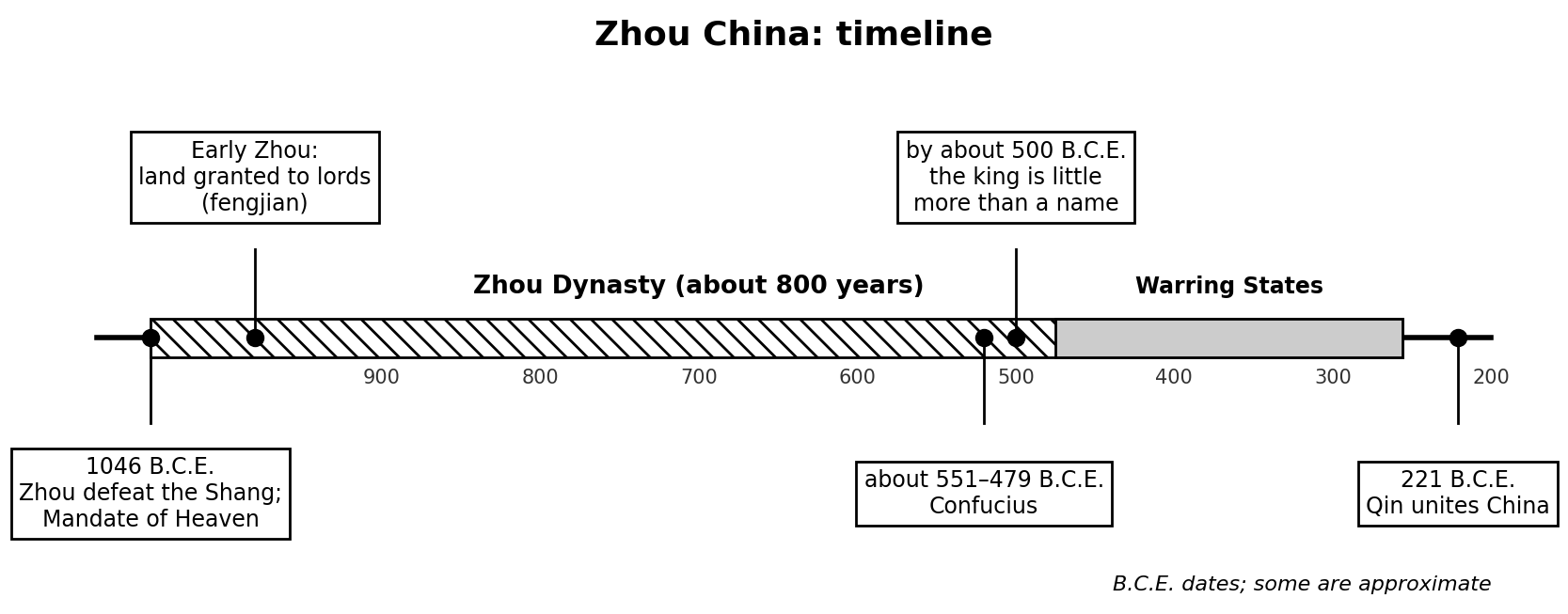
| Date | What happened |
|---|---|
| About 1046 B.C.E. | The Zhou defeat the Shang; the Mandate of Heaven |
| Early Zhou | The king grants land to relatives and lords (fengjian) |
| About 551–479 B.C.E. | Life of Confucius |
| By about 500 B.C.E. | The Zhou king is little more than a name; the states hold the real power |
| About 475–221 B.C.E. | The Warring States period; the Hundred Schools of Thought |
| 256 B.C.E. | The last Zhou king is removed |
| 221 B.C.E. | The State of Qin unites China (Unit 2) |
| Word | Meaning |
|---|---|
| justify | To give a good reason for something; to show an action was right |
| overthrow | To remove a ruler from power, usually by force |
| Mandate of Heaven | The right to rule, given by Heaven to a just ruler and taken away from a cruel one |
| Dynastic Cycle | The repeating rise and fall of dynasties |
| fengjian | The Zhou system: the king gave land to relatives and lords in return for loyalty |
| feudalism | A system where land is given in exchange for loyalty and service |
| decentralization | When power moves away from the centre to local rulers |
| philosophy | A set of ideas about how to live and how to rule |
| filial piety | Respect and obedience owed by children to their parents |
| Dao | "The way": the natural way the universe works |
| harmony | Living peacefully together, without conflict |
| human nature | What people are really like, deep down |
7. Connections
Before: the Shang
| Shang | Zhou | |
|---|---|---|
| Right to rule came from… | Speaking to the ancestors (oracle bones) | Heaven (the Mandate of Heaven) |
| Famous writing | Oracle bones: questions about the future | Documents, bronze inscriptions, philosophy: arguments |
After: the Qin (Unit 2)
The State of Qin used Legalism, and it won. In 221 B.C.E. Qin conquered every other state and united China. Legalism was brutal, and it worked.
Across Asia
At about the same time that Confucius taught in China, the Buddha taught in India (see the Vedic India packet). Both were trying to answer how people should live.
8. Where students lose marks on this topic
| Mistake | Fix |
|---|---|
| Saying the Shang made the Mandate of Heaven | The Zhou made it, to justify defeating the Shang. |
| Treating the Mandate as a neutral fact | It was the winners' argument. Say so in source questions. |
| Saying fengjian made the king stronger forever | It worked at first; over generations the lords grew stronger (decentralization). |
| Mixing up the three philosophies | Relationships = Confucianism. Nature and the Dao = Daoism. Laws and punishments = Legalism. |
| Saying Confucius wrote the Analects | His students wrote down his sayings after he died. |
| On the SAQ, giving only one category | Political = rule through relatives and lords given land. Cultural = the Mandate of Heaven. Give both when asked. |
| A "difference" answer that is true of both sides | On a compare question, check that your answer is true of only one side. |
Self-check
Cover the answers. Can you answer these in complete sentences?
- What is the Mandate of Heaven?
- Why did the Zhou need the Mandate of Heaven?
- What is fengjian, and what did the lords promise in return?
- How did the solution become the problem?
- Name the three philosophies and one teacher of each.
- Why do historians call the Mandate of Heaven an "argument"?
Check your answers (click to open)
- The Mandate of Heaven is the idea that Heaven gives a just ruler the right to rule, and takes it away if the ruler becomes cruel.
- The Zhou had taken power by force, so they needed to justify their rule. They said Heaven had taken the mandate from the cruel last Shang king and given it to them.
- Fengjian was the Zhou system in which the king gave land to relatives and trusted nobles. In return they promised loyalty, sent soldiers, sent gifts of grain and bronze, and performed rituals for the royal ancestors.
- Fengjian let the king rule a huge kingdom. But over many generations the lords grew rich, raised their own armies and made their own laws, until the king was little more than a name.
- Confucianism was taught by Confucius, Daoism by Laozi, and Legalism by Shang Yang and Han Fei.
- It was the Zhou's own explanation of why their conquest was right. It tells us what the winners wanted people to believe, not a neutral report of what happened.