Home › East Asian Civilization › Unit 1
Early Japan: the Jōmon, the Kofun and Shinto
East Asian Civilization · Unit 1 · Civilization Packet
1. At a glance
| Question | Answer |
|---|---|
| Where? | Japan: an archipelago (a chain of islands), cut off from the Asian mainland by the sea |
| Who? | The Jōmon culture (prehistoric hunter-gatherers), then the Kofun period (rulers buried in huge tombs) |
| When? | Jōmon: thousands of years, ending about 300 B.C.E. · Kofun: about 300–550 C.E. |
| Religion | Shinto, Japan's indigenous religion: belief in kami (spirits) |
| Known for | Cord-marked pottery; keyhole-shaped tombs; kami in mountains, rivers and trees |
| How do we know? | Jōmon: archaeology only. Kofun: archaeology, and the Kojiki (712 C.E.), written 400 years later in borrowed Chinese characters |
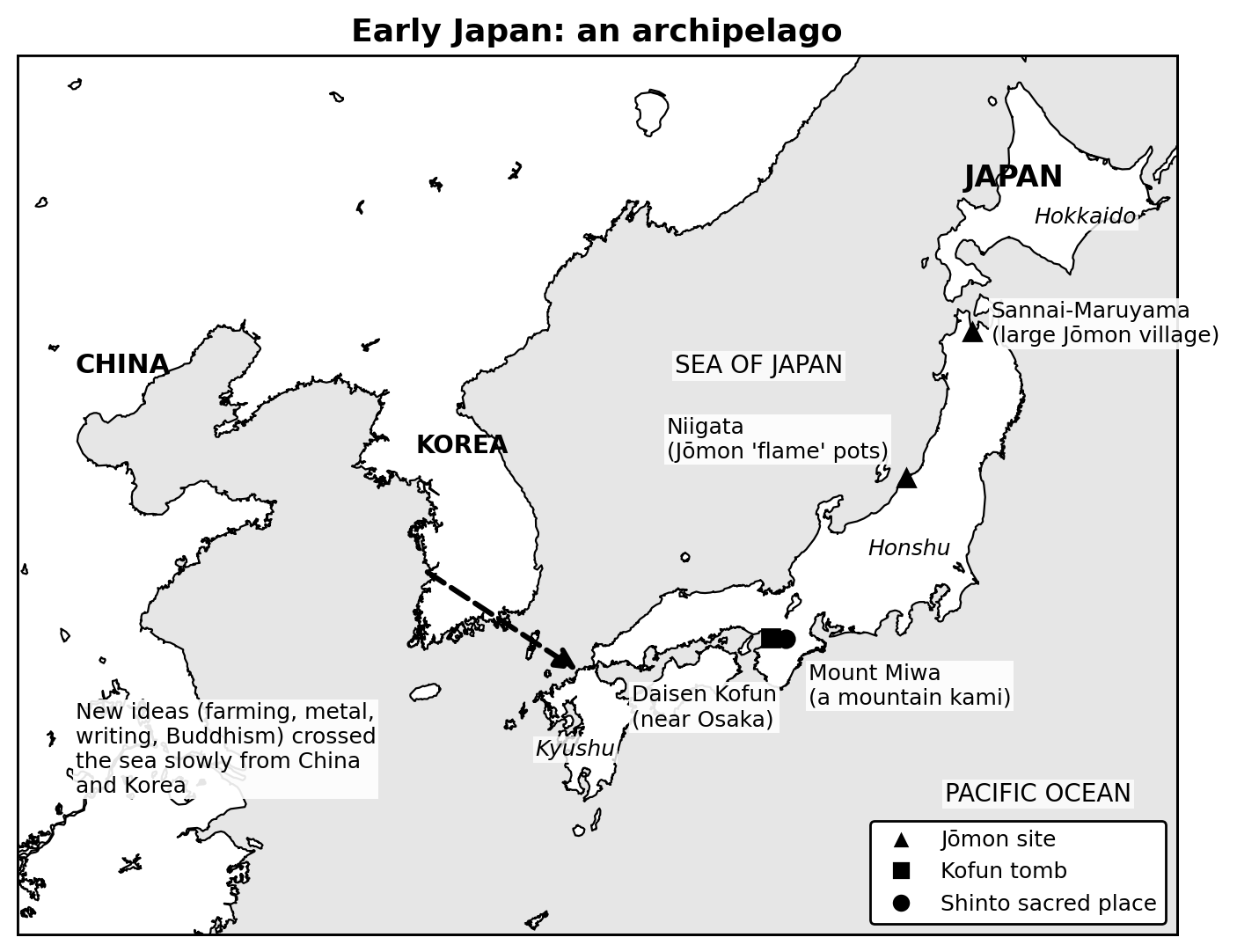
Why Japan was slow: the sea lay between Japan and the mainland, so new ideas (farming, metal and writing) reached Japan slowly. Japanese civilization developed later than China's and India's.
2. SPICE-T: the Jōmon
The Jōmon are the earliest people we know of in Japan. They lived thousands of years ago, before Japan had cities, kings or writing. That makes them prehistoric: from a time before written records.
| SPICE-T | The Jōmon |
|---|---|
| S — Social | Small groups that moved with the seasons. Many archaeologists believe Jōmon society was matriarchal: women held central power and passed down the family line. |
| P — Political | No kings and no cities. Small groups, not a state. |
| I — Interactions | The sea kept Japan apart from the mainland, so new ideas arrived slowly. |
| C — Cultural | Cord-marked pottery: they pressed cords into wet clay to make patterns. "Jōmon" means "cord-marked". No writing at all. |
| E — Economic | Hunter-gatherers: they did not farm. They hunted, fished, and gathered nuts, plants and shellfish. Japan's forests and seas gave them plenty of food. |
| T — Technology | Pottery: some Jōmon pots are among the oldest pottery found anywhere in the world. Stone tools. |
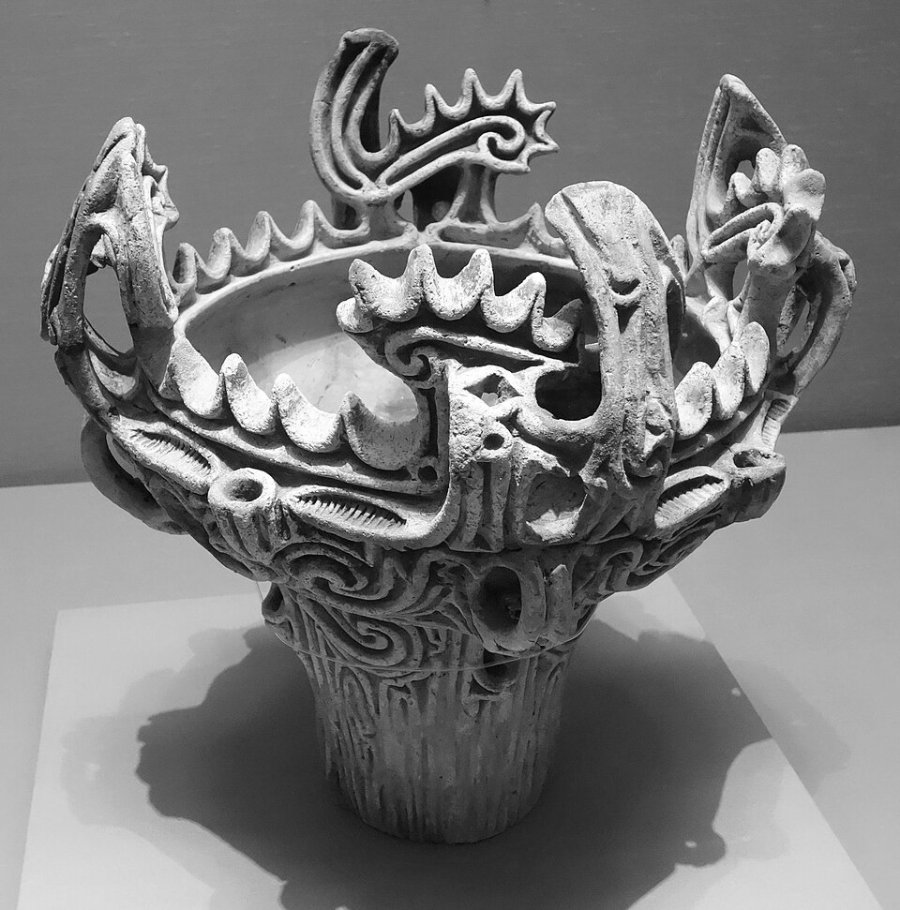
Credit: Daderot, Tokyo National Museum, Wikimedia Commons, CC0 (public domain)
3. SPICE-T: the Kofun period and Shinto
Over time, farming and metal reached Japan, and the Jōmon period ended. An organized civilization rose in its place: the Kofun period (about 300–550 C.E.).
S — Social
- Powerful rulers at the top, buried with great honor. Many workers were needed to build their tombs.
- Worship of ancestors: the dead could become kami. "A waterfall can be kami. So can your grandfather."
P — Political
- Rulers were strong enough to make thousands of people build giant tombs for them.
- The Kojiki later claimed that Japan's rulers were descended from the Sun Goddess, Amaterasu. This gave the rulers the right to rule.
I — Interactions
- Japan borrowed China's writing (Chinese characters).
- Buddhism later arrived from China, through Korea.
- But Japan did not borrow China's religion. The kami were there first.
C — Cultural: Shinto
Japan is mostly mountains and forest, with the sea on every side, volcanoes and earthquakes. For the first people there, nature was not just beautiful. Nature was power. It fed you, and it could kill you.
Out of that land came Japan's indigenous religion (indigenous = belonging to a place from the very beginning, not brought in from somewhere else).
Kami are spirits that live inside the world: in high mountains, rivers, old trees, strange rocks, storms, and the dead. A kami is not a god on a throne far away in the sky. A kami is a presence, inside a thing. Kami can be found everywhere.
Three great principles:
- Respect for nature
- Worship of ancestors
- Belief in the kami
What it did NOT have: no founder (no Confucius, no Laozi, no Buddha) and no holy book.
The name: for a long time it had no name. When Buddhism arrived, the Japanese needed a word for what they already had. They called it Shinto: shin = the gods, to = the way, so "the way of the gods". They wrote it with Chinese characters, 神道, and the second character, 道, is the same one the Chinese read as Dao.
Remember: Japan borrowed China's writing. Japan did not borrow China's religion.
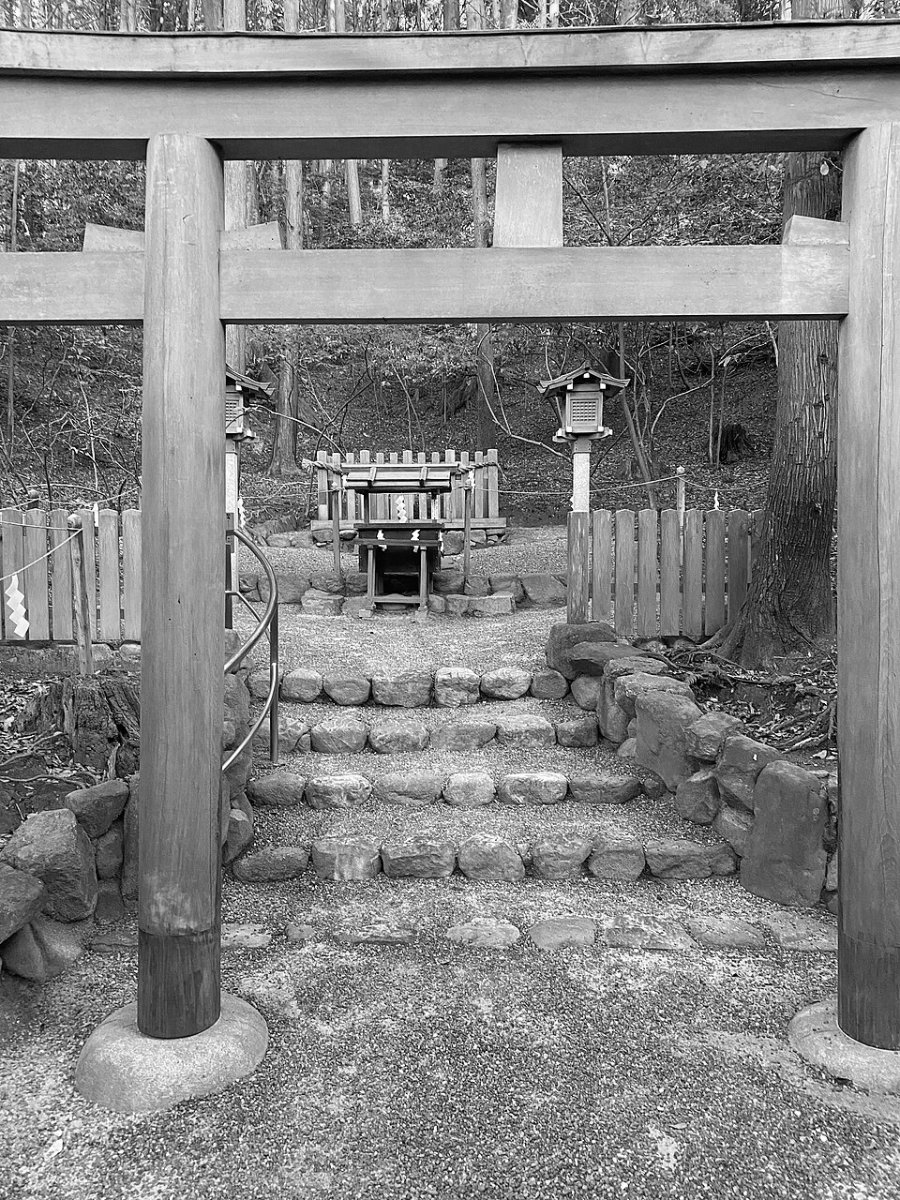
Credit: Immanuelle, Wikimedia Commons, CC BY-SA 4.0
E — Economic
- By the Kofun period, people farmed, and metal tools and weapons were in use.
- Rulers could gather enough food and workers to build huge tombs.
T — Technology
- Kofun tombs: huge mounds of earth. From the ground they look like hills. From the sky they are shaped like a keyhole. The largest is longer than four football pitches.
- Haniwa: clay figures placed on and around the tombs.
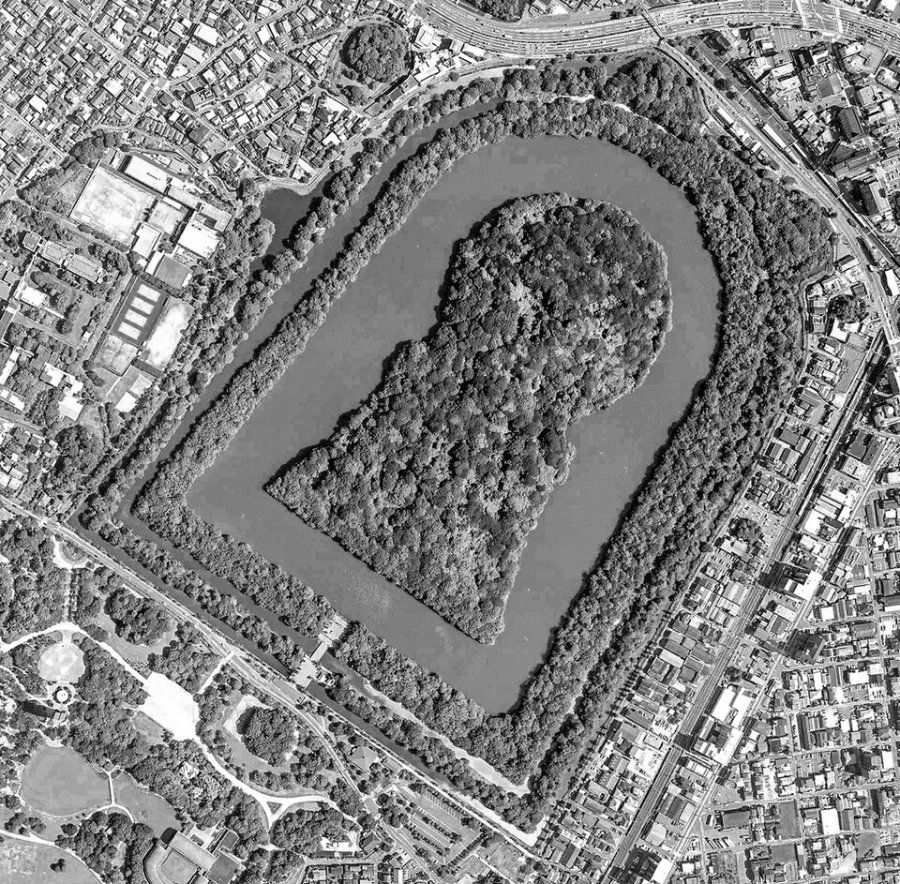
Credit: Geospatial Information Authority of Japan (2007), Wikimedia Commons, used with attribution
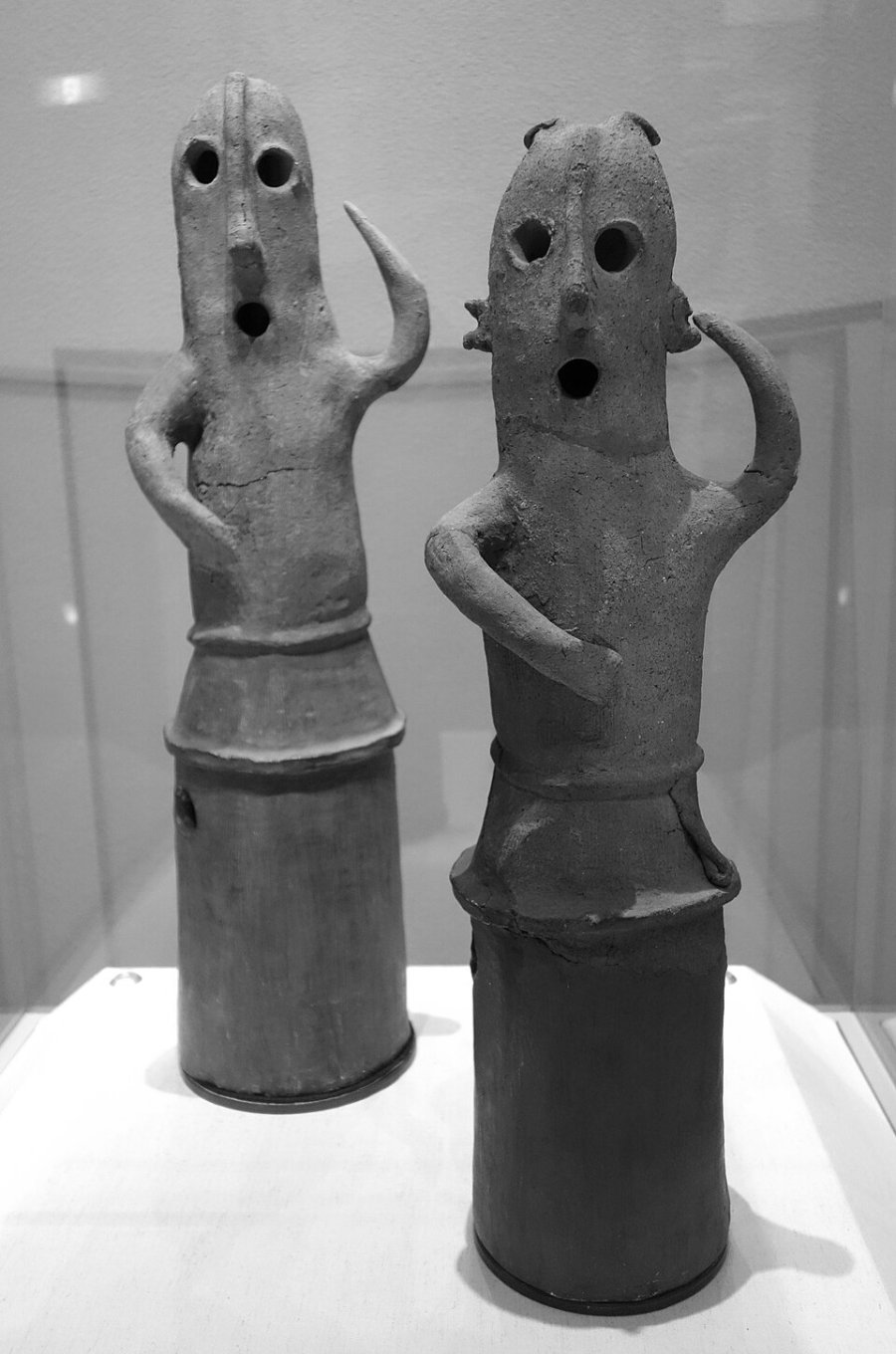
Credit: Daderot, Tokyo National Museum, Wikimedia Commons, CC0 (public domain)
4. Big ideas
- The sea slowed Japan down. Farming, metal and writing reached the islands late.
- No words of their own. The Jōmon left no writing. Everything we know about them comes from archaeology.
- Kami are everywhere. Shinto grew out of a land where nature had power. It is worship in nature, not just liking nature.
- Borrowed writing, not borrowed gods. Japan used Chinese characters, even to write the name "Shinto", but its religion was its own.
- A tomb nobody can open. The greatest Kofun tombs have never been opened. The Japanese government does not allow it.
5. Key sources: how do we know what we know?
| Source | Who made it? When? | Insider or outsider? | What it tells us | Be careful! |
|---|---|---|---|---|
| Jōmon pots, tools, homes and bones | Jōmon people, thousands of years ago | Objects | How the Jōmon lived, ate and made things | Objects do not tell us what people believed or said. |
| Kofun tombs | Kofun rulers and workers, from about 300 C.E. | Objects | Powerful rulers; many workers | The greatest tombs have never been opened. |
| The Kojiki ("Record of Ancient Matters") | The royal court, 712 C.E. | Insider | Kami; Amaterasu; the rulers' descent from the Sun Goddess | Written 400 years after the first great tombs, in a borrowed script, by a court with its own reasons. |
6. Timeline and vocabulary
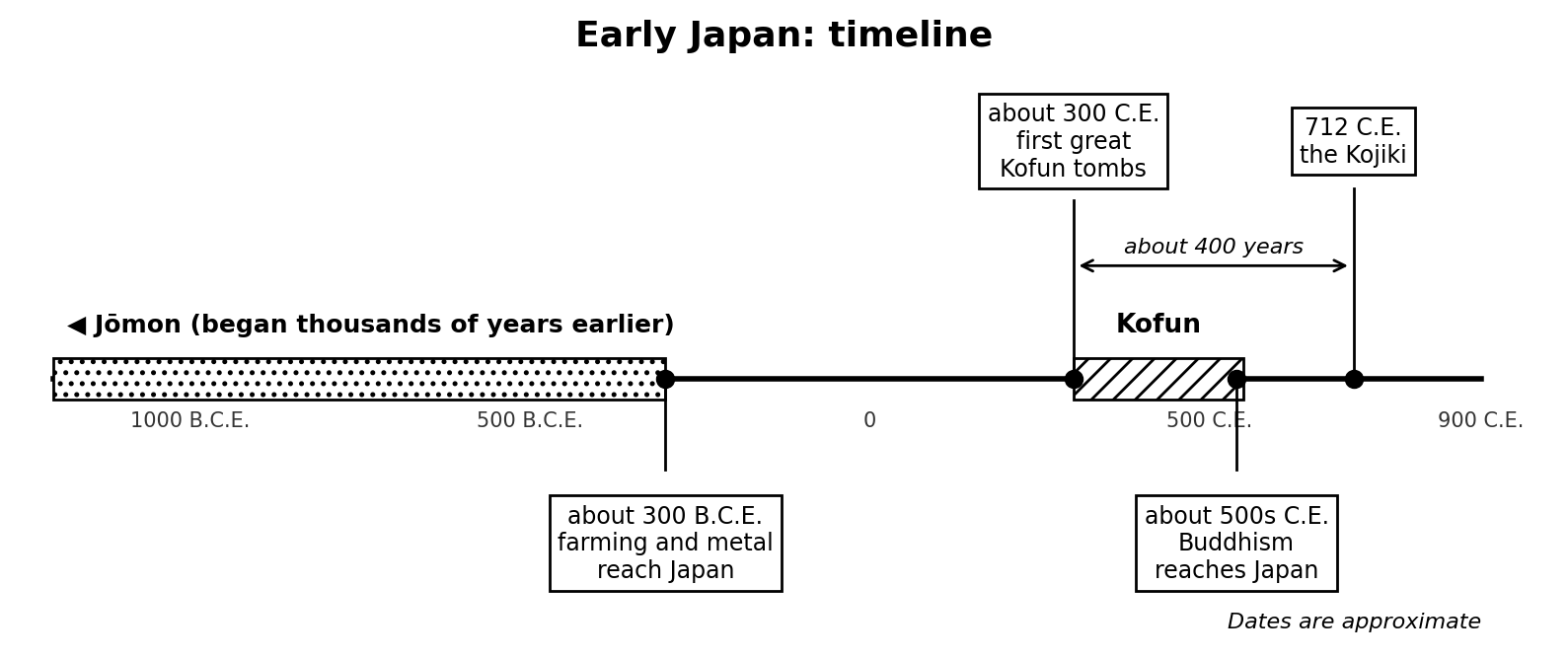
| Date (approximate) | What happened |
|---|---|
| Thousands of years ago | The Jōmon: hunter-gatherers making cord-marked pottery |
| About 300 B.C.E. | Farming and metal reach Japan; the Jōmon period ends |
| About 300 C.E. | The first great Kofun tombs are built |
| About 500s C.E. | Buddhism reaches Japan |
| 712 C.E. | The Kojiki is finished |
| Word | Meaning |
|---|---|
| archipelago | A chain or group of islands |
| prehistoric | From a time before written records; known only from the things people left behind |
| hunter-gatherer | A person who hunts, fishes and gathers food instead of farming |
| matriarchal | A society in which women hold central power |
| Jōmon (cord-marked) pottery | Pottery with patterns made by pressing cords into wet clay |
| indigenous | Belonging to a place from the very beginning; not brought in from somewhere else |
| spirit | A being without a body, believed to live in the world |
| kami | The spirits of Shinto, living in nature and in the dead |
| Shinto | "The way of the gods": Japan's indigenous religion |
| Kofun | A huge keyhole-shaped burial mound; also the name of the period |
| Kojiki | The oldest surviving book written in Japan (712 C.E.) |
7. Connections
How do we know what we know? The whole unit
| Civilization | The evidence problem |
|---|---|
| Indus Valley | Writing we cannot read |
| Vedic India | Sacred texts memorized for centuries, then written down by believers |
| Shang China | Writing we can read: oracle bones |
| Zhou China | Rival texts, arguing on purpose |
| Early Japan | No writing of their own; a book written 400 years late in a borrowed script; a tomb nobody can open |
Shinto and the Dao
The to in Shinto (道) is the same character as the Chinese Dao: "the way". Daoism and Shinto both honor nature. But they are different religions from different places.
Next: Unit 2
In Unit 2 you will meet the Yamato rulers of Japan, and the queen Himiko, described in Chinese records.
8. Where students lose marks on this topic
| Mistake | Fix |
|---|---|
| Saying "Japan's religion came from China" | Japan borrowed China's writing, not its religion. Shinto is indigenous. |
| Calling Kofun a religion | Kofun is a period and a kind of tomb. The religion is Shinto. |
| Saying kami are gods on thrones in the sky | A kami is a presence inside a thing: a mountain, a river, an ancestor. |
| Saying the Jōmon were farmers | They were hunter-gatherers. |
| Saying the Jōmon had writing | They had no writing at all. We know them from archaeology. |
| "They liked nature" as a characteristic of Shinto | Name the three principles: respect for nature, worship of ancestors, belief in kami. |
| Choosing a true fact that is not in the passage | On a Kojiki passage about kami, "the tombs are keyholes" is true but not in the source. |
| Saying "it was a long time ago" as an evidence problem | Name the specific problem: no writing, 400 years late, borrowed script, tomb never opened. |
Self-check
Cover the answers. Can you answer these in complete sentences?
- Why did Japanese civilization develop more slowly than China's and India's?
- How do historians know about the Jōmon?
- What are kami?
- Describe two characteristics of Shinto.
- What does the name "Shinto" mean, and how was it written?
- Describe two problems with the Kojiki as a source.
Check your answers (click to open)
- Japan is an archipelago cut off from the mainland by the sea, so new ideas like farming, metal and writing reached it slowly.
- The Jōmon left no writing, so historians know about them only from archaeology: their pots, tools, homes and bones.
- Kami are spirits that live inside the world, in mountains, rivers, trees, rocks, storms and the dead.
- One characteristic of Shinto is respect for nature. Another is worship of ancestors. (Also accepted: belief in kami; it is indigenous; it has no founder; it has no holy book.)
- "Shinto" means "the way of the gods". It was written in Chinese characters, and its second character is the same one the Chinese read as Dao.
- The Kojiki was written 400 years after the first great tombs were built. It was written in a borrowed Chinese script, by a royal court with its own reasons for telling the story its way.