Home › East Asian Civilization › Unit 2
The Qin Dynasty (221–206 B.C.E.)
East Asian Civilization · Unit 2 · Civilization Packet
1. At a glance
| Question | Answer |
|---|---|
| When? | 221–206 B.C.E.: only 15 years, but it changed China for 2,000 years |
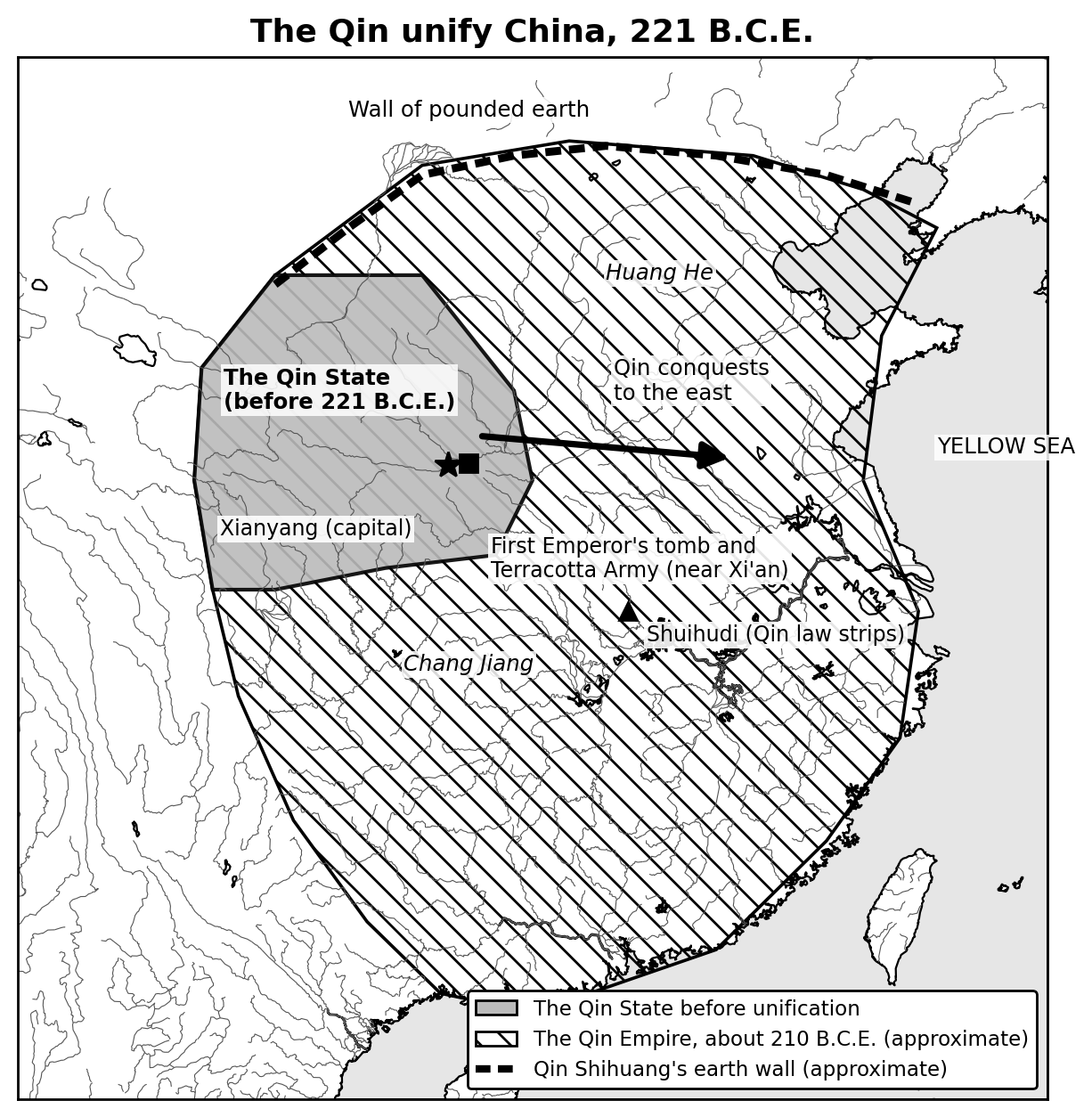
| Where? | The Qin State began in the west. In 221 B.C.E. it unified all of China. |
| Who? | Qin Shihuang, the "First Emperor of the Qin" |
| Big idea | Legalism turned into a government: one ruler, one law, one way of doing things |
| Known for | Unification; a bureaucratic government; codified laws; standardizing writing, weights and measures, and money; roads and canals; an earth wall; the Terracotta Army |
| How do we know? | Stories written by the Han, Qin's enemies; the Qin's own laws on bamboo strips; the artefacts in the First Emperor's tomb complex |
Unit 2's big question: how do you hold a big thing together? The Qin's answer: make everything the same, and control everyone with law.
2. How the Qin won
- For more than 200 years, China was many states at war: the Warring States Period. The Zhou kings were still called kings, but they could not control anyone.
- In the west sat the Qin State. It built a strong army and a strong government.
- One by one, the Qin defeated their rivals. In 221 B.C.E. they defeated the last one, and China was unified: joined together under one ruler.
- The king of Qin took a new title: Qin Shihuang, "First Emperor of the Qin".
Why did the Qin win? Legalism. Legalists believed people are naturally selfish. People obey strict written laws because they fear harsh punishments. Other states treated Legalism as an idea. The Qin turned it into a government.
3. SPICE-T: the Qin Dynasty
SPICE-T = Social, Political, Interactions, Cultural, Economic, Technology.
S — Social
- Noble families lost their power. They could no longer rule their own lands and pass them down to their sons.
- Hundreds of thousands of ordinary people were forced to work on roads, canals, the wall and the emperor's tomb. Many died.
- Harsh punishments: fines, hard labour, and worse.
P — Political
A centralized, bureaucratic government. A bureaucratic government is a government run by appointed officials who follow set rules.
| Before the Qin (Zhou fengjian) | Under the Qin |
|---|---|
| Noble families ruled their own lands | China was cut into districts |
| Lords inherited their power from their fathers | The emperor appointed officials, paid them, and could remove them |
| Each state had its own laws | Codified laws: one written law code for the whole empire |
| Power drained away from the king | Power flowed to the centre: officials sent reports back to the capital |
- Codified laws = laws written down and collected into one code. Crimes and punishments were listed.
- The law controlled the officials too. An official whose grain count was wrong, or whose report was late, was fined.
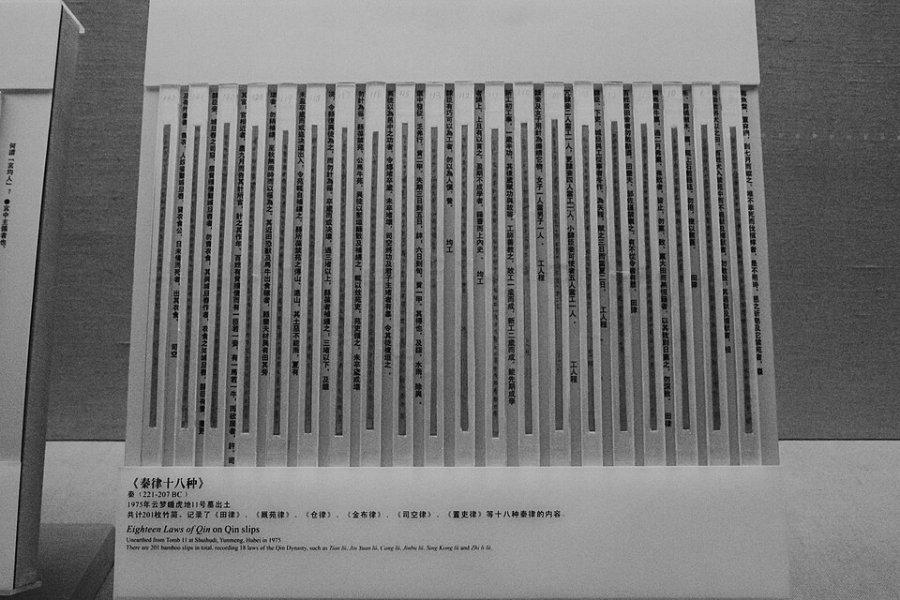
Credit: Gary Todd, Hubei Provincial Museum, Wikimedia Commons, CC0 (public domain)
I — Interactions
- The Qin conquered every rival state and ended the Warring States Period.
- In the north, the emperor built a wall to keep out northern peoples. He joined together walls the northern states had already built.
C — Cultural
- One script: the emperor standardized the writing, so an order written in the capital could be read anywhere.
- According to a story told by Han historians, the First Emperor burned books and buried scholars alive. The story was written by Qin's enemies, about 100 years later, but the Qin's own laws do show harsh punishments. We cannot simply believe it, and we cannot simply reject it.
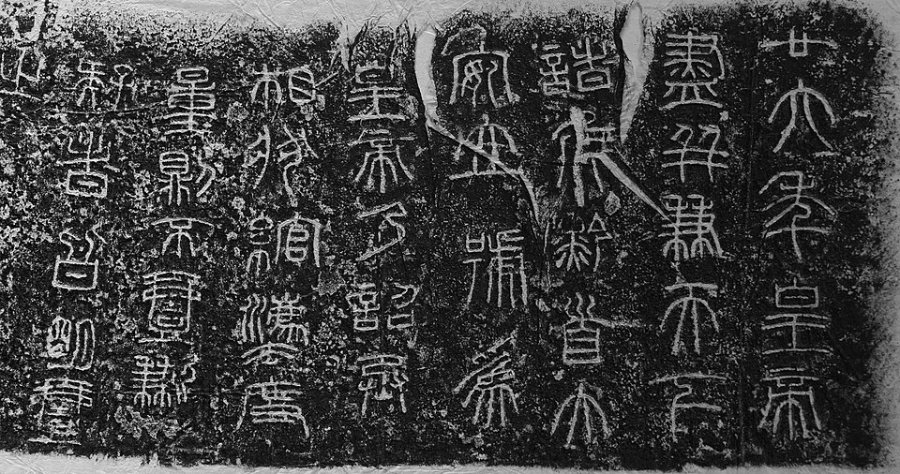
Credit: ReijiYamashina777, Wikimedia Commons, CC0 (public domain)
E — Economic
- Standardized weights and measures: a basket of grain meant the same amount in every district.
- Standardized currency: one bronze coin, round with a square hole, replaced the many coins of the old states.
- Canals carried grain by boat from the rivers of the south. Irrigation channels watered the fields.
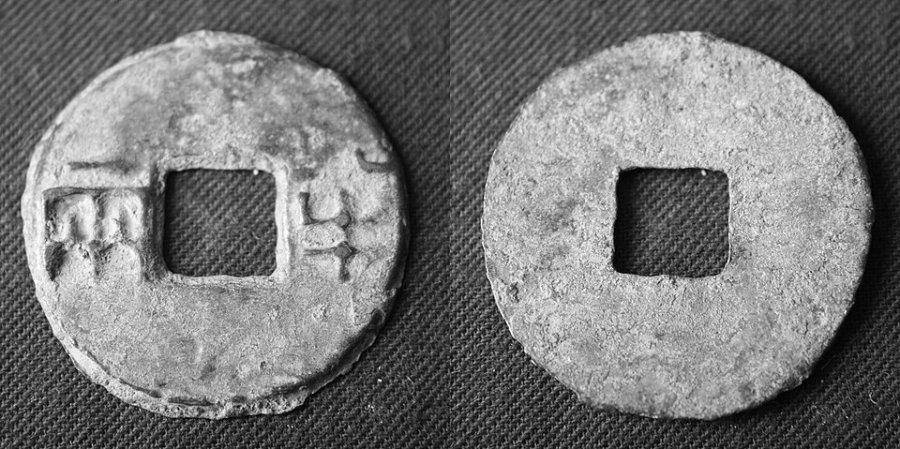
Credit: Gary Lee Todd, Wikimedia Commons, CC0 (public domain)
T — Technology
- Roads ran out from the capital in every direction. Even the axles of carts were made one width, so every cart fitted the ruts of every road. Grain could move. Armies could move faster.
- The wall was made of earth, pounded hard. It is not the stone Great Wall in photographs, which the Ming Dynasty built more than 1,500 years later.
- The Terracotta Army: thousands of life-size clay soldiers, made from moulds but finished by hand, each with a different face.
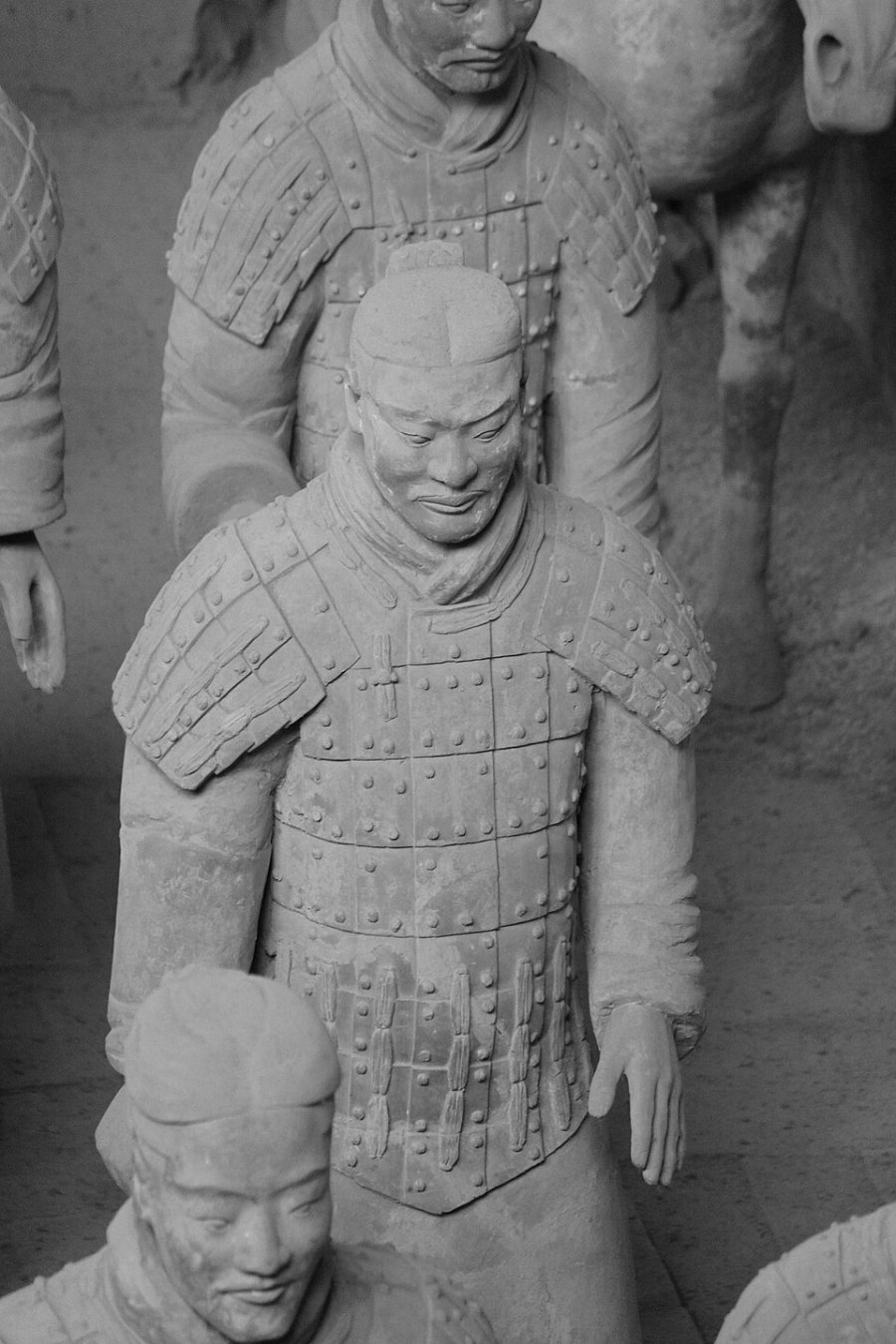
Credit: Gary Lee Todd, Wikimedia Commons, CC0 (public domain)
4. Big ideas
- Legalism won. The Qin turned Legalism into a government, and it unified China.
- Make everything the same. One script, one coin, one set of weights and measures, one law, one width for cart axles. Standardization held the empire together.
- Appointed, not inherited. Officials got their jobs from the emperor, not from their fathers, and he could remove them.
- Fast and brutal. The Qin lasted only 15 years, but the machine it built (a central government run by appointed officials) lasted for 2,000.
- The enemy kept the records. Most famous stories about the Qin were written by the Han, the dynasty that replaced them. A good historian reads the enemy's stories and the Qin's own strips.
5. Key sources: how do we know what we know?
| Source | Who made it? When? | Insider or outsider? | What it tells us | Be careful! |
|---|---|---|---|---|
| Shuihudi bamboo strips | Qin government; buried with the official Xi about 217 B.C.E.; found 1975 | Insider | The Qin's own written laws, fines and punishments | They show the rules, not whether everyone obeyed them. |
| The Terracotta Army | Qin workers, about 210 B.C.E.; found 1974 | Artefact | The size, weapons and organization of the Qin army | It shows, but it cannot tell: no words. |
| Sima Qian's history (the Shiji) | A Han historian, about 100 years after the Qin fell | Outsider | The book burning; the inside of the tomb | Written for the dynasty that destroyed the Qin. Possible bias. |
| Inscriptions of the First Emperor | The Qin court, on stones and bronze | Insider | What the emperor wanted people to believe about his rule | It is the emperor praising himself. |
The tomb mound itself has never been opened. Sima Qian described rivers of mercury inside. Scientists found high levels of mercury in the soil above it. The historian was not there, and the tomb has not been opened, but the two witnesses agree.
6. Timeline and vocabulary
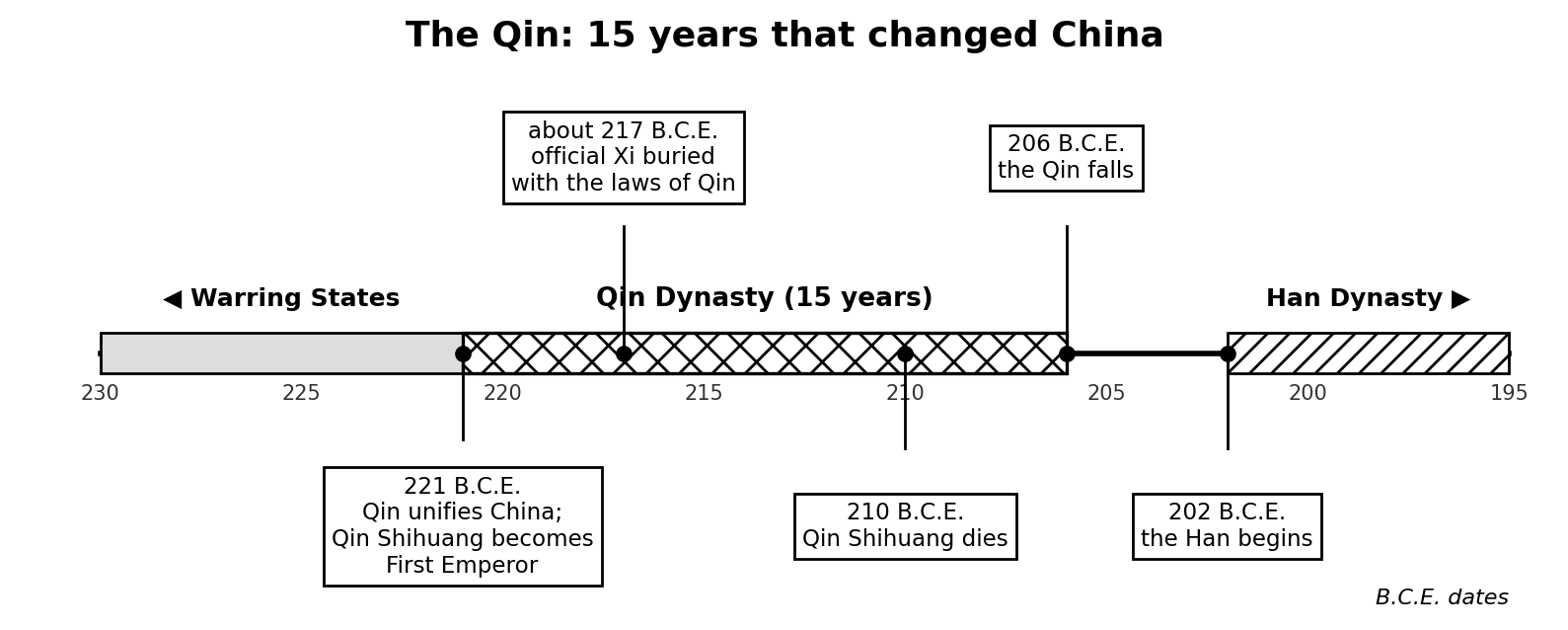
| Date | What happened |
|---|---|
| About 475–221 B.C.E. | The Warring States Period |
| 221 B.C.E. | The Qin State unifies China; Qin Shihuang becomes First Emperor |
| About 217 B.C.E. | The official Xi is buried at Shuihudi with the laws of Qin |
| 210 B.C.E. | Qin Shihuang dies; the Terracotta Army is buried near his tomb |
| 206 B.C.E. | The Qin Dynasty falls, after only 15 years |
| 202 B.C.E. | The Han Dynasty begins |
| 1974 C.E. | Farmers digging a well find the Terracotta Army |
| 1975 C.E. | Archaeologists find the Shuihudi bamboo strips |
| Word | Meaning |
|---|---|
| unify | To join separate parts together into one whole |
| Warring States Period | About 200 years when China's states fought each other |
| Legalism | The belief that people obey strict laws because they fear harsh punishments |
| bureaucratic government | A government run by appointed officials who follow set rules |
| centralized | With power held at the centre, by one ruler |
| codified laws | Laws written down and collected into one code |
| standardize | To make things the same everywhere |
| currency | The money a country uses |
| irrigation | Channels that bring water to fields |
| artefact | An object made by people in the past |
| terracotta | Baked clay |
| bias | When a writer's side or interests make their account unfair or one-sided |
7. Connections
Before: the Zhou
| Zhou | Qin | |
|---|---|---|
| Who ruled the land? | Lords given land under fengjian | Appointed officials in districts |
| How did they get the job? | Inherited it | Appointed by the emperor |
| Main idea | The Mandate of Heaven | Legalism |
| What went wrong? | Decentralization: power drained away from the king | Too harsh: the dynasty lasted only 15 years |
After: the Han (Unit 2)
The Han replaced the Qin in 202 B.C.E. The Han criticized the Qin, but they kept the Qin's machine: the bureaucracy run by appointed officials. New robes, same machine.
Across Asia: the Mauryan Empire
At about the same time, the Mauryan Empire united most of India. Its emperor Ashoka held his empire together a different way: with Buddhist ideas. See the Mauryan packet.
8. Where students lose marks on this topic
| Mistake | Fix |
|---|---|
| "Qin Shihuang built the Great Wall" (the stone one) | He built an earth wall by joining older walls. The stone wall was built by the Ming, 1,500 years later. |
| Mixing up Legalism and Confucianism | Legalism = strict laws and punishments. Confucianism = good relationships and example. |
| "Officials inherited their jobs" | Under the Qin, officials were appointed and could be removed. That is the whole change. |
| Believing the book-burning story as plain fact | It comes from Han historians, Qin's enemies. Name the bias, but don't call it false either. |
| Calling the Terracotta Army a written source | It is an artefact: it shows, but it cannot tell. |
| On the SAQ, mixing up political and economic | Political = bureaucracy, appointed officials, codified laws, punishments. Economic = standard coin, weights and measures; canals, roads, irrigation. |
| Choosing "the Qin unified China in 221 B.C.E." on a question about a passage that doesn't say it | True, but not in the source. Prove answers with the passage's words. |
Self-check
Cover the answers. Can you answer these in complete sentences?
- What was the Warring States Period, and who ended it?
- What is a bureaucratic government?
- Name three things Qin Shihuang standardized.
- How was Qin Shihuang's wall different from the Great Wall in photographs?
- Why do historians treat the Shuihudi bamboo strips as especially valuable?
- Does the fact that the Han wrote the book-burning story mean it is false? Explain.
Check your answers (click to open)
- The Warring States Period was more than 200 years when China's states fought each other. The Qin State ended it by defeating the last of its rivals in 221 B.C.E.
- A bureaucratic government is a government run by appointed officials who follow set rules.
- Qin Shihuang standardized the writing, the weights and measures, and the currency. (Also accepted: the law code; the width of cart axles.)
- Qin Shihuang's wall was made of pounded earth and joined older walls together. The stone Great Wall in photographs was built by the Ming Dynasty more than 1,500 years later.
- The strips were written by the Qin themselves, not by the later Han historians who had reason to attack the Qin.
- No. The Han had reasons to make the Qin look bad, so we cannot simply believe the story. But the Qin's own laws show harsh punishments, so we cannot simply reject it either.