Home › East Asian Civilization
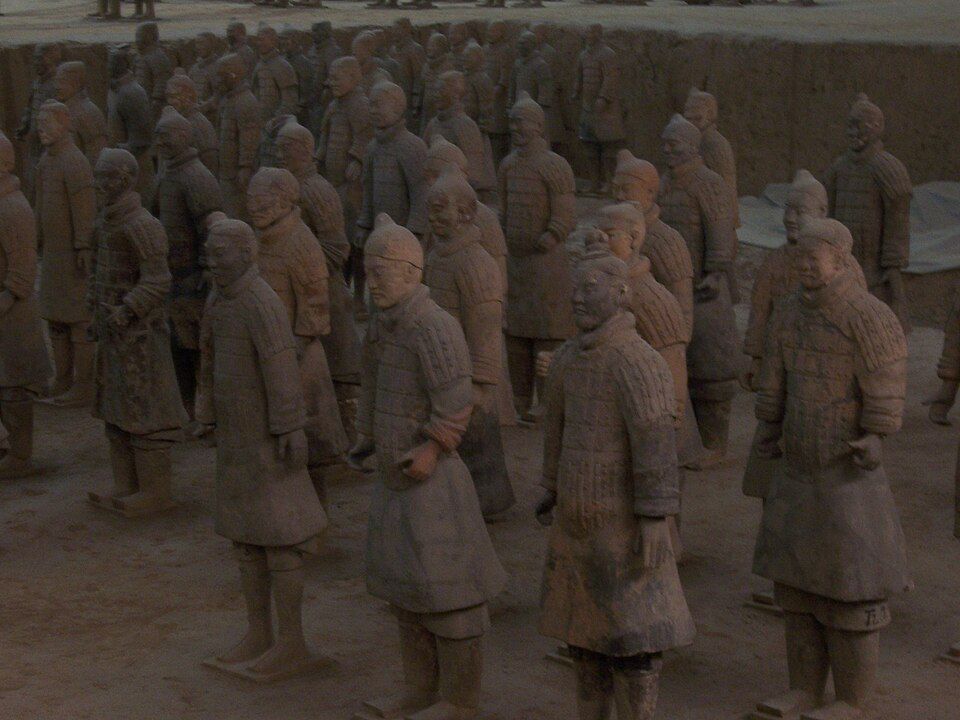
Unit 2: Centralization and the Rise of Empires
East Asian Civilization · Grade 7 · Quarter 1 · Unit Packet
1. The big question: how do you hold a big thing together?
Unit 2 visits five packets, from about 321 B.C.E. to 701 C.E. Every one of them asks the same question: how do you hold a big thing together? Each civilization gives a different answer.
| Civilization | How did it hold together? | The evidence problem |
|---|---|---|
| The Qin | Legalism: one law, harsh punishments, and standardized everything (writing, money, weights, cart axles) | Its story was written by its enemies, the Han |
| The Mauryan Empire | First control (officials, taxes, spies); then Ashoka's dhamma, carved in stone | Ashoka wrote his own story: he chose what to carve |
| Yamato Japan | Marriage alliances and titles; the right to rule by birth, from Amaterasu | Described by neighbours; the greatest tombs are sealed |
| The Han | New robes, same machine: the Qin's bureaucracy with a Confucian face; assimilation into one Han people | The Xiongnu left no writing; only half the story survived |
| Korea's Three Kingdoms | Borrow the best tools from a stronger neighbour, then pass them on | Korea's own history was written 500 years later |
The unit's thread: every civilization is studied against a neighbour.
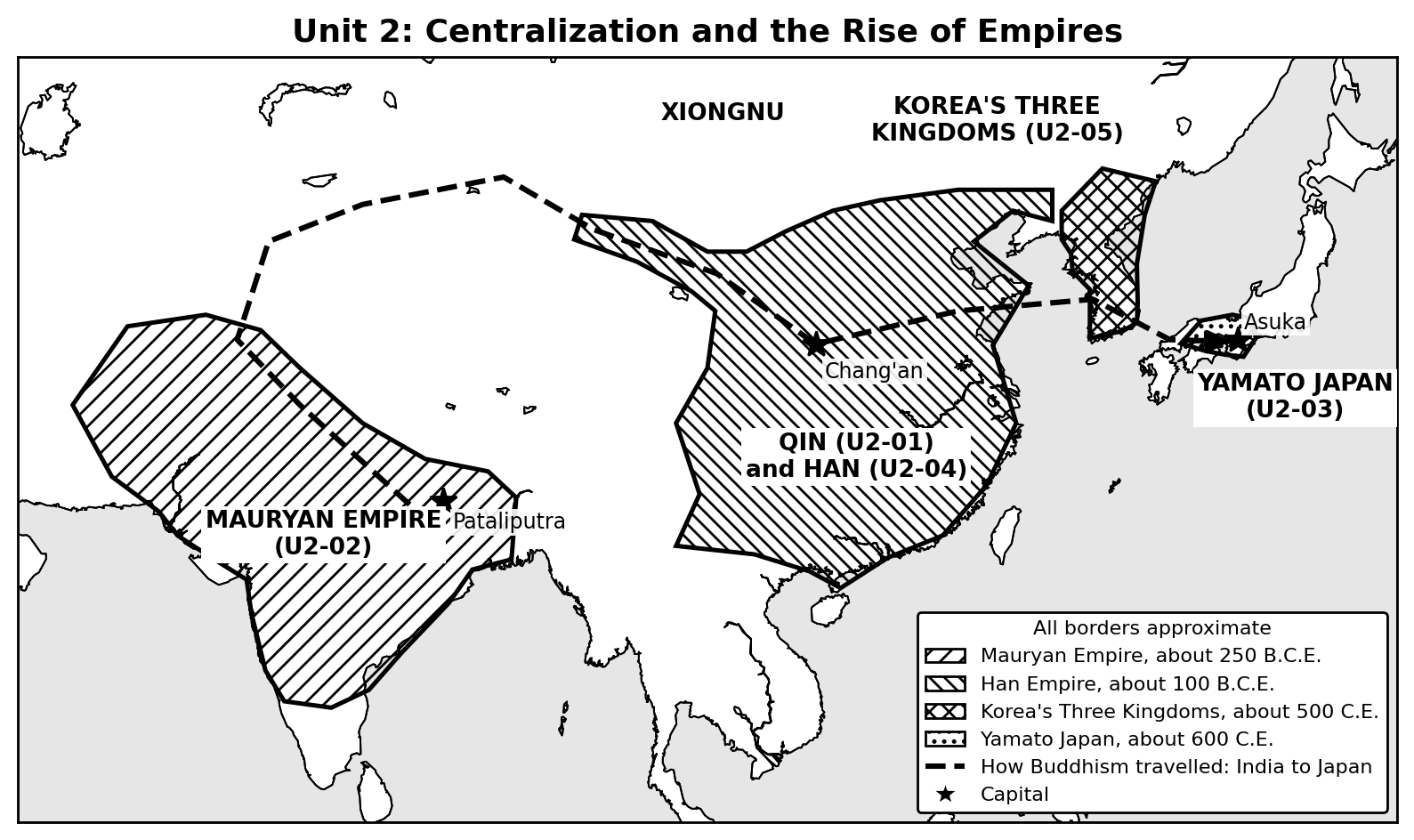
2. Every civilization against a neighbour
| Pair | The comparison |
|---|---|
| Qin and Mauryan Empire | Both began with conquest. The Qin held power with law and fear (Legalism). Ashoka held it with dhamma: peace and self-control. |
| Qin and Han | The Han destroyed the Qin but kept its machine: officials whose power came from the emperor. The Han made punishments softer and added Confucianism. |
| China and Yamato Japan | In China, the Mandate of Heaven could be taken back, so a rival replaced the ruling family. In Japan, the right to rule came from birth, so a rival could only control the emperor. |
| The Han and the Xiongnu | Farmers with cities and writing against nomads with horses and no writing. The war opened the road west: the Silk Road. |
| China, Korea and Japan | China was the source; Korea was the bridge; Japan rebuilt its whole government in China's image. |
3. Two key ideas for the whole unit
Centralized or decentralized?
Centralized = power held at the centre, by one ruler. Decentralized = power spread out, to great families or clans.
| Centralized (power at the centre) | Decentralized (power spread out) |
|---|---|
| The Qin: appointed officials, one law code | The Zhou before them: land given to great families (fengjian) |
| The Western Han: the Qin's bureaucracy kept | The Eastern Han: power slipping to local families |
| The Mauryan Empire: paid officials, taxes, spies | Kofun Japan: many uji, none ruling the whole country |
| Japan after the Taika Reforms (645): land and people belong to the state, under the emperor | Japan before the reforms: land held by powerful families |
The pattern: an official's power comes from the ruler and can be taken back. A noble's or a clan's power is born, and cannot. That is why emperors chose officials.
Ideas travel, and change
Diffusion is the spread of ideas from one place to another. Follow Buddhism across the whole unit:
- India: the Buddha teaches the Eight-Fold Path (Unit 1). Ashoka backs it and sends missionaries (U2-02).
- Central Asia and China: Mahayana Buddhism travels north, along the road the Han opened (U2-04).
- Korea: the Korean kingdoms adopt Buddhism from China (U2-05).
- Japan: Baekje sends a Buddha image and sacred writings to the Yamato court (U2-03, U2-05).
What travels, changes. Each people that received an idea made it their own. Chinese writing made the same journey: China, then Korea, then Japan.
4. SPICE-T across the unit
SPICE-T = Social, Political, Interactions, Cultural, Economic, Technology.
| Qin | Mauryan | Yamato | Han | Korea / Japan's reforms | |
|---|---|---|---|---|---|
| S | Nobles lost power; forced labour | Caste remained; India did not become Buddhist | Uji clans; marriage joined them | Assimilation: one Han people | Japan's great families lost their land to the state |
| P | Legalism; appointed officials; codified laws | Bureaucracy and spies; Ashoka's edicts | Alliances and titles; legitimacy by descent | Qin bureaucracy kept; Confucianism under Emperor Wu; Wang Mang | Taika Reforms (645); Taiho Code (701) |
| I | Conquered the Warring States; an earth wall | Kalinga; missionaries | Envoys to China; Korean alliances | Xiongnu wars; Zhang Qian; Silk Road | China → Korea → Japan; Baekje falls (660) |
| C | One script; the book-burning story | Buddhism becomes a missionary religion; Bhakti answers it | Shinto; Amaterasu; the Kojiki | Confucian classics; one standard script | Writing and Buddhism adopted, then passed on |
| E | One coin; standard weights; canals | Taxes in every province | Thousands of workers for each kofun | Wu zhu coin; tax-free estates | Baekje's ships; land belongs to the state |
| T | Roads; the Terracotta Army | Stone pillars; the Lion Capital | Huge kofun | Roads; forts on the way west | Ships; writing as a tool of government |
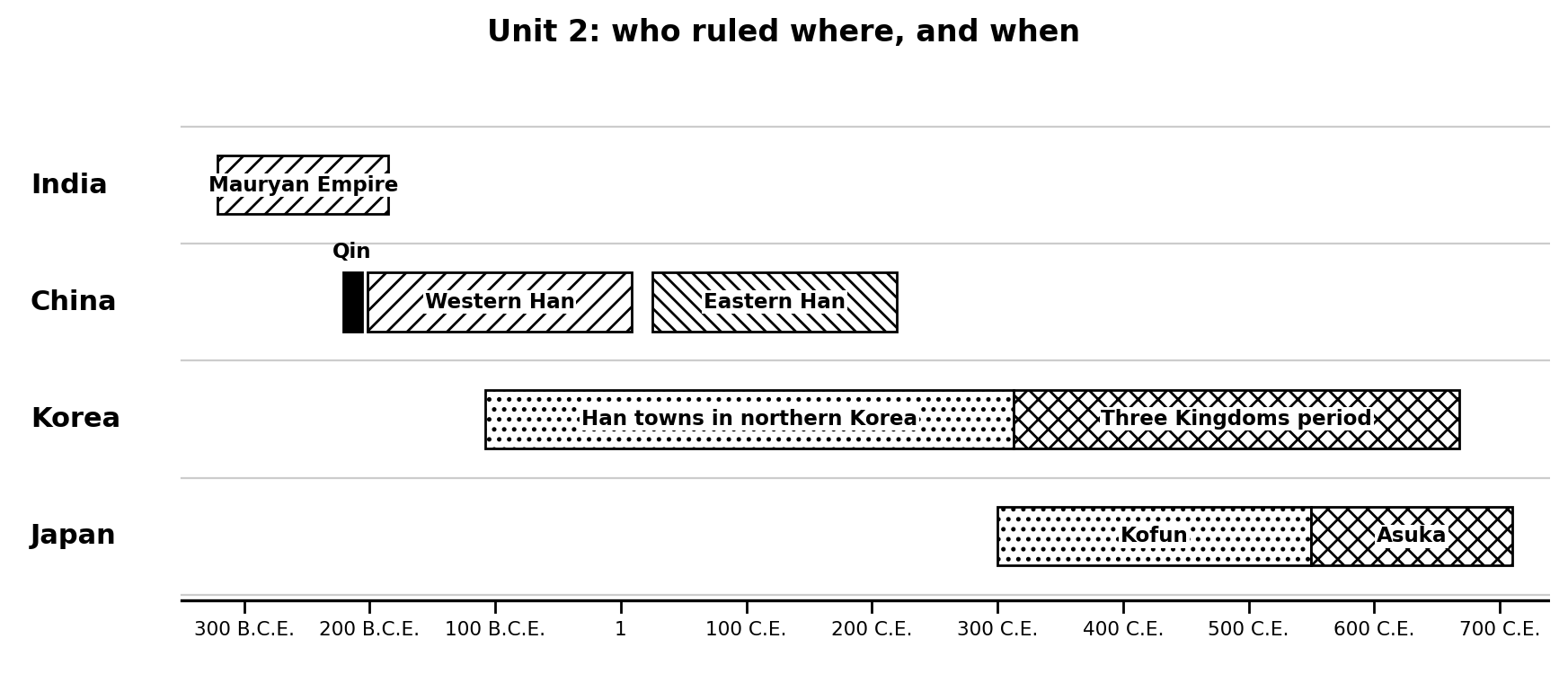
5. Unit timeline
| Date | What happened |
|---|---|
| 321 B.C.E. | Chandragupta Maurya takes power in India |
| 261 B.C.E. | Ashoka's war on Kalinga; he turns to Buddhism |
| 221 B.C.E. | The Qin unifies China |
| 206 B.C.E. | The Qin falls |
| 202 B.C.E. | Liu Bang founds the Han |
| 185 B.C.E. | The Mauryan Empire ends |
| 141 B.C.E. | Emperor Wu takes the Han throne |
| 108 B.C.E. | A Han army takes northern Korea |
| 9 C.E. | Wang Mang ends the Western Han |
| 200s C.E. | A Chinese chronicle describes Queen Himiko of Wa |
| 220 C.E. | The Han ends |
| About 300 C.E. | Japan's Kofun period begins |
| 313 C.E. | Goguryeo destroys the last Han town in Korea |
| 500s C.E. | Baekje sends Buddhism to Japan |
| About 600 C.E. | The Yamato are the strongest uji |
| 645 C.E. | The Taika Reforms |
| 660 C.E. | Baekje is destroyed |
| 701 C.E. | The Taiho Code |
| 712 C.E. | The Kojiki |
6. How do we know what we know? Every evidence problem so far
| Civilization | The evidence problem | Unit |
|---|---|---|
| The Harappans | Writing we cannot read | 1 |
| The Qin | A record written by their enemies | 2 |
| Ashoka | A record written by himself | 2 |
| Early Japan | A record written by a neighbour | 1–2 |
| The Yamato | The evidence is sealed in the ground | 2 |
| The Xiongnu | No writing at all; only their enemies wrote about them | 2 |
| Korea's Three Kingdoms | Books written centuries later, or by outsiders | 2 |
A source can be biased and still be useful. Ask: who made it, when, who paid them, and what did they have reason to say?
7. Skills for the test
The SAQ: how the points are scored
| Points | What you need |
|---|---|
| 1 | You are right, and the teacher can read it. |
| 2 | You used the task verb, wrote complete sentences, and answered all of the prompt. |
| 3 | (Explain only) Topic sentence + at least one specific piece of evidence + at least one sentence of analysis. |
On the benchmark, each SAQ is Identify (2) + Describe (3) + Explain (3) = 8 points.
Task verbs
| Verb | What you must do |
|---|---|
| Identify | Name it, or give an example |
| Describe | Say what it was like: list its characteristics |
| Explain | Give the reasons why or how something happened |
| Compare | Describe or explain similarities or differences |
TEA: a full paragraph
- Topic sentence: answer the question in one sentence.
- Evidence: one specific thing you could point to: an edict carved, a coin made, a missionary sent. Not just "religion" or "laws".
- Analysis: the sentence that says how your evidence proves your topic sentence. This is the sentence everybody forgets, and it is worth the most.
The five multiple-choice traps
| Trap | Unit 2 example |
|---|---|
| True but not supported | "This edict proves Ashoka became a Buddhist" (true, but Rock Edict 13 only shows regret) |
| Too strong | "Every rich family refused to pay any taxes"; "women always ruled Wa" |
| Plausible invention | "Himiko became ruler because she was the daughter of the previous king" |
| Yesterday's trap in costume | "The Kojiki was written by the family's enemies" (that was the Qin problem) |
| The similarity in disguise | On a difference question: "both used officials" is true of the Qin and the Han |
Also check the verb: a true answer that does the wrong job is still wrong.
8. Where students lose marks in Unit 2
| Mistake | Fix |
|---|---|
| "Qin Shihuang built the Great Wall" (the stone one) | His wall was earth; the stone wall is Ming, 1,500 years later. |
| "Ashoka founded the Mauryan Empire" | Chandragupta did. Ashoka was his grandson. |
| "After Ashoka, India became Buddhist" | Most people kept their Hindu traditions. |
| "The Yamato conquered Japan" | They used marriage alliances and titles. |
| "The Han threw out the Qin system" | The Han kept the Qin bureaucracy. |
| "Liu Bang made China Confucian" | That came 60 years later, under Emperor Wu. |
| "The Han built the Silk Road" | It was the leftover of a war with the Xiongnu. |
| "Wang Mang ended the Han" | He ended the Western Han. The Han was restored and ended in 220 C.E. |
| "Buddhism began in China" | It began in India. |
| Mixing up Taika (645) and Taiho (701) | Taika = the Great Change: power to the emperor. Taiho = the written law code. |
| A biased source is "useless" | Too strong. Name the bias, then use what it tells you. |
| Evidence that is too general ("religion", "laws") | Name one specific thing: an edict, a coin, a missionary, a code. |
9. Self-check
Cover the answers. Can you answer these in complete sentences?
- For each of the five packets, identify one way the civilization held a big thing together.
- Compare how the Qin and the Mauryan Empire held their empires together.
- Explain why emperors preferred officials to nobles.
- Compare the Mandate of Heaven with the Yamato claim to rule.
- Describe the journey Buddhism took from India to Japan.
- Explain why a biased source can still be useful. Use one example from this unit.
Check your answers (click to open)
- The Qin used Legalism and standardization. The Mauryan Empire used officials, taxes and spies, and then Ashoka's dhamma. The Yamato used marriage alliances, titles and descent from Amaterasu. The Han kept the Qin's bureaucracy, added Confucianism, and made many peoples into one Han people. Korea and Japan borrowed writing, Buddhism, a bureaucracy and written law from China.
- Both empires began with conquest. The Qin held its empire together with strict laws and harsh punishments. Ashoka held his together with dhamma, carved on rocks and pillars where everyone could read it.
- An official's power came from the emperor and could be taken back, so the emperor stayed in control. A noble was born into his power, and it could not be taken away.
- In China, Heaven gave the Mandate and could take it back from a bad ruler, so a rival could replace the ruling family. In Japan, the right to rule came from birth, from descent from Amaterasu, so it could not be taken away and a rival could only control the emperor.
- Buddhism began in India, where Ashoka sent missionaries to spread it. It travelled north into Central Asia and east into China, then to the Korean kingdoms. Baekje passed it on to the Yamato court of Japan.
- A biased source still tells us what its writer saw and believed. For example, Sima Qian worked for the Han, but his Shiji still tells us how the Xiongnu lived. We must name the bias, then use the information carefully.