Home › East Asian Civilization › Unit 2
The Mauryan Empire (321–185 B.C.E.)
East Asian Civilization · Unit 2 · Civilization Packet
1. At a glance
| Question | Answer |
|---|---|
| When? | 321–185 B.C.E. Ashoka ruled from about 268 to 232 B.C.E. |
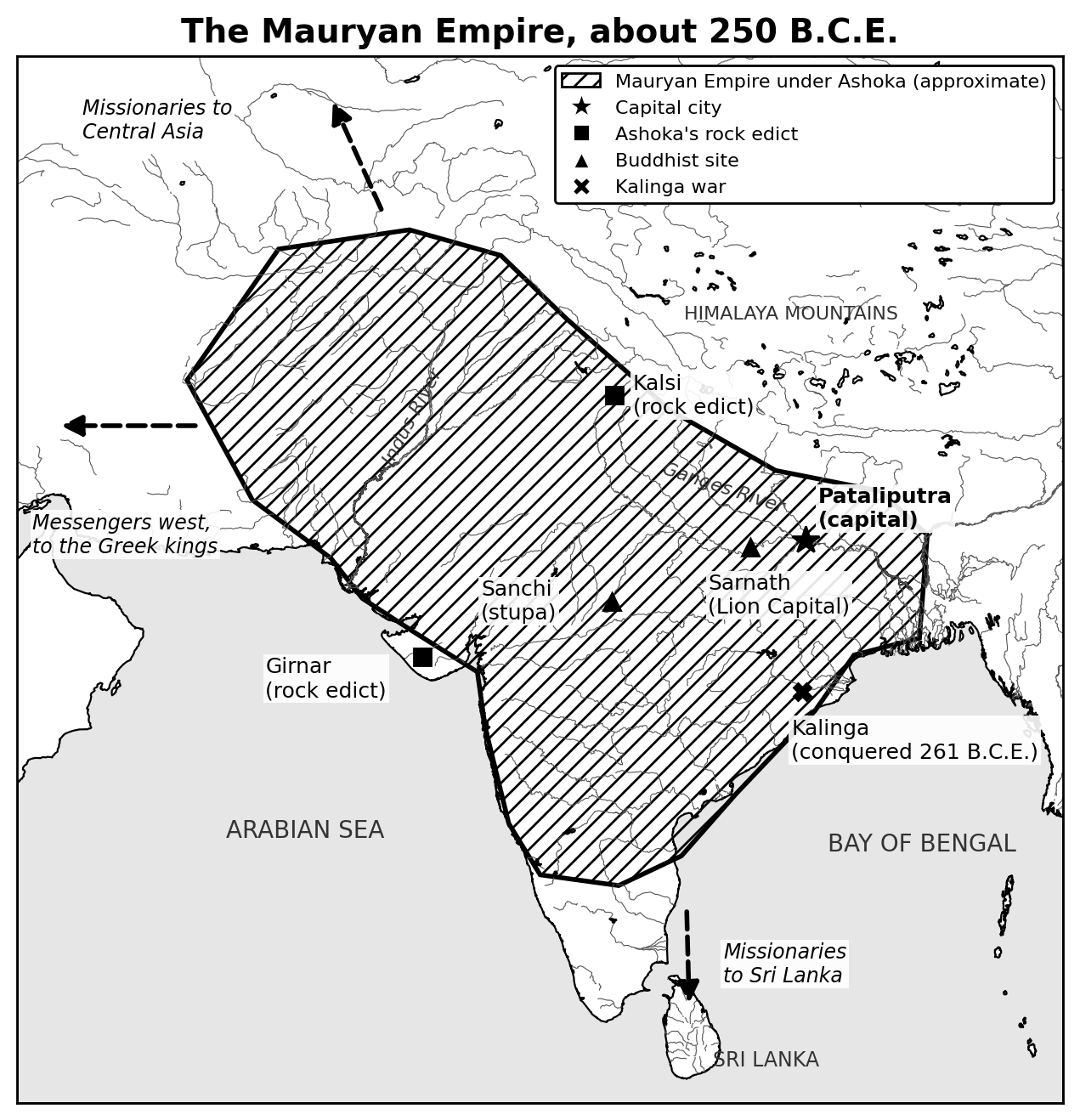
| Where? | Northern India at first, then nearly all of India. The capital was Pataliputra, on the Ganges River. |
| Who? | Chandragupta Maurya (the founder), his advisor Kautilya, and his grandson Ashoka Maurya |
| Big idea | An empire won by war, then held together by Buddhist ideas |
| Known for | The first empire to hold nearly all of India together; a bureaucracy with spies; the war on Kalinga; Ashoka's conversion to Buddhism; edicts carved in stone; missionaries who spread Buddhism beyond India |
| How do we know? | Kautilya's book, the Arthashastra (advice); Megasthenes, a Greek traveller (an outsider); and Ashoka's own edicts (the king's own words) |
Unit 2's big question: how do you hold a big thing together? The Mauryan answer changed halfway through: first force and control, then dhamma, Ashoka's word for a good and peaceful way of life.
2. The story in two kings
Chandragupta: control everything
- In 321 B.C.E., a young leader named Chandragupta Maurya seized power in northern India. He fought and bargained his way across the land.
- His chief advisor was Kautilya, a political theorist: a person who studies how power works. Kautilya taught that a ruler must control everything: taxes, roads, soldiers and spies.
- Chandragupta built a bureaucracy: a system of paid officials who carry out the ruler's orders. Officials collected taxes in every province. Spies watched the officials.
- Power was centralized: it was held in one place, by one man. He did not fully trust the people who worked for him.
Ashoka: the king who said sorry
- Chandragupta's grandson, Ashoka, wanted more land. In 261 B.C.E. he attacked Kalinga, a kingdom on the east coast.
- Kalinga fought back hard. About 100,000 people were killed. Many more were driven from their homes. Ashoka won.
- Then he did something no conquering king had done before. He looked at the dead and was horrified. He turned away from war and converted to Buddhism.
- After Kalinga, he fought no more wars of conquest. His conversion changed his actions, not just his words.
The empire was won with an army. The religion was spread without one.
3. SPICE-T: the Mauryan Empire
SPICE-T = Social, Political, Interactions, Cultural, Economic, Technology.
S — Social
- India did not become a Buddhist country. Most people kept their older Hindu traditions. Buddhism grew beside them, not instead of them.
- Caste still shaped most people's lives. In Hinduism, your dharma (your duty) depends on your caste.
- The Buddhist dharma is universal: the Eight-Fold Path is the same for everyone. A farmer, a merchant, a king: one path. Caste did not decide it.
- Ashoka's edicts ask all living beings to be safe, to control themselves, and to live in peace.
P — Political
- A centralized empire: one ruler, one capital, power held at the centre.
- A bureaucracy of paid officials who collected taxes in every province.
- Spies watched the officials.
- Edicts: Ashoka had his words carved into rock and onto stone pillars and set them up in public places across the empire. The edicts carried the king's voice to every corner of the land.
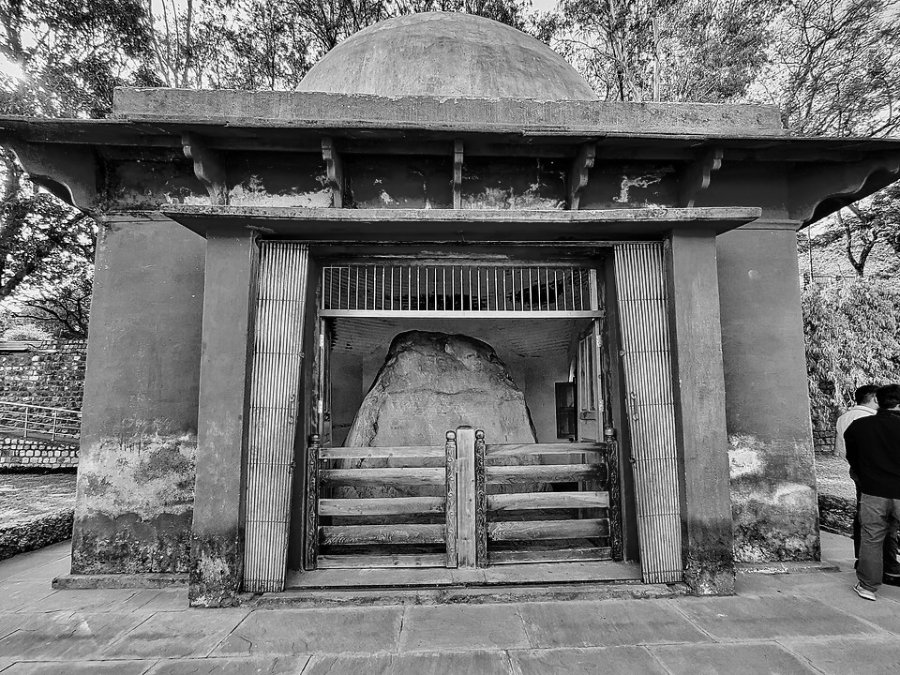
Credit: Ms Sarah Welch, Wikimedia Commons, CC0 (public domain)
I — Interactions
- Conquest: Chandragupta conquered northern India; Ashoka conquered Kalinga.
- Missionaries: people who travel to teach their religion and win new believers. Ashoka sent them south to Sri Lanka, north into Central Asia, and west toward the Greek kings.
- Megasthenes, a Greek traveller, visited the Mauryan capital and wrote about what he saw.
C — Cultural
- Buddhism became a missionary religion: a religion that actively looks for new believers beyond its homeland.
- Before Ashoka, Buddhism was a small movement in one corner of India. Now it had the support of the most powerful king in the land.
- Ashoka built stupas: dome-shaped temples that hold relics of the Buddha.
- The spread of ideas from one place to another is called diffusion.
E — Economic
- Officials collected taxes in every province, as Kautilya advised. Taxes paid the officials, the soldiers and the spies.
- Roads were part of what the ruler had to control.
T — Technology
- Stone carving on a huge scale. Edicts were cut into rocks and onto tall, polished stone pillars, some topped with carved animals.
- The Lion Capital at Sarnath is the top of one of Ashoka's pillars: four lions facing out in every direction. (Today it is the national emblem of India.)
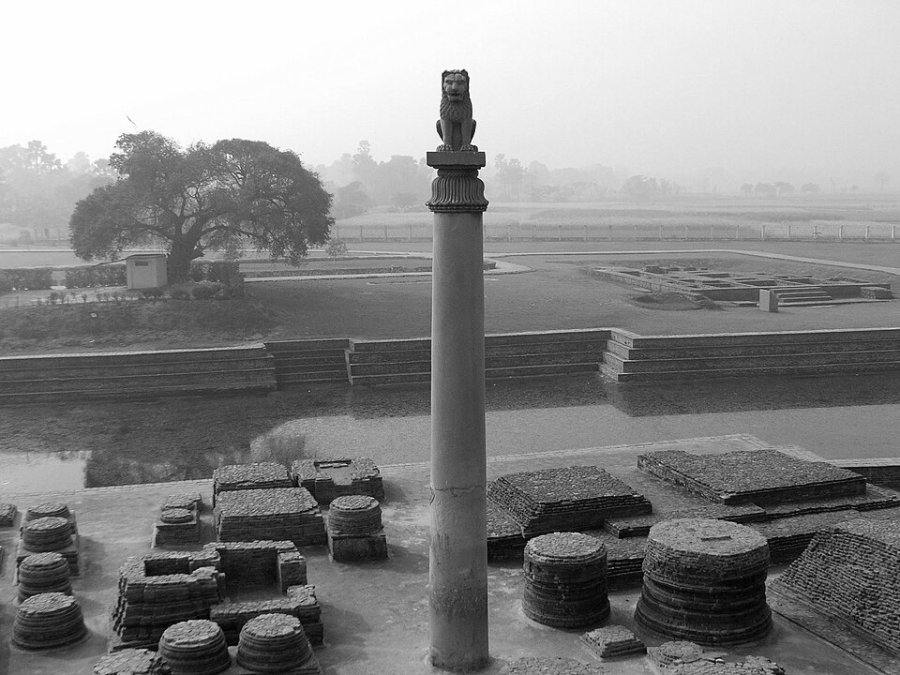
Credit: Bpilgrim, Wikimedia Commons, CC BY-SA 2.5
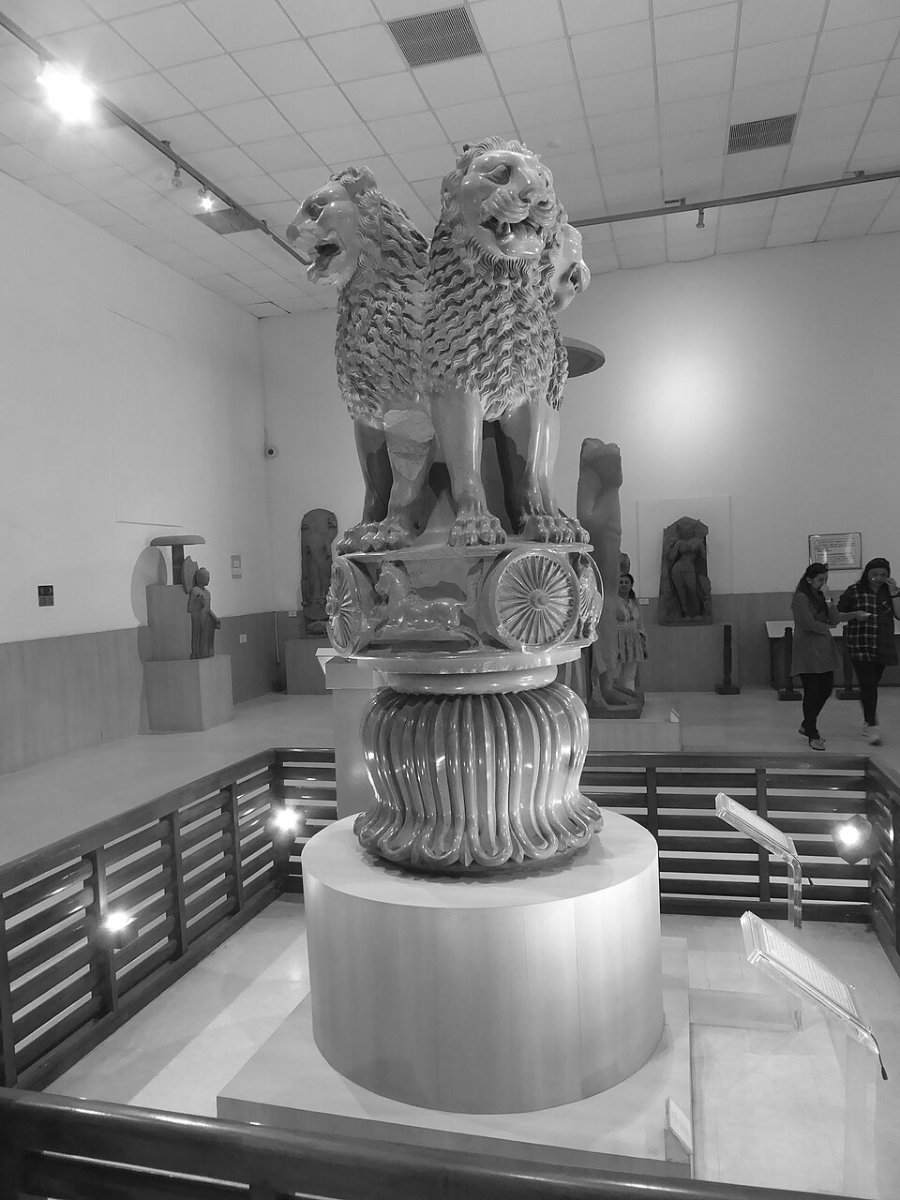
Credit: lisa bat, Wikimedia Commons, CC BY 2.0
4. Big ideas
- Two ways to hold an empire. Chandragupta used control: officials, taxes and spies. Ashoka added ideas: dhamma, carved where everyone could see it.
- Kalinga was the turning point. A terrible victory made Ashoka turn away from war and convert to Buddhism.
- Ashoka made Buddhism travel. With a king's support and missionaries on the road, a small movement became a missionary religion.
- What travels, changes. As Buddhism moved, it grew into two traditions: Theravada ("the way of the elders") in the south and east, and Mahayana ("the great vehicle") in the north. Same founder. Same beginning. Two traditions.
- Hinduism answered. Over time, a movement called Bhakti Hinduism taught that personal devotion to a god of the Trimurti (Brahma, Vishnu or Shiva) mattered more than your caste. Hinduism did not copy Buddhism. It answered it.
5. Key sources: how do we know what we know?
| Source | Who made it? | Insider or outsider? | What it tells us | Be careful! |
|---|---|---|---|---|
| The Arthashastra | Kautilya, Chandragupta's advisor | Insider | What Kautilya thought a king should do | It is advice, not a record. It does not tell us what Chandragupta actually did. |
| Megasthenes' writing | A Greek traveller who visited the capital | Outsider | What a foreign visitor saw | He was a foreigner, and he was only passing through. He cannot tell us what he did not see. |
| Ashoka's edicts | Ashoka himself, carved in his own lifetime | Insider (the king) | Ashoka's own words: his regret for Kalinga; his dhamma; the foreign kings who heard it | He chose what to carve. They cannot tell us anything Ashoka chose to leave out. |
| Stupas and pillars | Ashoka's builders and carvers | Artefacts | Where Buddhism spread; how much the king spent on it | They show, but most cannot tell: no words (except the edicts carved on the pillars). |
Every source has an expiry date. The split into Theravada and Mahayana happened after Ashoka died. His rocks cannot tell us about it.
Compare the Qin: Qin Shihuang's story was written by the dynasty that overthrew him. His enemies held the brush. Ashoka's story was written by Ashoka. He held the chisel. We hear Ashoka's own voice, but we still have to ask what he chose not to say.
6. Timeline and vocabulary
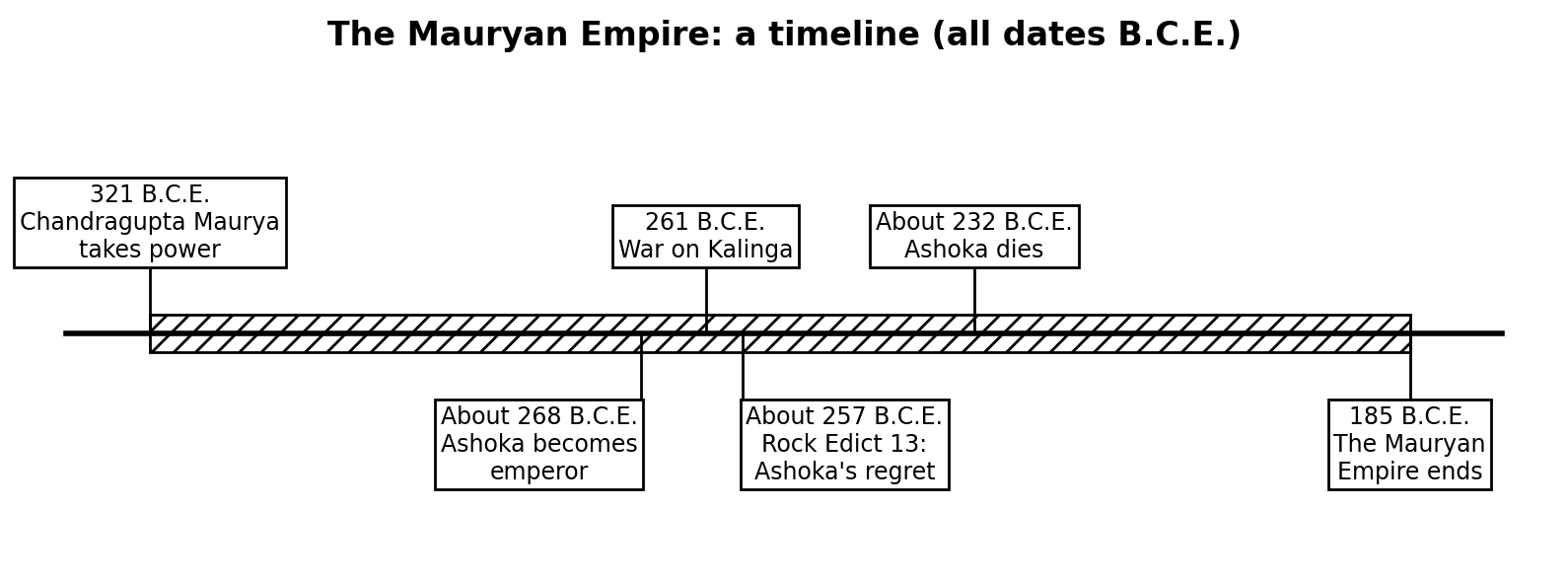
| Date | What happened |
|---|---|
| 321 B.C.E. | Chandragupta Maurya seizes power in northern India |
| About 268 B.C.E. | Ashoka becomes emperor |
| 261 B.C.E. | Ashoka's war on Kalinga; afterwards he converts to Buddhism |
| About 257 B.C.E. | Rock Edict 13: Ashoka writes about Kalinga and says he is sorry |
| About 232 B.C.E. | Ashoka dies |
| 185 B.C.E. | The Mauryan Empire ends |
| After Ashoka | Buddhism splits into Theravada and Mahayana |
| Word | Meaning |
|---|---|
| conquest | Taking control of a land or a people by force, in war |
| convert | To change from one religion or belief to another |
| political theorist | A person who studies how power works |
| bureaucracy | A system of paid officials who carry out the ruler's orders |
| centralized | With power held in one place, by one ruler |
| edict | A public order or message from a ruler; Ashoka's were carved in stone |
| stupa | A dome-shaped temple that holds relics of the Buddha |
| missionary | A person who travels to teach their religion and win new believers |
| missionary religion | A religion that actively looks for new believers beyond its homeland |
| diffusion | The spread of ideas from one place to another |
| dharma | Duty, or the right way to live. In Hinduism it depends on caste; in Buddhism it is the same for everyone. |
| Theravada | "The way of the elders": the Buddhism that travelled south and east |
| Mahayana | "The great vehicle": the Buddhism that travelled north, to Central Asia, China, Korea and Japan |
| Bhakti | Devotion. Bhakti Hinduism put personal devotion to a god above caste. |
7. Connections
Before: Vedic India (Unit 1)
The Buddha (Siddhartha Gautama) taught the Eight-Fold Path in Vedic India, centuries before Ashoka. Vedic India also gave us caste and the Hindu idea of dharma. See the Vedic India packet.
Across Asia: the Qin (Unit 2)
| Qin | Mauryan Empire | |
|---|---|---|
| How did it begin? | Conquest: Qin defeated the Warring States | Conquest: Chandragupta took northern India |
| How was it run? | Appointed officials, codified laws, harsh punishments | Paid officials, taxes, spies |
| Main idea | Legalism: people obey because they fear punishment | Under Ashoka: dhamma, peace, self-control |
| Who wrote its story? | Its enemies, the Han (they held the brush) | Ashoka himself (he held the chisel) |
After: Buddhism travels east
Mahayana Buddhism travelled north out of India, into Central Asia, then east into China and Korea, and from Korea to Japan. Ashoka carved his rocks in the 200s B.C.E. Centuries later, there were Buddhist temples in Japan. See the Yamato Japan packet.
After: the Gupta Empire (Unit 3)
Centuries later, the Gupta Empire united northern India again, this time with strong support for Hinduism. See the Gupta packet.
8. Where students lose marks on this topic
| Mistake | Fix |
|---|---|
| "Ashoka founded the Mauryan Empire" | Chandragupta founded it in 321 B.C.E. Ashoka was his grandson. |
| "After Ashoka, India became a Buddhist country" | No. Most people kept their Hindu traditions. Buddhism grew beside them. |
| Treating the Arthashastra as a record of what happened | It is advice: what Kautilya thought a king should do. |
| Using Ashoka's edicts to explain Theravada and Mahayana | The split came after Ashoka died. His rocks cannot tell us about it. |
| Choosing "This edict proves Ashoka became a Buddhist" for Rock Edict 13 | True, but not in the passage. Rock Edict 13 shows regret; it does not name Buddhism. Prove answers with the passage's words. |
| Choosing "Ashoka never fought another war" | Too strong, and not in the passage. He fought no more wars of conquest. |
| Mixing up the two dharmas | Hindu dharma depends on caste. Buddhist dharma is the same for everyone. |
| On an EXPLAIN question, giving evidence with no analysis | TEA: Topic sentence, Evidence (one specific thing: a missionary sent, an edict carved), Analysis (HOW it proves your point). Analysis is worth the most. |
Self-check
Cover the answers. Can you answer these in complete sentences?
- Who founded the Mauryan Empire, and who was his advisor?
- What is a bureaucracy?
- What happened at Kalinga, and how did it change Ashoka?
- Describe what changed for Buddhism after Ashoka converted.
- Describe one thing Ashoka's edicts can tell us that no other source can, and one reason to be careful with them.
- Explain how the Buddhist dharma was different from the Hindu dharma.
Check your answers (click to open)
- Chandragupta Maurya founded the Mauryan Empire in 321 B.C.E. His chief advisor was Kautilya, a political theorist.
- A bureaucracy is a system of paid officials who carry out the ruler's orders.
- Ashoka conquered the kingdom of Kalinga in 261 B.C.E., and about 100,000 people were killed. He was horrified by the killing, so he turned away from war and converted to Buddhism.
- Before Ashoka, Buddhism was a small movement in one corner of India. After Ashoka converted, it had the support of the most powerful king in the land, and he sent missionaries to spread it to other countries.
- The edicts tell us Ashoka's own thoughts in his own words, such as his regret for Kalinga. But we should be careful, because Ashoka chose what to carve, and he could leave out anything he did not want people to know.
- In Hinduism, a person's dharma depended on their caste. The Buddhist dharma was universal: the Eight-Fold Path was the same for everyone, so caste did not decide it.