Home › East Asian Civilization › Unit 2
Yamato Japan (about 300–700 C.E.)
East Asian Civilization · Unit 2 · Civilization Packet
1. At a glance
| Question | Answer |
|---|---|
| When? | The Kofun period (about 300–550 C.E.), then the Asuka period (about 550–710 C.E.) |
| Where? | The Kansai region of Honshu, Japan's largest island. The Chinese called the land Wa. |
| Who? | The uji (clans) of Japan; the Yamato, the clan that rose above the rest; Queen Himiko, described by the Chinese |
| Big idea | The Yamato united central Japan without a war, and claimed the right to rule by birth: descent from the Sun Goddess Amaterasu |
| Known for | Huge kofun (burial mounds); marriage alliances and titles; Chinese writing and Buddhism arriving by way of Korea; one ruling family that still holds the title today |
| How do we know? | Chinese chronicles (outsiders); objects from the kofun, like Owake's sword; the Kojiki (the family's own story). The greatest mounds are sealed. |
Unit 2's big question: how do you hold a big thing together? The Yamato answer: marriage, titles, and a sacred family line. Nobody could take the title away, so everybody wanted to control it.
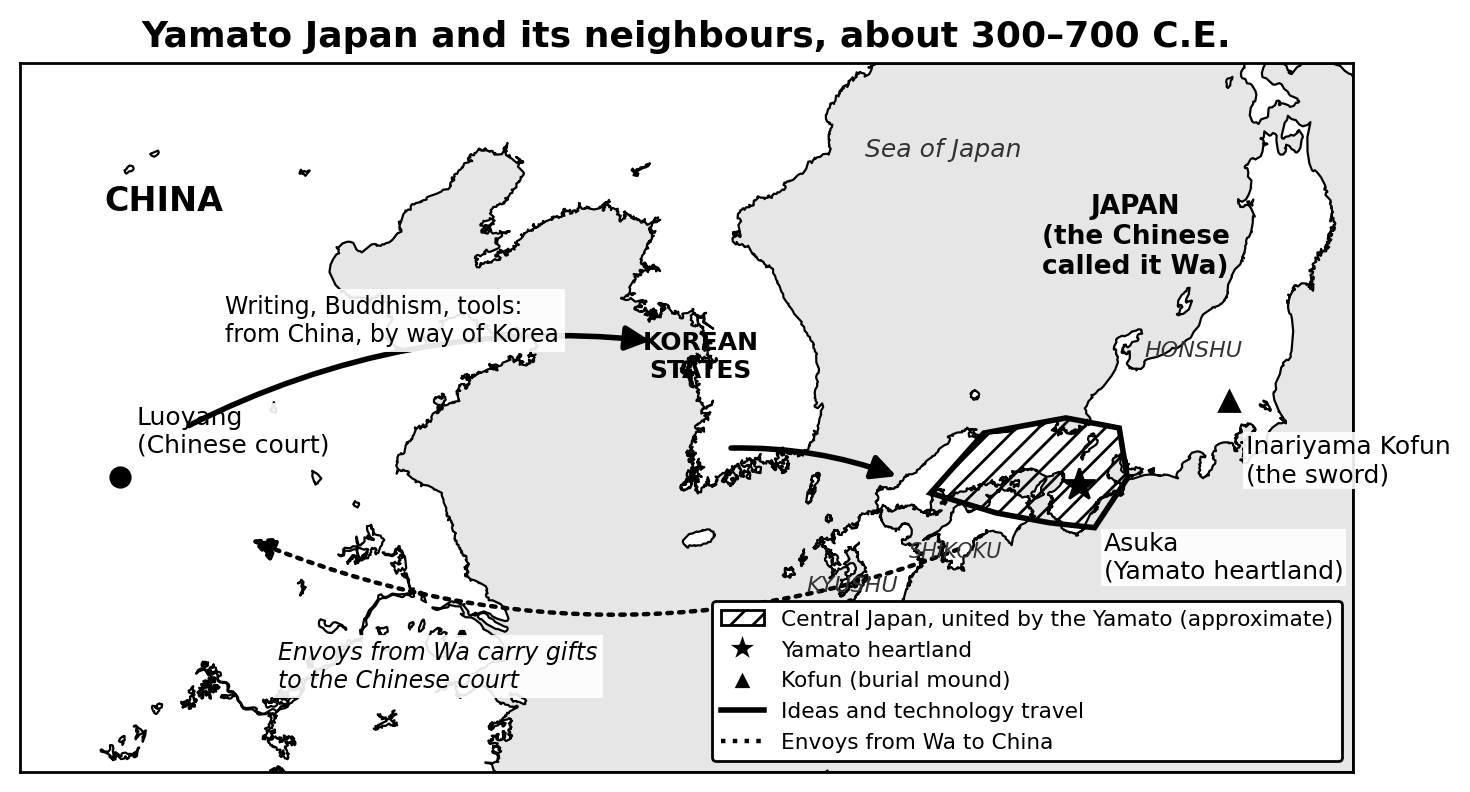
2. The story: from many clans to one family
Many clans, no country
- After the Jōmon came the Kofun period, named after the kofun: huge mounds of earth where rulers were buried. Kofun means "old mound".
- Japan was not one country with one king. Power was held by many uji. An uji was a clan: a large group of families who believed they shared one ancestor.
- Each uji had its own lands, its own warriors, and its own kami. None of them ruled the whole country. Japan was divided.
One clan rises, without a war
- One uji slowly grew stronger than the rest: the Yamato, from the Kansai region of Honshu.
- The Yamato did not conquer everybody. They united
central Japan in two ways:
- Marriage alliances with competing uji. An alliance is an agreement between two groups to help each other.
- Titles for subordinate clans: clans that accepted Yamato leadership.
- A clan that has married into your family, and holds a title you gave it, has less reason to fight you. By the start of the 7th century C.E. (about 600), the Yamato were the strongest uji in Japan.
Looking outward: the Asuka period
- In the Asuka period, the Yamato formed alliances with Korean states across the sea.
- Through Korea came the culture and technology of China: Chinese characters, Buddhism, new tools, new ways of building.
- The ideas were Chinese. But they reached Japan by way of Korea.
3. SPICE-T: Yamato Japan
SPICE-T = Social, Political, Interactions, Cultural, Economic, Technology.
S — Social
- Society was organized into uji (clans). Each believed it shared one ancestor.
- Marriage joined clans together. Marrying into a powerful family was a way to gain power.
- Building one great kofun took thousands of workers, moving earth by hand, for years.
P — Political
- From many clans to one. The Yamato rose by alliances and titles, not by conquest.
- Legitimacy means the accepted right to rule. Ruling is not the same as having the right to rule.
- The Yamato's legitimacy came from descent: the family line you are born from. They said they were descended from Amaterasu the Sun Goddess.
- That right came from birth. It could not be earned, and it could not be taken away. You either had the blood of the Sun Goddess, or you did not.
- So a rival could not replace the emperor. Instead he tried to control him: he married into the family, advised the emperor, and ruled in the emperor's name.
- Over the centuries the emperors lost their real power. Other families, and later warriors, ran the government. But nobody ended the line. The same family holds the title in Japan today.
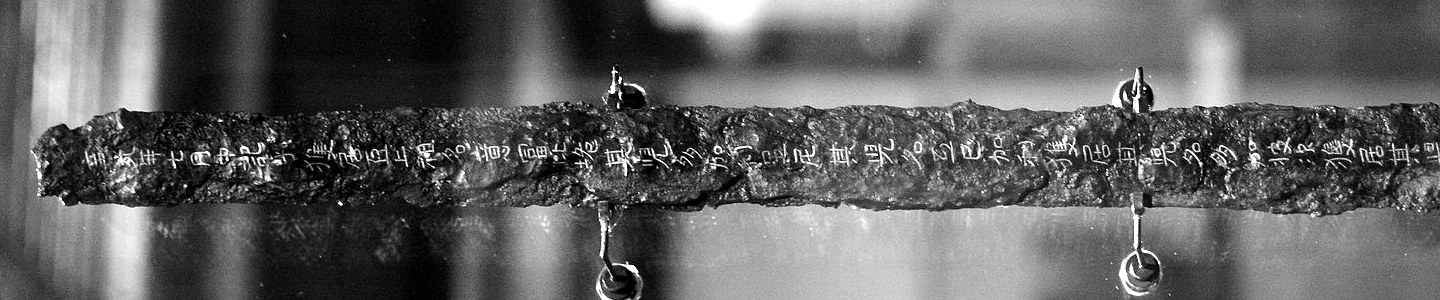
Credit: Saigen Jiro, Wikimedia Commons, public domain
I — Interactions
- With China: envoys from Wa crossed the sea carrying gifts to the Chinese court. Chinese officials wrote down what they were told.
- With Korea: the Yamato formed alliances with Korean states. Korea was the bridge that carried Chinese ideas to Japan.
C — Cultural
- Shinto, the old religion of Japan, has many kami. The most important is Amaterasu, the Sun Goddess.
- Buddhism arrived from Korea. (It began in India. Remember Ashoka's missionaries: what travels, changes.)
- The Kojiki (712 C.E.) told the family's own story: Amaterasu sent her grandson down from heaven with a mirror, a jewel and a sword, and said his children should rule forever.
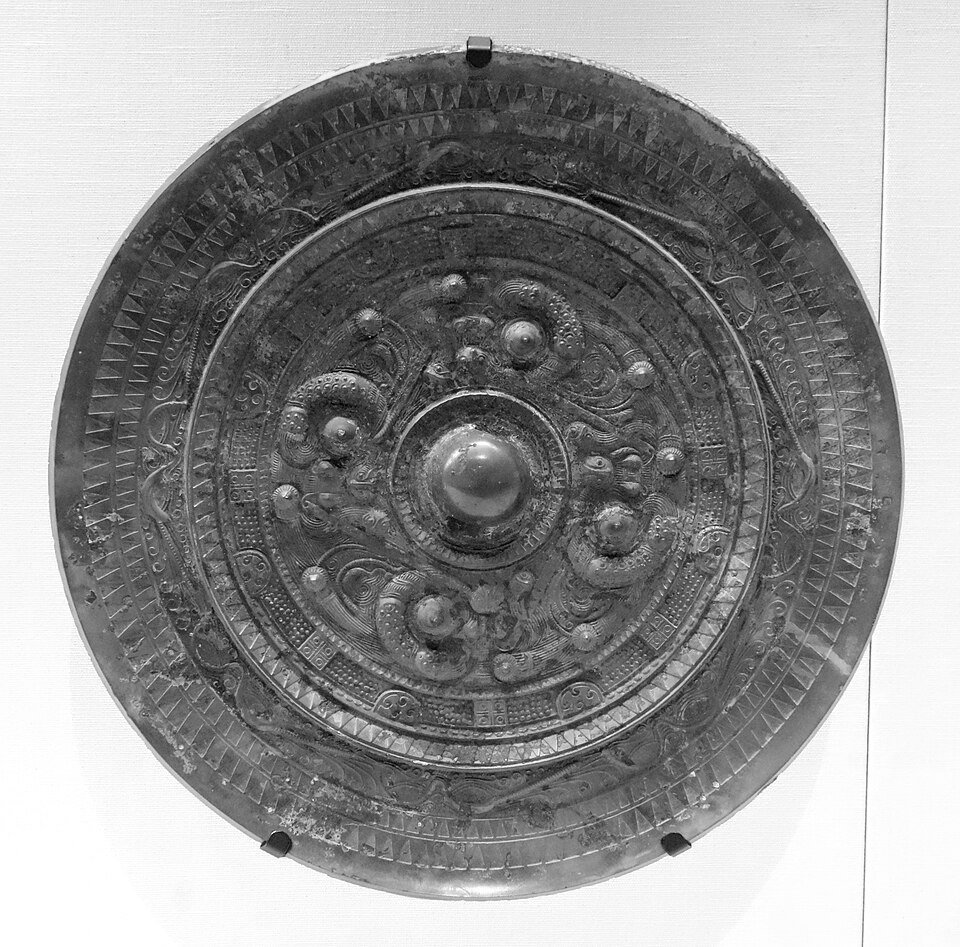
Credit: Daderot, Wikimedia Commons, CC0 (public domain)
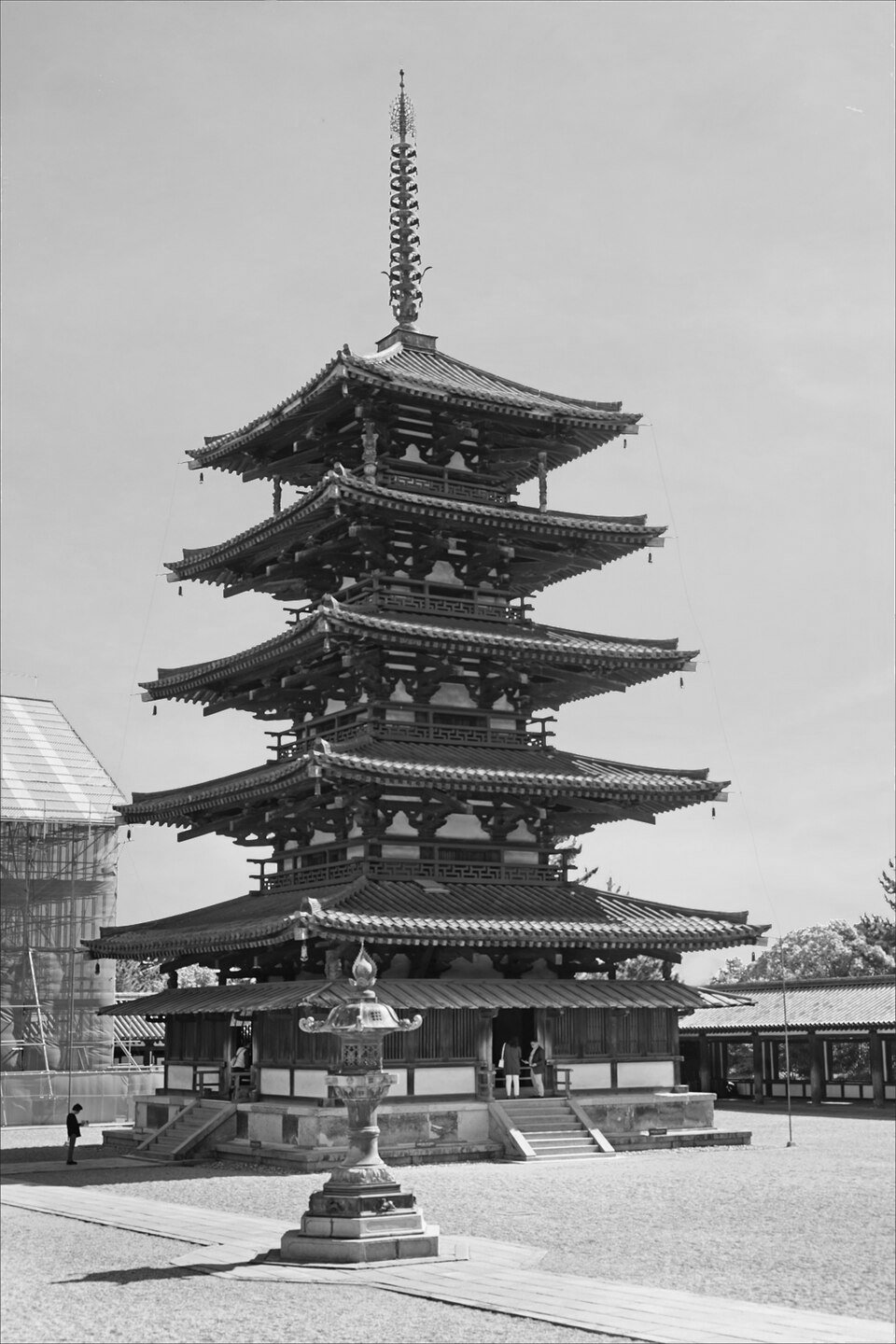
Credit: Jean-Pierre Dalbéra, Wikimedia Commons, CC BY 2.0
E — Economic
- Only a wealthy and powerful ruler could feed and organize the thousands of workers who built a kofun.
- Rulers were buried with valuable goods: iron weapons, bronze mirrors, treasure.
T — Technology
- The kofun themselves: some are keyhole-shaped, and the largest is longer than four football fields. The size of the mound is an argument: it tells us the power of the king, even though it never tells us his name.
- Writing arrived from China, by way of Korea. Early Japan had no writing system of its own. The first writing found in Japan uses Chinese characters.
- New tools and new ways of building came from China through Korea.
4. Big ideas
- United without a war. The Yamato rose by marriage alliances and titles, not by conquest.
- Legitimacy by birth. The Yamato's right to rule came from descent from Amaterasu. It could not be earned, and it could not be taken away.
- Not the throne, the hand on it. A rival could not replace the emperor, so he tried to control him. The emperors lost their power but kept their title.
- The title was valuable, not worthless. The emperor's name was the one thing that made a government look legal. So everyone had a reason to protect the line, and nobody had a reason to end it.
- Chinese ideas, Korean road. Writing, Buddhism and new technology came from China, by way of Korea.
5. Key sources: how do we know what we know?
| Source | Who made it? When? | Insider or outsider? | What it tells us | Be careful! |
|---|---|---|---|---|
| Chinese chronicles (the Wei Zhi) | Chinese officials, 200s C.E. | Outsider | Envoys and gifts; Queen Himiko, chosen after 70–80 years of war, rarely seen, helped by her younger brother | Written from outside Japan, in Chinese, about places most writers never saw, from what envoys told them. A country described by its neighbours. |
| Owake's sword | Owake, a Kofun-period servant of the Great King; 471 C.E.; found in a kofun at Inariyama | Insider | Owake's family served the Great King for generations; writing in Chinese characters had reached Japan | It tells us what Owake wanted remembered: his service. It does not tell us how the Yamato united Japan. |
| The kofun | Kofun-period rulers and workers | Artefacts | The power of the kings who ordered them | The greatest mounds are imperial graves. The government does not allow them to be opened. |
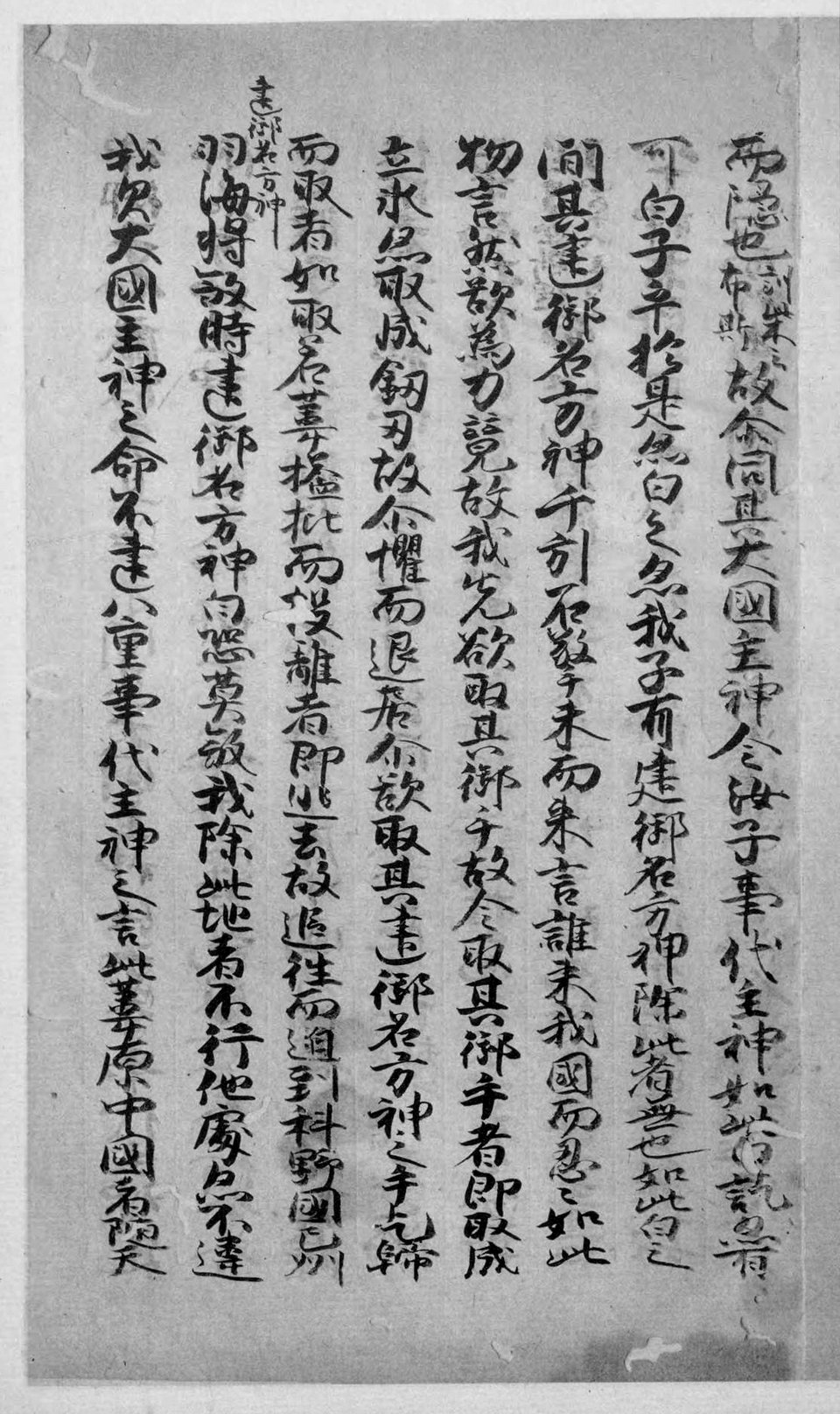
| The Kojiki | The imperial family's court, about 712 C.E. | Insider (the family itself) | The family's claim: descent from Amaterasu, in one unbroken line | Written about 300 years after the Kofun period, by the family it is about, at a time when it needed to prove it should rule. |
The Yamato evidence problem is different. Look at every problem we have met this year:
| Civilization | The evidence problem |
|---|---|
| The Harappans | Writing we cannot read |
| The Qin | A record written by their enemies |
| Ashoka | A record written by himself |
| Early Japan | A record written by a neighbour |
| The Yamato | The evidence is sealed in the ground. It is not lost. We know where it is. We are not allowed to look. |
Two records, one country. The Chinese wrote that the people of Wa agreed upon a woman as ruler, after years of war. The Kojiki, written centuries later by the family itself, says the rulers came from the Sun Goddess and ruled from the beginning. The two stories do not fit together. Ask: who wrote each one, when, and why?
Credit: Wikimedia Commons, public domain
6. Timeline and vocabulary
| Date | What happened |
|---|---|
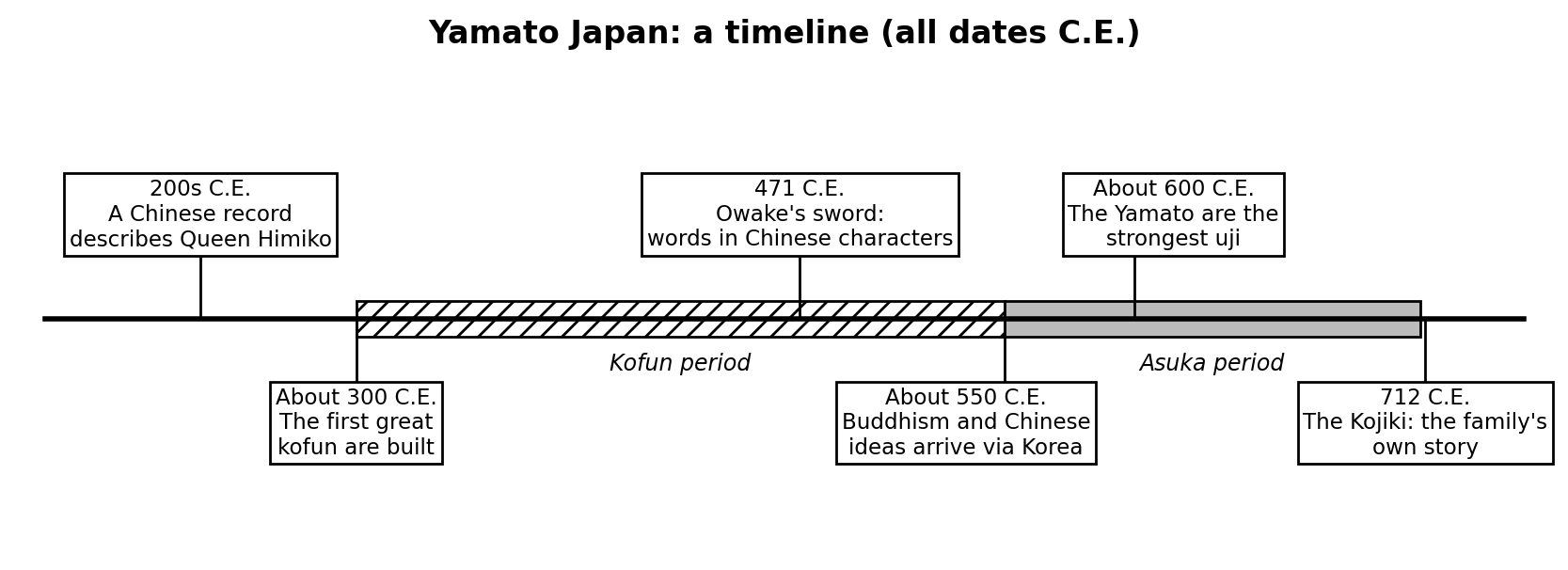
| 200s C.E. | A Chinese chronicle describes Queen Himiko of Wa |
| About 300 C.E. | The Kofun period begins: the first great kofun are built |
| 471 C.E. | Owake's sword: words in gold, in Chinese characters |
| About 550 C.E. | The Asuka period begins; Buddhism and Chinese ideas arrive by way of Korea |
| About 600 C.E. | The Yamato are the strongest uji in Japan |
| 712 C.E. | The Kojiki: the imperial family's own story |
| Today | The same family still holds the title of emperor |
| Word | Meaning |
|---|---|
| kofun | "Old mound": a huge burial mound for a ruler; also the name of the period |
| uji | A clan of Kofun-period Japan |
| clan | A large group of families who believe they share one ancestor |
| Wa | The Chinese name for early Japan |
| envoy | A messenger sent by one ruler to another |
| chronicle | A written record of events, in the order they happened |
| alliance | An agreement between two groups to help each other |
| subordinate | Lower in rank; under someone else's control |
| imperial | Belonging to an emperor or an empire |
| descent | The family line you are born from |
| legitimacy | The accepted right to rule |
| justify | To give a reason why something is right or allowed |
| kami | A god or spirit in Shinto |
| Amaterasu | The Sun Goddess, the most important kami in Shinto |
| Kojiki | "Record of Ancient Matters": the imperial family's book about its own past, about 712 C.E. |
7. Connections
Before: Early Japan (Unit 1)
You met the Jōmon, the first kofun, and Shinto in the Early Japan packet. This packet asks the next question: who built the mounds, and how did one clan come to rule?
Across Asia: China's Mandate of Heaven
Two countries. Same problem: who gets to rule. Two opposite machines.
| China (Mandate of Heaven) | Japan (descent from Amaterasu) | |
|---|---|---|
| Where does the right to rule come from? | Heaven gives it | Birth: the blood of the Sun Goddess |
| Can it be lost? | Yes. Heaven can take it back from a bad ruler. | No. It cannot be earned or taken away. |
| A rival's move | Replace the ruling family | Control the ruling family |
| Result | Many dynasties | One line |
See the Zhou packet for the Mandate of Heaven.
Across Asia: the Mauryan Empire
Ashoka carved his edicts in India in the 200s B.C.E. Centuries later, Buddhism reached Japan, by way of China and Korea. See the Mauryan packet.
8. Where students lose marks on this topic
| Mistake | Fix |
|---|---|
| "The Yamato conquered Japan" | They united central Japan with marriage alliances and titles, not by conquest. |
| "China ruled Japan" | No. Chinese ideas reached Japan, by way of Korea. China wrote about Japan; it did not rule it. |
| "Chinese writing came straight from China" | It came from China, by way of Korea, through the Yamato's Korean alliances. |
| "The Chinese record must be false, because foreigners wrote it" | Too strong. It is an outsider's view, so be careful, but for this period it is almost all we have. |
| Treating the Kojiki as proof (that Amaterasu existed, or that the line was never broken) | It is the family's own story, written about 300 years later, when it needed to prove it should rule. |
| Saying the Kojiki was written by the family's enemies | That was the Qin problem. The Kojiki was written by the family itself. |
| "The later emperors were fake / did not matter" | They lost their power, but the title made a government look legal. That is why powerful men protected the line. |
| Choosing "the sword proves the Yamato used marriage alliances" | True, but not in the source. The sword only tells us about Owake's service. Prove answers with the passage's words. |
| Choosing "women always ruled Wa" | Too strong. The record says one woman, Himiko, was chosen after a time of war. |
Self-check
Cover the answers. Can you answer these in complete sentences?
- What were the uji, and which uji became the strongest by about 600 C.E.?
- Identify the two ways the Yamato united central Japan without a war.
- Describe what reached Japan by way of Korea.
- Describe one problem with using Chinese records to study early Japan.
- Explain how the Yamato's claim to legitimacy was different from China's Mandate of Heaven.
- The later emperors had no real power. Explain why the title still mattered.
Check your answers (click to open)
- The uji were the clans of Kofun-period Japan: large groups of families who believed they shared one ancestor. By about 600 C.E., the Yamato were the strongest uji.
- The Yamato formed marriage alliances with competing uji, and they granted titles to subordinate clans that accepted Yamato leadership.
- Chinese characters, Buddhism, new tools and new ways of building reached Japan from China, by way of Korea.
- The Chinese wrote from outside Japan, in their own language, about places most of them had never seen. They wrote down what envoys told them.
- In China, Heaven gave the Mandate and could take it back from a bad ruler, so a rival could replace the ruling family. The Yamato's right to rule came from birth, from descent from Amaterasu, so it could not be earned or taken away, and a rival could only try to control the emperor.
- The emperor's name was the one thing that made a government look legal. Anyone who wanted to rule Japan needed it, so everyone had a reason to protect the family line.