Home › East Asian Civilization › Unit 2
The Han Dynasty (202 B.C.E.–220 C.E.)
East Asian Civilization · Unit 2 · Civilization Packet
1. At a glance
| Question | Answer |
|---|---|
| When? | Western Han: 202 B.C.E.–9 C.E. · Eastern Han: 25–220 C.E. More than 400 years in all. |
| Where? | China. The capital was Chang'an in the west; later, Luoyang, further east. |
| Who? | Liu Bang (Han Gaozu), the founder; Emperor Wu (Han Wudi); the envoy Zhang Qian; the usurper Wang Mang; the Xiongnu on the northern border |
| Big idea | New robes, same machine. The Han kept the Qin's bureaucracy, then gave it a Confucian face. |
| Known for | A centralized bureaucracy; Confucianism as the basis of government; war with the Xiongnu; opening the road west (later called the Silk Road); the wu zhu coin; making many peoples into one Han people |
| How do we know? | Sima Qian's Shiji (written by a Han official); official letters in the Book of Han; artefacts like coins and Xiongnu graves. The Xiongnu left no writing. |
Unit 2's big question: how do you hold a big thing together? The Han answer: keep the Qin's machine, make it softer, and make everyone share the same writing, money and ideas until they feel like one people.
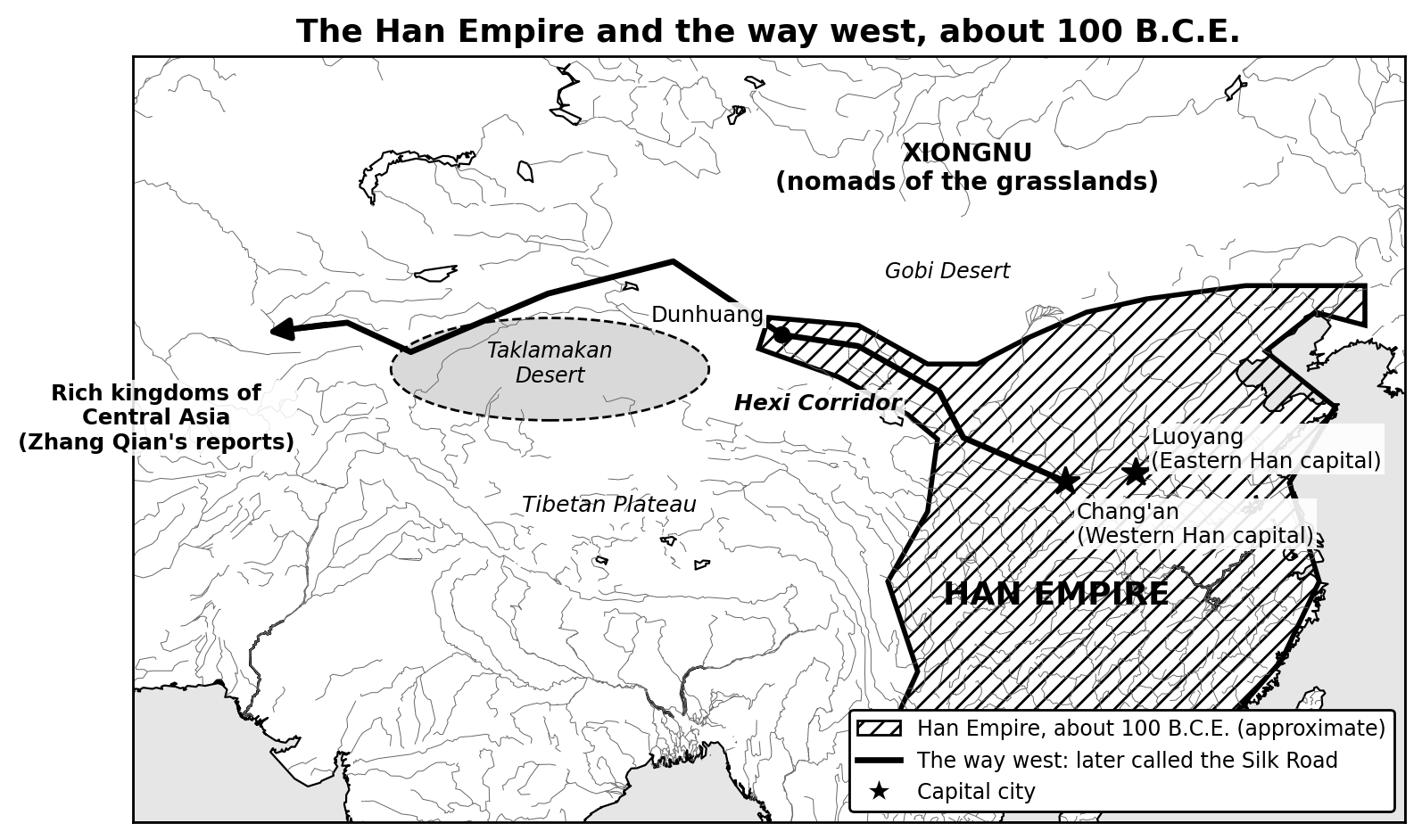
2. The story of the Han in four parts
1. A village official beats a nobleman
- The Qin fell in 206 B.C.E., and
China broke apart into war again. Two men fought for the empire:
- Xiang Yu: a nobleman from the old state of Chu, and a famous general.
- Liu Bang: from a farming village; before the war, a minor official for the Qin. Almost nobody expected him to win.
- In 202 B.C.E., Liu Bang defeated Xiang Yu, re-united China and founded the Han Dynasty. As emperor he took the name Han Gaozu.
- The two men wanted different kinds of country:
| Xiang Yu | Liu Bang | |
|---|---|---|
| What he wanted | Go back to the Zhou way: the empire broken into pieces and handed to great families (feudalism) | One state, ruled from one centre |
| Who would rule the land? | Nobles, born into power that could not be taken away | Officials, whose power came from the emperor and could be taken back tomorrow |
- So Liu Bang made a strange choice: he kept the system of the Qin, the dynasty he had helped destroy. He made the punishments softer, but left the rest almost unchanged.
2. A Confucian face on a Qin body
- The adviser Lu Jia kept quoting the old Confucian books. Liu Bang lost his temper: he had won the empire on horseback, so what use were books?
- Lu Jia answered: "You won it on horseback. Do you mean to rule it from horseback too?" Liu Bang was ashamed, and asked Lu Jia to write a book about why the Qin had lost. But he still did not change the basis of his government.
- Sixty years later, under Emperor Wu (141–87 B.C.E.), Confucianism became the basis of government. Emperor Wu set up a school to train officials in the Confucian classics. More and more, officials were chosen for their learning, not their birth.
- The robes were new. The machine was old.
3. The Xiongnu, and the way west
- The Xiongnu were nomads on the grasslands north of China: the best horsemen in Asia.
- At first the Han could not beat them, so they paid: every year, tribute of silk, grain, and even princesses, for about 70 years.
- Emperor Wu stopped paying and went to war. He used the government Liu Bang had built, which could collect taxes from the whole empire and move an army a thousand miles.
- He sent the envoy Zhang Qian west to look for allies. Zhang Qian was captured by the Xiongnu and held for ten years. He came home with no allies, but with descriptions of rich kingdoms in Central Asia.
- The Han pushed the Xiongnu out of the Hexi Corridor, the only easy way west, between the mountains and the desert. They built forts and moved in soldiers and farmers. As a result, merchants could carry silk west, and goods and ideas came back. This route was later called the Silk Road. Nobody set out to build it. It was the leftover of a war.
- The Xiongnu were not wiped out. Some surrendered and were settled inside Han borders. Others moved far west. They did not disappear from the earth. They disappeared from the records.
4. The rot within: how the Han fell
- Child emperors and powerful in-laws. Emperors often came to the throne as children, and their wives' families ruled for them.
- One in-law, Wang Mang, usurped the throne in 9 C.E. (usurp = take power that is not legally yours). The Western Han ended.
- Rebellions broke out. Wang Mang was overthrown, and a member of the Han family restored the dynasty. The new capital stood further east, so this second Han is the Eastern Han.
- The Eastern Han was different: more emphasis on Confucianism, and more decentralized (power spread out, away from the centre, to powerful local families).
- Falling tax revenue. Rich families gathered land into huge estates and avoided taxes. Less land was taxed, so the government had less money, so the emperor depended even more on the great families.
- No foreign army conquered the Han. It fell from the inside.
3. SPICE-T: the Han Dynasty
SPICE-T = Social, Political, Interactions, Cultural, Economic, Technology.
S — Social
- Assimilation: making different groups slowly become one, by sharing the same ways of life. The Han did this on purpose.
- After 400 years of sharing the same writing, coin and rules, people stopped calling themselves Chu or Qi. They called themselves the people of Han. "Han" began as the name of a ruling family. It became the name of a whole people. Most people in China still call themselves Han today.
- Rich and poor: powerful families took more and more land. Common farmers were pushed off their fields.
P — Political
- A centralized bureaucracy, kept from the Qin. Officials collected taxes, kept records and carried out orders, and they held their jobs only because the emperor let them.
- Confucianism became the basis of government under Emperor Wu. Officials were trained in the Confucian classics.
- The fall: powerful in-laws, a usurper (Wang Mang), and a decentralized Eastern Han.
I — Interactions
- The Xiongnu: about 70 years of tribute, then decades of war under Emperor Wu.
- Zhang Qian's journey west, and the Hexi Corridor taken and guarded.
- The Silk Road: silk went west; goods and ideas came back.
- Surrendered Xiongnu were settled inside the empire. Some leaders were given Chinese names and Han titles, and their sons served in the Han army and court.
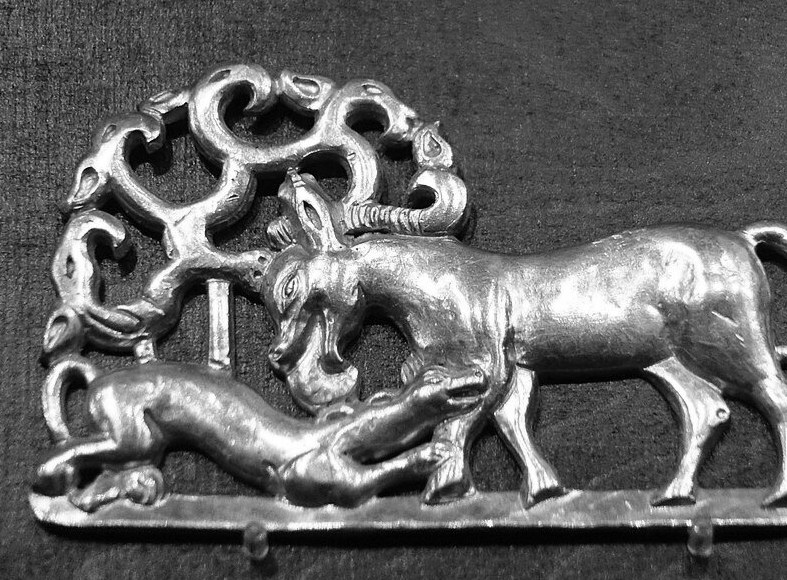
Credit: Daderot, Wikimedia Commons, CC0 (public domain)
C — Cultural
- Confucianism: respect for tradition, for elders, and for correct behaviour between people.
- One standard set of characters: an official in the south could read an order from the north.
- The same books: educated men across the empire read the same books and learned the same ideas.
- A Han identity: made by a government, on purpose.
E — Economic
- The wu zhu coin (from 118 B.C.E.): one coin for the whole empire, round with a square hole. A farmer in the south and a trader in the north held the same money.
- One system of weights: a bag of grain weighed the same in every market.
- Silk traded west along the road the war had opened.
- The money problem: tax-free estates meant falling revenue (the money a government takes in).
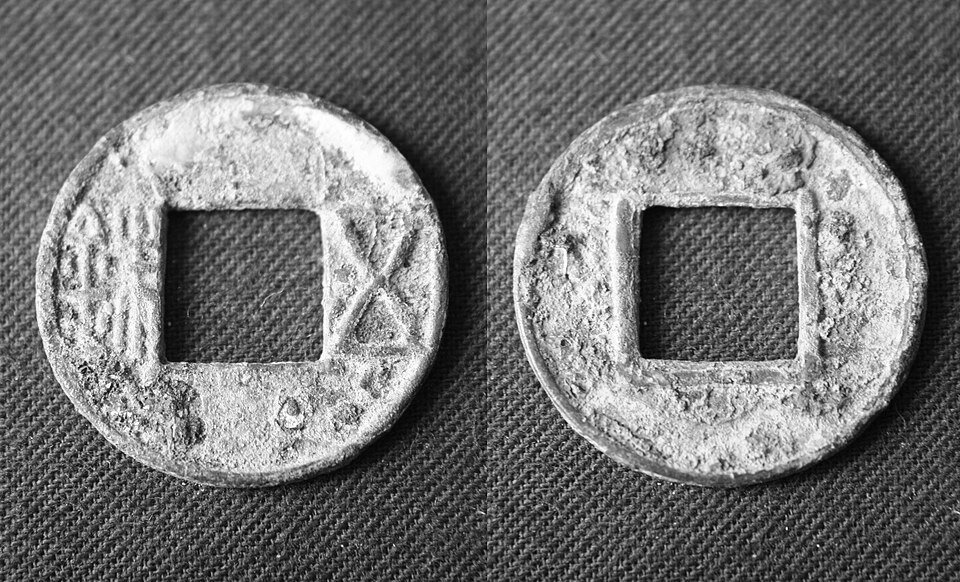
Credit: Gary Lee Todd, Wikimedia Commons, CC0 (public domain)
T — Technology
- Roads joined the far regions to the centre.
- Forts guarded the Hexi Corridor and the way west.
- A government that could move an army a thousand miles.
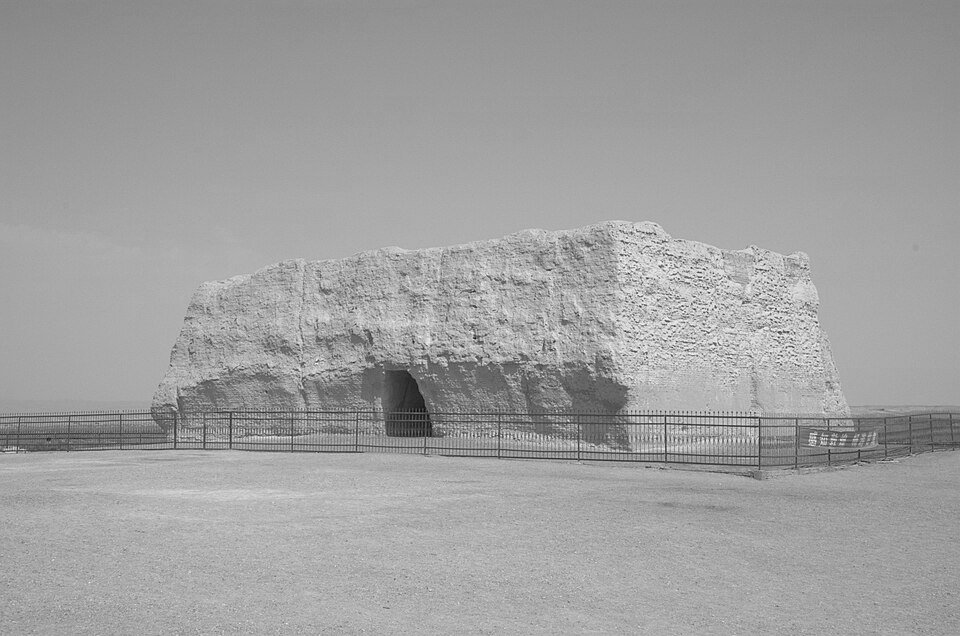
Credit: 张骐, Wikimedia Commons, CC BY-SA 3.0
4. Big ideas
- New robes, same machine. The Han destroyed the Qin but kept its bureaucracy. Confucianism became the "robes" only 60 years later, under Emperor Wu.
- Officials, not nobles. A noble's power could not be taken away. An official's power came from the emperor and could be taken back. That is why one man could hold China together.
- The Silk Road was the leftover of a war. The Han fought the Xiongnu, took the Hexi Corridor, and the way west opened.
- How to make a people. Shared writing, money, weights and books, over 400 years, turned many peoples into one Han people.
- The rot within. Child emperors, powerful in-laws, a usurper, and falling tax revenue brought the Han down from the inside. It completed the dynastic cycle.
5. Key sources: how do we know what we know?
| Source | Who made it? When? | Insider or outsider? | What it tells us | Be careful! |
|---|---|---|---|---|
| Sima Qian's Shiji ("Records of the Grand Historian") | Sima Qian, a historian paid by the Han court; about 91 B.C.E. | Insider (for the Han) | Liu Bang and Lu Jia; the war with Xiang Yu; the Xiongnu | He worked for the winners, about 100 years after some events. But he wrote Xiang Yu as brave and tragic, which propaganda does not usually do. Biased, and still useful. |
| The Shiji on the Xiongnu | The same Han historian | Outsider (and an enemy) | How the Xiongnu lived: herds, horses, no cities, no writing | Written by the people at war with the Xiongnu. Only half the story survived. |
| Xiongnu graves | The Xiongnu themselves | Artefacts | Gold plaques, weapons, horse gear, and Han silk | No writing at all. Every Xiongnu name we have was written by a Chinese scribe, guessing at the sounds. |
| The wu zhu coin | The Han government, from 118 B.C.E. | Artefact | One coin used across the whole empire | It shows one money; on its own it cannot tell us how people felt about being Han. |
| Dong Zhongshu's letter (in the Book of Han) | A Confucian scholar, writing advice to the emperor | Insider | Powerful families taking land; the poor "without land to stand a needle upon" | It is advice: one scholar's warning, not a count of every family. |
A source can be biased and still be useful. Ask who wrote it, who paid them, and what they had reason to say. Then use what it tells you.
6. Timeline and vocabulary
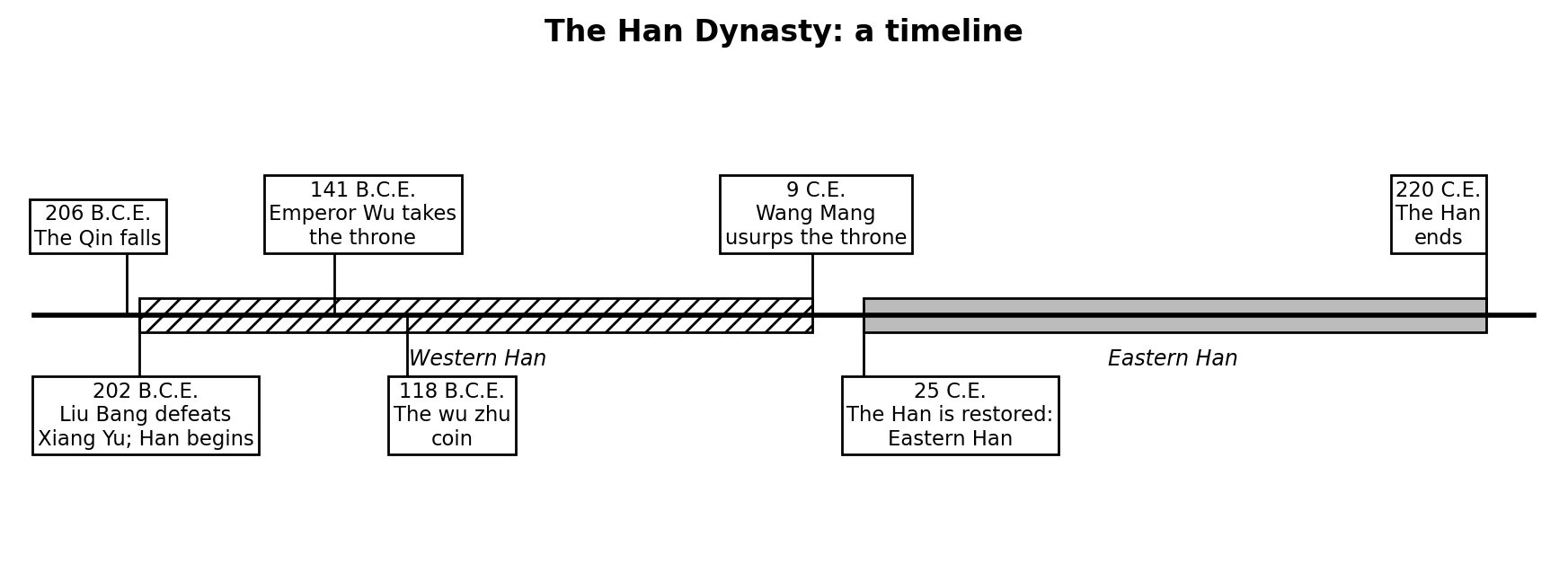
| Date | What happened |
|---|---|
| 206 B.C.E. | The Qin falls; war for the empire |
| 202 B.C.E. | Liu Bang defeats Xiang Yu and founds the Han |
| 195 B.C.E. | Liu Bang dies |
| About 200–130 B.C.E. | The Han pay tribute to the Xiongnu (about 70 years) |
| 141 B.C.E. | Emperor Wu takes the throne; war with the Xiongnu; Zhang Qian goes west |
| 118 B.C.E. | The first wu zhu coins |
| About 91 B.C.E. | Sima Qian writes the Shiji |
| 9 C.E. | Wang Mang usurps the throne; the Western Han ends |
| 25 C.E. | The Han is restored: the Eastern Han |
| 220 C.E. | The Han Dynasty ends |
| Word | Meaning |
|---|---|
| bureaucracy | A government run by appointed officials who follow set rules |
| feudalism | A system where land is handed to great families who rule it themselves |
| Legalism | The Qin belief that order comes from strict rules and heavy penalties |
| Confucianism | Teaching respect for tradition, for elders, and for correct behaviour between people |
| maintain | To keep something going; to keep it the same |
| nomad | A person who moves with their animals and does not live in one place |
| tribute | Payment one ruler sends another, to buy peace or show respect |
| envoy | An official messenger sent by a ruler |
| assimilation | Making different groups slowly become one, by sharing the same ways of life |
| identity | Who a person or group feels they are |
| court | The emperor and the powerful people around him who help him rule |
| usurp | To take power that is not legally yours |
| decentralized | With power spread out, away from the centre |
| revenue | The money a government takes in, mostly from taxes |
7. Connections
Before: the Qin (Unit 2)
The Han criticized the Qin, but kept the Qin's machine: the bureaucracy run by appointed officials. The Han made the punishments softer and added Confucianism. See the Qin packet.
Before: the Zhou and the dynastic cycle (Unit 1)
Xiang Yu wanted to go back to the Zhou way: land for great families. The Han then completed the whole dynastic cycle: rise, rule well, grow weak, fall. See the Zhou packet.
Across Asia: Yamato Japan
In China, a powerful in-law (Wang Mang) could take the throne for himself. In Japan, a rival could never become the emperor, so he could only control him. See the Yamato packet.
After: Korea's Three Kingdoms (Unit 2)
As the Han declined, it could no longer hold its towns in northern Korea. Three Korean kingdoms rose in the space it left. See the Korea's Three Kingdoms packet.
8. Where students lose marks on this topic
| Mistake | Fix |
|---|---|
| "The Han threw out the Qin system" | The Han kept the Qin's bureaucracy and made punishments softer. New robes, same machine. |
| "Liu Bang made China Confucian" | Liu Bang did not change his government. Confucianism became the basis of government 60 years later, under Emperor Wu. |
| "The Han built the Silk Road" | Nobody set out to build it. It was the leftover of a war with the Xiongnu. |
| "The Xiongnu were wiped out" | Their alliance broke apart. Some were settled inside Han borders. They disappeared from the records. |
| "Wang Mang ended the Han Dynasty" | He ended the Western Han. The Han was restored as the Eastern Han, which ended in 220 C.E. |
| "A foreign army conquered the Han" | No. It fell from the inside: in-laws, a usurper, and falling tax revenue. |
| "The Shiji is biased, so it is useless" | Too strong. It is biased and useful. Name who wrote it and who paid him. |
| Choosing "every rich family refused to pay any taxes" | Too strong. The source says powerful families took land; it does not say every family. |
| Choosing "the Eastern Han emphasized Confucianism" for Dong Zhongshu's letter | True, but not in that passage. Prove answers with the passage's words. |
| On an EXPLAIN question, no analysis sentence | TEA: Topic sentence, Evidence, Analysis: the sentence that says why the evidence proves the claim. |
Self-check
Cover the answers. Can you answer these in complete sentences?
- Identify who Liu Bang defeated, and the dynasty he founded.
- Describe the system of government Liu Bang kept from the Qin, and what Xiang Yu wanted instead.
- Describe what Zhang Qian was sent to find, and what he actually brought back.
- Explain how the war with the Xiongnu opened the Silk Road.
- Explain how sharing one writing system and one coin helped make one Han people.
- Explain how court politics and falling tax revenue together led to the fall of the Han.
Check your answers (click to open)
- Liu Bang defeated Xiang Yu in 202 B.C.E. He founded the Han Dynasty.
- Liu Bang kept the Qin's bureaucracy, in which officials got their power from the emperor and could be removed. Xiang Yu wanted feudalism instead: the empire handed out to great families who would rule their own land.
- Zhang Qian was sent west to find allies against the Xiongnu. He found no allies, but he brought back descriptions of rich kingdoms in Central Asia.
- The Han pushed the Xiongnu out of the Hexi Corridor, the only easy way west, and built forts there. As a result, the way west was open and guarded, so merchants could carry silk into Central Asia.
- Sharing the same writing and the same coin gave people across the empire the same way of life. Over 400 years, this led people to stop calling themselves Chu or Qi and to call themselves the people of Han.
- Child emperors let powerful in-laws rule, and one in-law, Wang Mang, usurped the throne. At the same time, rich families avoided taxes, so the government had less money and depended more on those families. Together, these problems weakened the emperor until the Han fell from the inside.