Home › East Asian Civilization › Unit 3
The Gupta Empire (about 320–550 C.E.)
East Asian Civilization · Unit 3 · Civilization Packet
1. At a glance
| Question | Answer |
|---|---|
| When? | About 320–550 C.E. |
| Where? | Northern India, along the Ganges River |
| Capital | Pataliputra |
| Religion of the rulers | Hinduism |
| Famous rulers | Chandragupta I (founder), Samudragupta (conqueror), Chandragupta II (Golden Age) |
| Known for | Re-unifying northern India; a golden age; religious tolerance; the Nine Jewels |
| How did it end? | Invasions by the White Huns, plus weaker rulers. It fell apart around 550 C.E. |
| How do we know? | A Chinese visitor, Fa Xian; a court poet's praise of the king on a pillar; coins, caves and the Iron Pillar |
Unit 3's big question: why do empires fall apart, and how do they come back together? The Gupta shows what can happen when a land comes back together: a golden age.
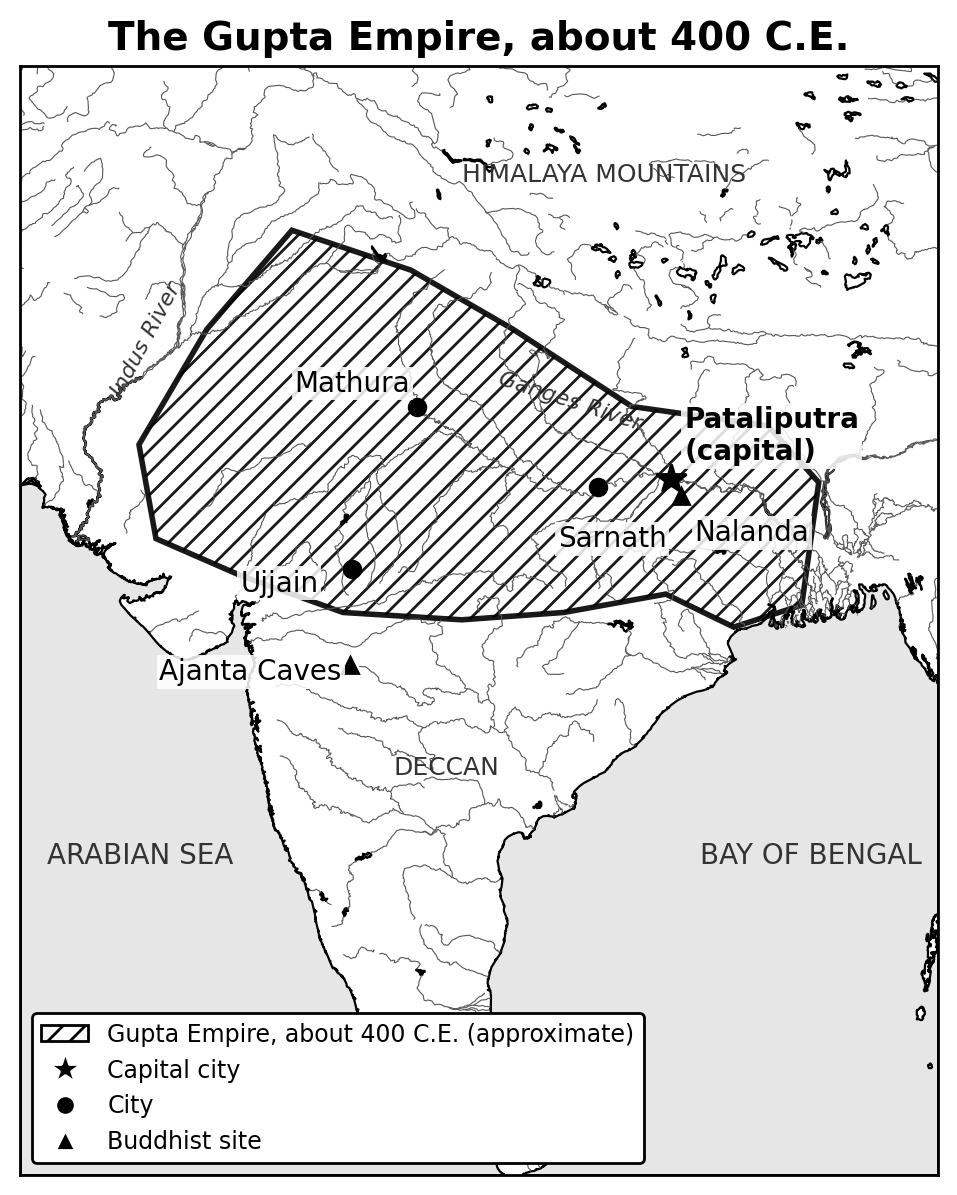
Map notes: The Gupta Empire covered most of northern India. The Ajanta Caves were just outside its border, in the kingdom of the Vakatakas. The Vakatakas were close allies of the Guptas: Chandragupta II's daughter married a Vakataka king.
Do not confuse: Chandragupta Maurya founded the Mauryan Empire (about 321 B.C.E.). Chandragupta I and Chandragupta II were Gupta kings, more than 600 years later.
2. SPICE-T: the Gupta Empire
SPICE-T = Social, Political, Interactions, Cultural, Economic, Technology.
S — Social
- The caste system became stricter. People were born into a group, and it was hard to change it.
- Brahmins (priests) had high status.
- Most people were farmers who lived in villages.
- Women had fewer rights than men.
P — Political
- Before the Gupta, northern India was divided into many small kingdoms that fought each other. The Gupta rulers re-unified northern India: they joined it back together under one government.
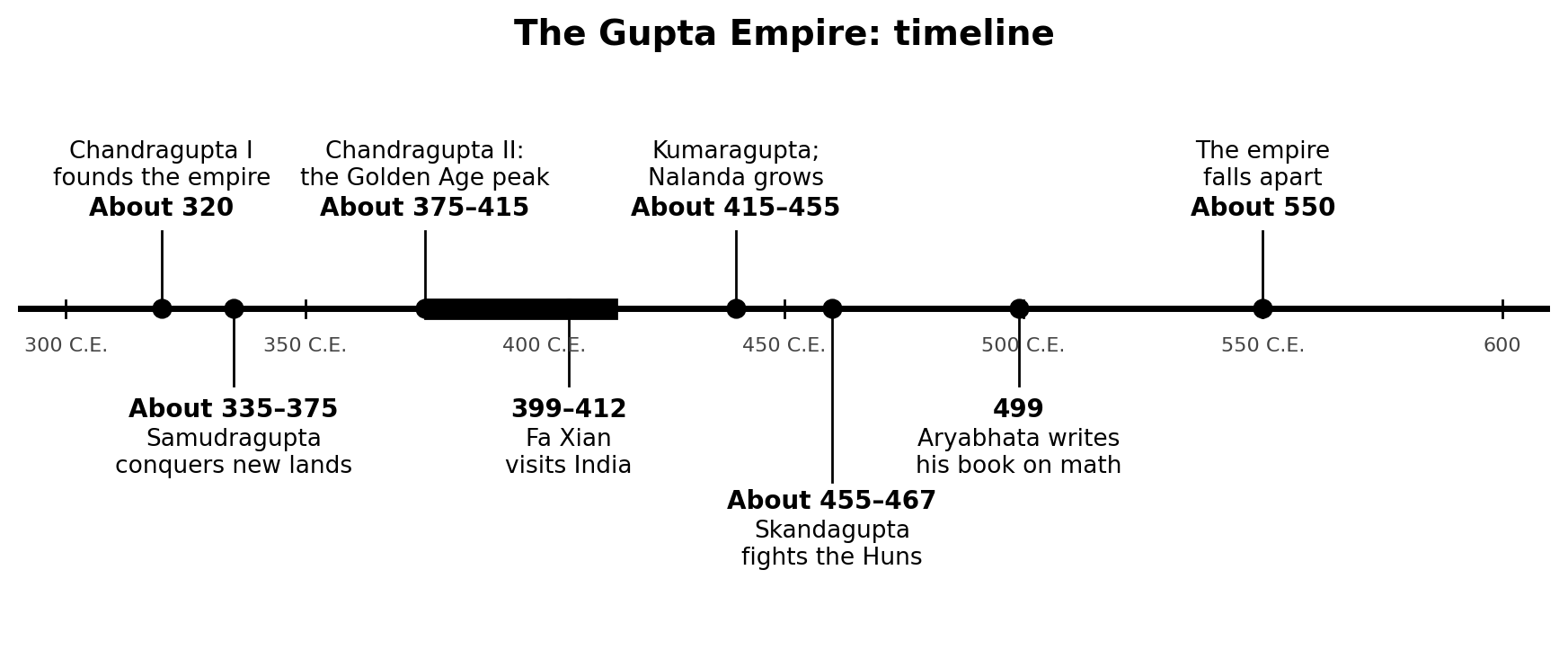
- Chandragupta I started the empire around 320 C.E.
- Samudragupta conquered many lands. Many defeated kings kept their thrones but paid tribute (gifts and money) to him.
- Chandragupta II made the empire strong. He made alliances through marriage (for example, with the Vakatakas).
- Less centralized: local kings and officials kept a lot of power.
- Gentle rule: Fa Xian wrote that most criminals only paid a fine.
I — Interactions
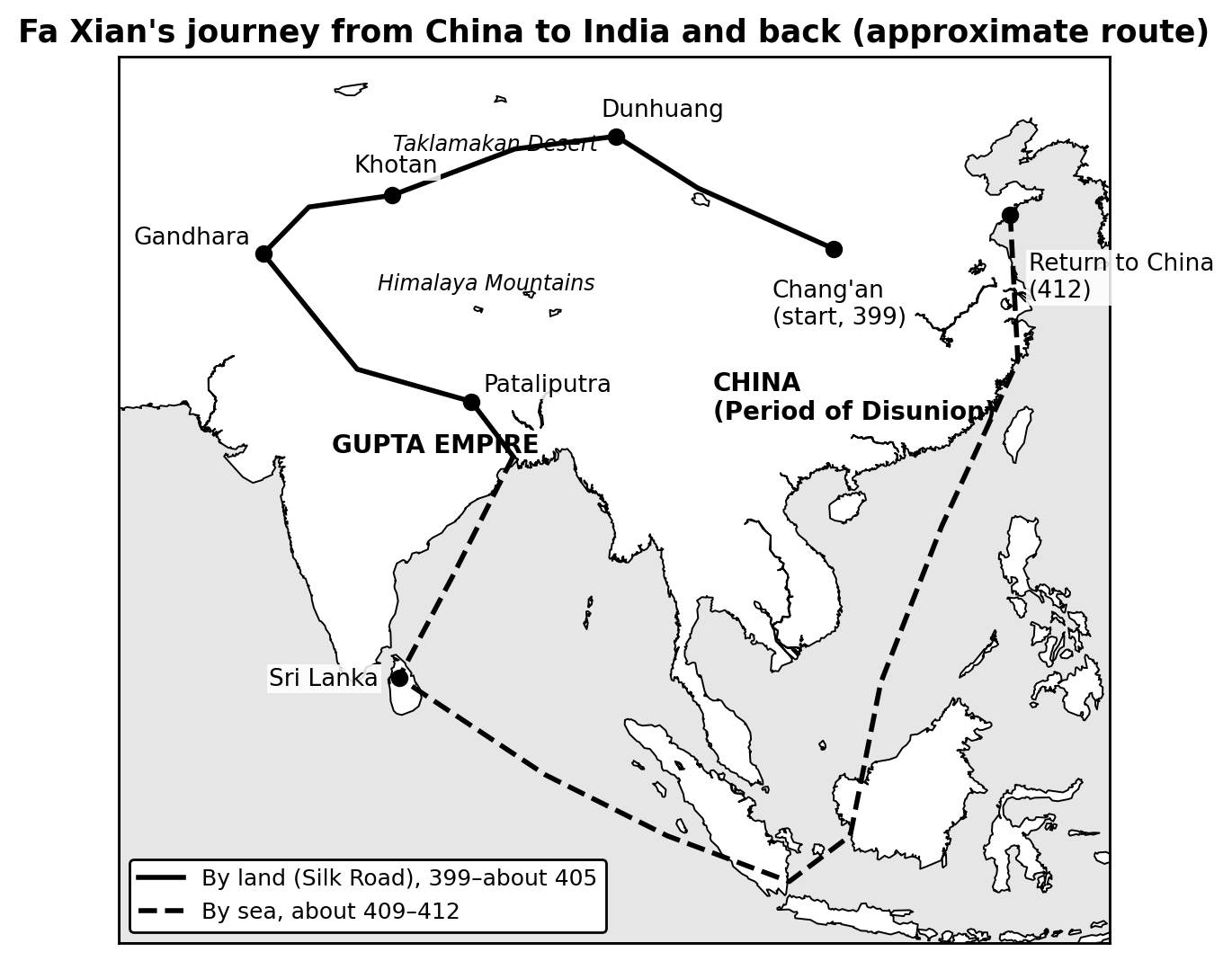
- Visitors from China, like the monk Fa Xian, came to study Buddhism (see the map below).
- Trade by land and sea with China, Southeast Asia and the Middle East.
- War: the White Huns (nomads from Central Asia) invaded in the late 400s and helped end the empire.
C — Cultural
- Hinduism grew stronger. People built some of the first stone Hindu temples.
- Religious tolerance: the Hindu kings also supported Buddhists and Jains.
- Buddhist art: the paintings in the Ajanta Caves and the Buddha statues of Sarnath.
- Nalanda grew into a great Buddhist university. Students came from all over Asia.
- Literature: the poet and playwright Kalidasa wrote in Sanskrit.
The Nine Jewels: the Gupta court is famous for a group of brilliant scholars called the Nine Jewels. A "jewel" here means a person so talented that the ruler treasured them. Three to know:
| Jewel | Who? | Remembered for |
|---|---|---|
| Kalidasa | Playwright and poet | The greatest writer in Sanskrit; his play Shakuntala is still performed today |
| Sushruta | Physician (doctor) | Medicine and early surgery: cleaning wounds, repairing damaged skin; the Sushruta Samhita |
| Aryabhata | Mathematician and astronomer | The place-value number system; a close value for pi; the Earth spins on its axis |
The Nine Jewels are evidence that the Gupta was a golden age of learning.
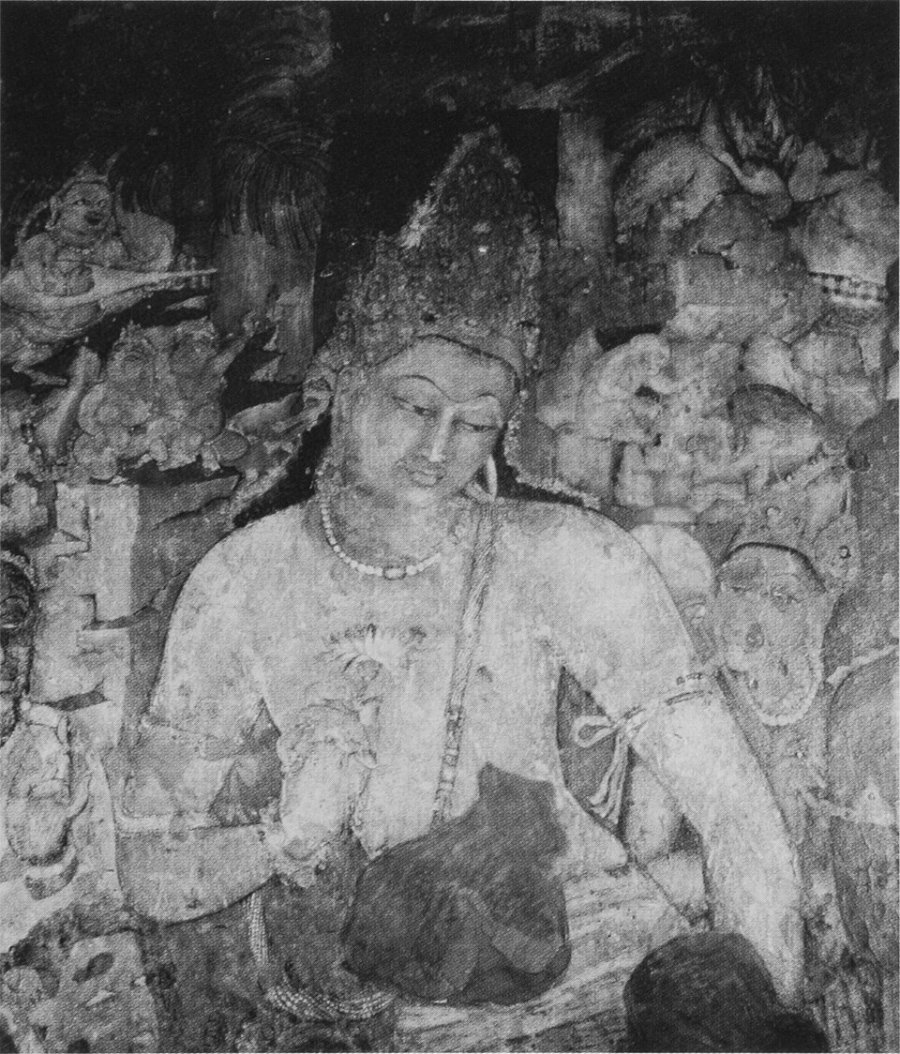
Credit: Wikimedia Commons, public domain
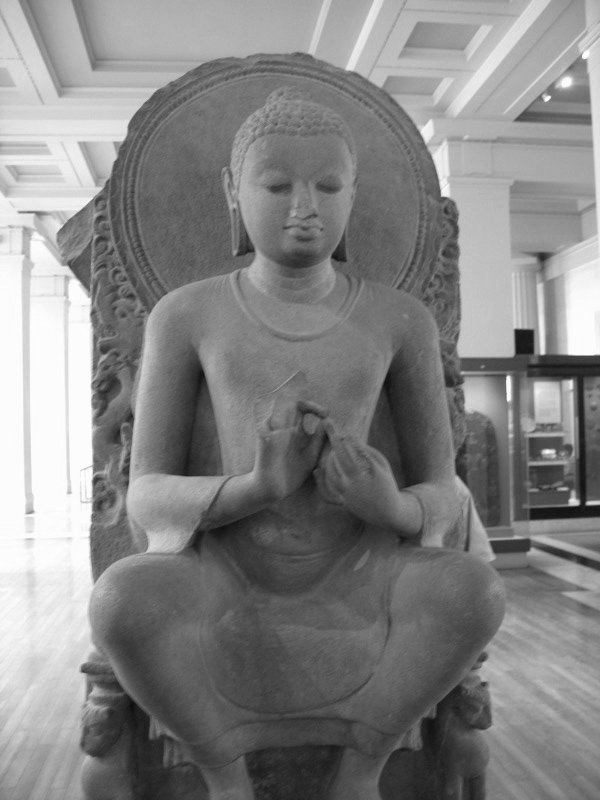
Credit: dr.jd, Wikimedia Commons, CC BY-SA 2.0
E — Economic
- Farming was the base of the economy. Farmers paid taxes on their land.
- Trade in spices, cloth, gems and ivory made the empire rich.
- Guilds (groups of craftsmen and merchants) organized work and trade.
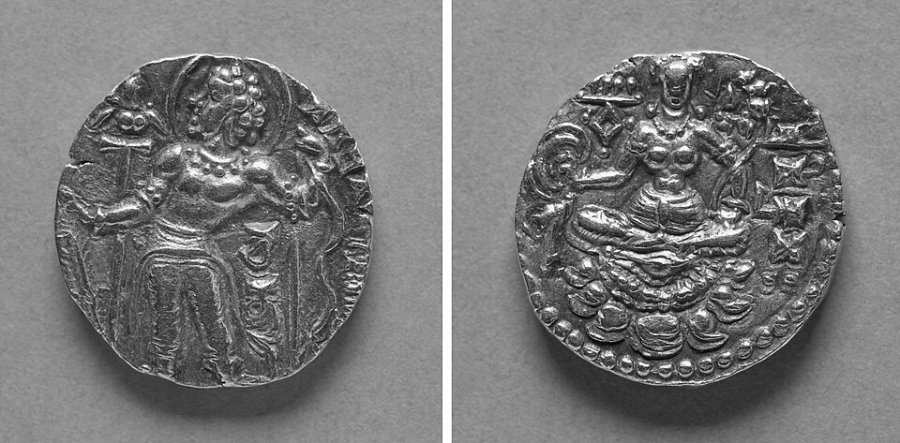
- The kings made beautiful gold coins.
Credit: Cleveland Museum of Art, CC0 (public domain)
T — Technology
- Math: Indian mathematicians developed the decimal place-value system with zero (the numbers 0–9 we use today).
- Science: in 499 C.E., Aryabhata wrote that the Earth spins. He calculated pi (π) and explained eclipses.
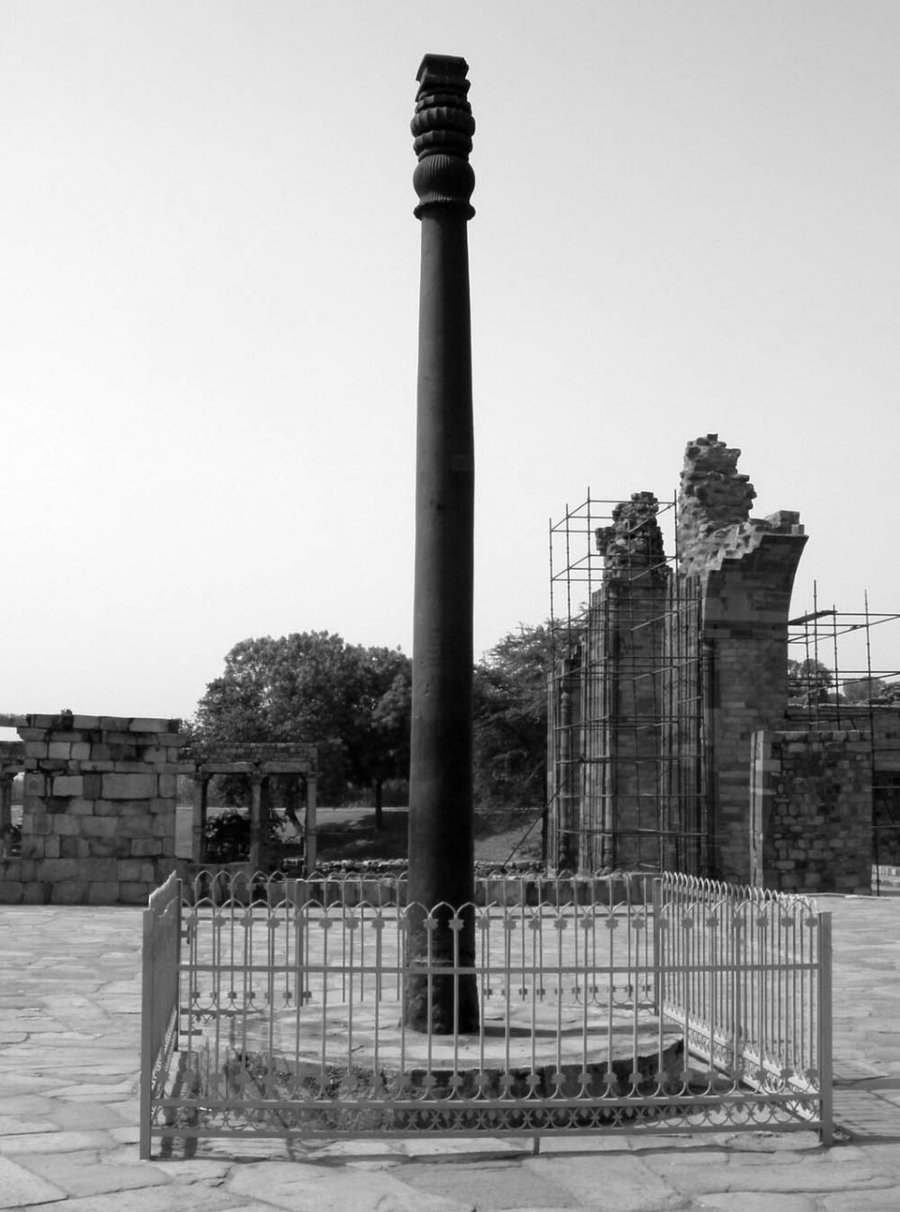
- Metal work: the Iron Pillar has stood for about 1,600 years and has almost no rust.
- Medicine: doctors used herbs and did simple surgery.
Credit: Mark A. Wilson, Wikimedia Commons, public domain
3. Big ideas
- The Gupta re-unified northern India. Before the Gupta, the north was divided into small kingdoms that fought each other. The Gupta joined it back together, and peace and order returned.
- Peace led to a golden age. A golden age is a time remembered after the fact as a peak of achievement. Peace gave people time to build, to write and to study. (Cause → effect.)
- Religious tolerance. The Gupta rulers were Hindu, but they co-existed with a large Buddhist population. They even paid for the Buddhist school at Nalanda.
- The Nine Jewels are the evidence. Great thinkers like Kalidasa, Sushruta and Aryabhata are the proof that the Gupta was a golden age of learning.
- Ideas spread across Asia. Visitors like Fa Xian carried Buddhist books and ideas from India back to China.
- Invasions ended the empire. Attacks by the White Huns, plus weaker rulers, broke the empire apart around 550 C.E.
4. Key sources: how do we know what we know?
| Source | Who made it? When? | Insider or outsider? | What it tells us | Be careful! |
|---|---|---|---|---|
| A Record of Buddhist Kingdoms | Fa Xian, a Chinese Buddhist monk, about 400–414 C.E. | Outsider (from China) | Gupta rule was gentle; Buddhism was strong in India | He was a Buddhist visitor, so he wrote most about Buddhist places. |
| Nalanda (Buddhist monastery and school) | Founded by the Gupta emperor Kumaragupta I, about 450 C.E. | Insider | Hindu rulers paid for a Buddhist school: religious tolerance | What we know comes from ruins and later descriptions. |
| The Iron Pillar | Gupta metalworkers, about 400 C.E. | Insider | Gupta skill in technology: almost pure iron, almost no rust | It shows technology, not daily life. |
| Allahabad Pillar inscription | Harishena, a court poet of Samudragupta, about 350–375 C.E. | Insider (worked for the king) | The lands Samudragupta conquered | It was written to praise the king, so it may exaggerate. |
| Gold coins | The Gupta kings, about 320–450 C.E. | Insider | The empire was rich; how the kings wanted to be seen (as archers, horsemen) | Coins show the king's own message about himself. |
| Ajanta Cave paintings | Buddhist monks and artists, about 450–490 C.E. | Insider | Buddhist beliefs, clothes and daily life | They show religious stories, not everyday news. |
Source questions to ask every time: Who made it? When? Why did they make it? What can it tell us? What can it not tell us?
5. Timeline and vocabulary
| Word | Meaning |
|---|---|
| golden age | A period remembered after the fact as a time of great success in art, science and government |
| re-unify | To join a divided land back together under one government |
| religious tolerance | Allowing people to follow different religions without punishment |
| co-exist | To live together, at the same time, in peace |
| Nine Jewels | The brilliant scholars of the Gupta court, treasured by the ruler |
| empire | A large area of land ruled by one ruler or government |
| tribute | Gifts or money a weaker ruler pays to a stronger ruler |
| centralized | Power is held by one central government |
| caste system | A system that puts people into social groups by birth |
| Hinduism | The religion of the Gupta rulers; the oldest and largest religion in India |
| Buddhism | A religion that began in India and follows the teachings of the Buddha |
| Sanskrit | The old language of Indian religion, poetry and science |
| White Huns | Nomads from Central Asia who invaded India in the late 400s |
6. Connections
Before: the Mauryan Empire (about 321–185 B.C.E.)
| SPICE-T | Mauryan Empire | Gupta Empire |
|---|---|---|
| Political | Strong central government, big army, spies | Less centralized; local kings kept power |
| Cultural | Ashoka became Buddhist and spread Buddhism | Hindu kings who supported Buddhism too |
| Cultural | Both accepted many religions | Both accepted many religions |
| Interactions | Ashoka sent Buddhist teachers to other lands | Chinese monks like Fa Xian came to India |
| Technology | Long roads; polished stone pillars | Zero and the decimal system; the Iron Pillar |
At the same time: China's Period of Disunion (220–589 C.E.)
| SPICE-T | China (Period of Disunion) | India (Gupta Empire) |
|---|---|---|
| Political | Not unified: many kingdoms at war | One mostly peaceful empire |
| Interactions | Steppe nomads invaded and ruled the north | White Huns invaded later, in the late 400s |
| Cultural | Buddhism spread fast and became a major religion | Buddhism was accepted and supported |
The link: Buddhism connected the two. Chinese monks like Fa Xian travelled to India to collect Buddhist books. Read the Period of Disunion packet.
Coming next (Unit 4)
The White Huns are one of the steppe nomad groups you will study in Unit 4. Watch for the same pattern: nomads from the steppe attack a rich, settled empire.
7. Where students lose marks on this topic
| Mistake | Fix |
|---|---|
| Mixing up Chandragupta Maurya (Mauryan) and Chandragupta I or II (Gupta) | Check the dates: Mauryan = B.C.E.; Gupta = C.E. |
| Saying the Gupta kings were Buddhist | The Gupta kings were Hindu. They supported Buddhists (religious tolerance). |
| Saying the Guptas had a strong central government | That was the Mauryans. The Guptas were less centralized. |
| Choosing a true fact that is not in the source | Find the words in the source that prove your answer. |
| Saying "Golden Age" without saying why | Explain the cause: peace and stability gave people time for learning. |
| Writing "they" or "it" | Use the exact name: "the Gupta kings", "Fa Xian". |
Self-check
Cover the answers. Can you answer these in complete sentences?
- Why is the Gupta period called a Golden Age?
- Give ONE example of Gupta religious tolerance.
- How was the Gupta government different from the Mauryan government?
- Who was Fa Xian, and why is his writing useful?
- Name ONE Gupta achievement in math or science.
- What helped end the Gupta Empire?
Check your answers (click to open)
- The Gupta period is called a Golden Age because peace and stable rule gave people time for math, science and art.
- The Hindu Gupta kings supported Buddhists. For example, Buddhist art was made at the Ajanta Caves and Sarnath.
- The Mauryan government was strong and centralized. The Gupta government let local kings keep power.
- Fa Xian was a Chinese Buddhist monk who visited India around 400 C.E. His writing is useful because he saw the Gupta Empire with his own eyes.
- Indian mathematicians developed the decimal system with zero. (Also correct: Aryabhata said the Earth spins.)
- Invasions by the White Huns, plus weaker rulers, helped end the Gupta Empire.