Home › East Asian Civilization
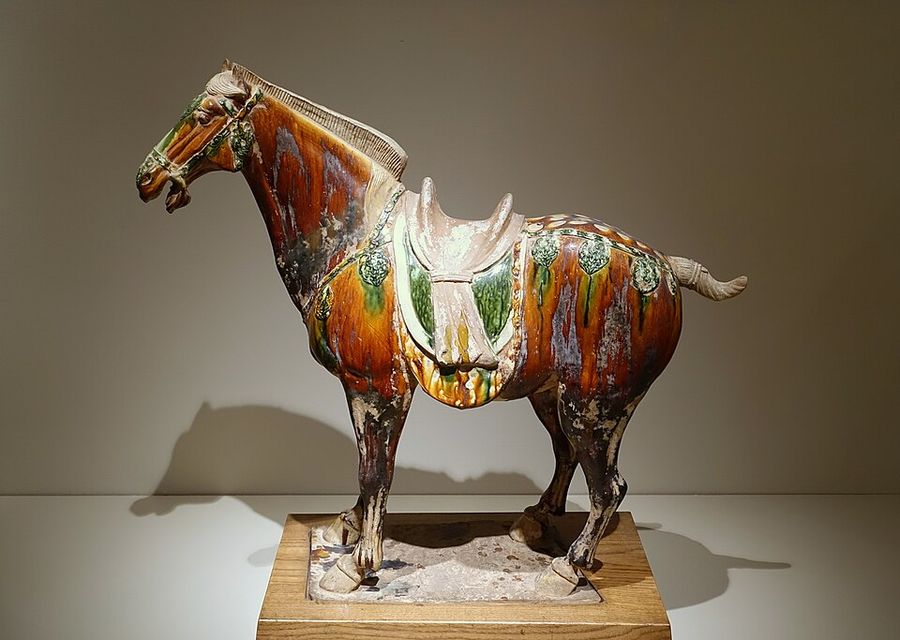
Unit 3: Periods of Unification and Civil War
East Asian Civilization · Grade 7 · Quarter 2 · Unit Packet
1. The big question: why do empires fall apart, and how do they come back together?
Unit 3 visits six packets, from about 220 to 1192 C.E. Every one of them asks the same question: why do empires fall apart, and how do they come back together?
| Packet | Unified or divided? | The evidence problem |
|---|---|---|
| The Gupta Empire | Unified: a golden age in northern India | A king's poet praised him; a Chinese visitor saw mostly Buddhist places |
| China's Period of Disunion | Divided: north and south, for more than 350 years | The most famous version is a novel written 1,100 years later |
| The Sui Dynasty | Reunified China in 589, with harsh rule | Its history was written by the Tang, who replaced it |
| The Tang Dynasty | Unified: China's golden age, then decline after 755 | Poems show feelings, not numbers; the histories came later |
| Nara and Heian Japan | Unified under the emperor, but who held the power changed | The court wrote its own story; a novel is our window into court life |
| The Rise of the Samurai | Warriors take power from the court; a military government | An epic story that teaches a lesson, retold for centuries |
The unit's thread: the same pattern, again and again.
Disunion → reunification → stability → golden age → decline
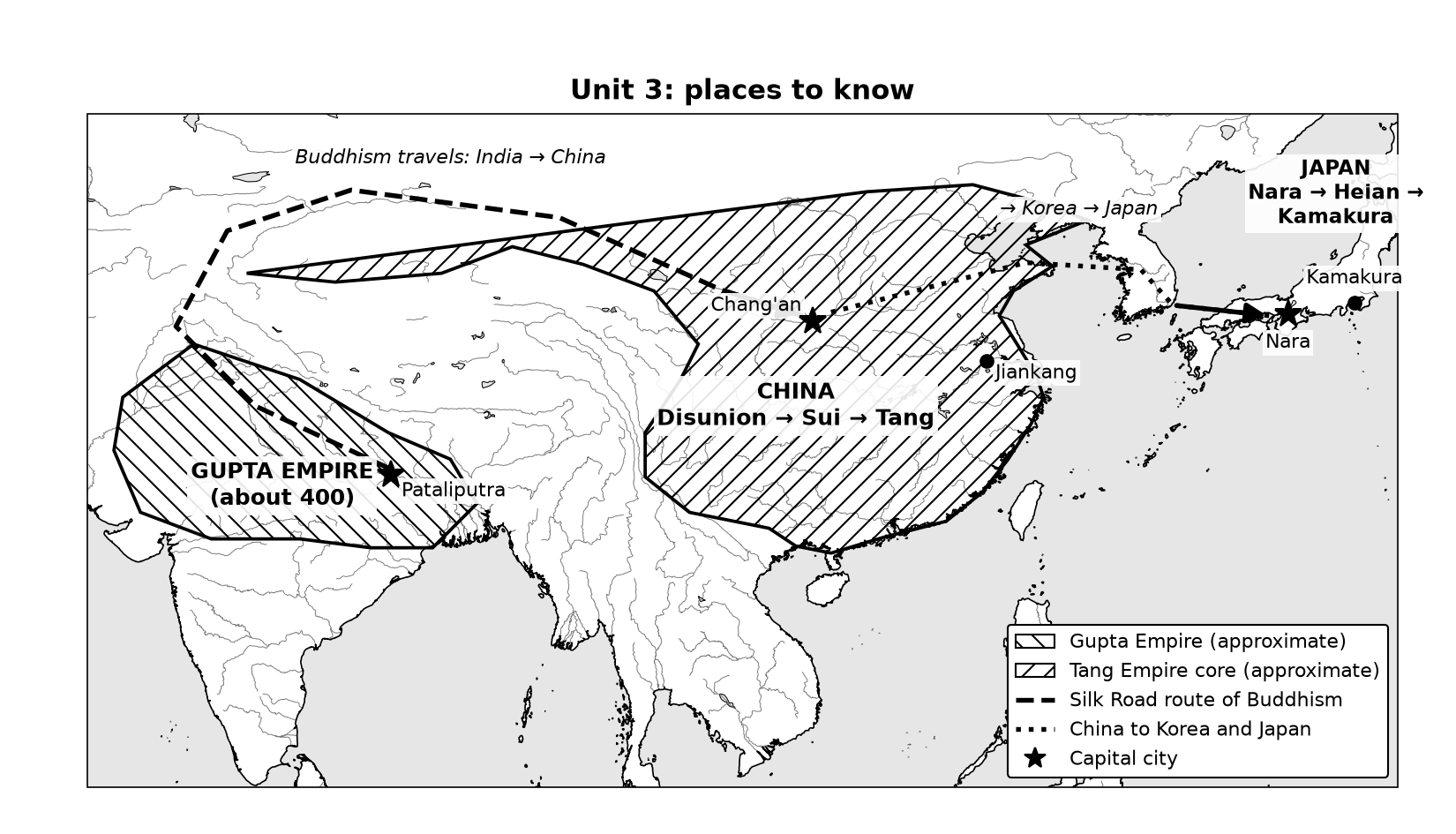
2. The pattern, civilization by civilization
| Step | India | China | Japan |
|---|---|---|---|
| Disunion | Small kingdoms fight after the Mauryan Empire | The Period of Disunion (220–589) | Warrior clans fight: the Genpei War (1180–1185) |
| Reunification | The Gupta (about 320) | The Sui (589) | The Kamakura shogunate (1192) |
| Golden age | The Gupta golden age | The High Tang (618–755) | The Heian court's culture |
| Decline | White Huns invade | The An Lushan Rebellion (755) | The court loses control to warriors |
What causes a golden age? Stability (peace and order) and prosperity (wealth). Peace gives people time and money for art, writing and learning.
What ends one? Invasions (the Gupta), rebellions (the Tang), or a government that loses control of its land and taxes (Heian Japan).
3. Two key ideas for the whole unit
Who really holds power?
In China, a weak dynasty could be replaced: Heaven could take back the Mandate. In Japan, the emperor's family was never replaced. Others controlled the emperor instead.
| Period | Who held the real power | How |
|---|---|---|
| High Tang China | The emperor | A centralized government and the civil service exam |
| Late Tang China | Generals in the provinces | Their own armies, after the An Lushan Rebellion |
| Nara Japan | The emperor (with powerful Buddhist monks) | A government copied from Tang China |
| Heian Japan | The Fujiwara | Marriage and regency |
| Kamakura Japan | The shogun | Military force |
Ideas travel, and change
Follow Buddhism across the unit:
- India: Hindu Gupta kings support Buddhists. The Buddhist school at Nalanda grows (U3-01).
- China: in dangerous times, people turn to Buddhism. Fa Xian walks to India for Buddhist books. Northern rulers carve cave temples (U3-02).
- Tang China: Buddhism is very influential. The monk Xuanzang goes to India. The Diamond Sutra is printed (U3-04).
- Japan: the emperor builds Todai-ji and its Great Buddha (U3-05). Later, Pure Land and Zen Buddhism spread (U3-06).
What travels, changes. Japan also copied Tang government, writing and city plans, then made them its own: kana writing, The Tale of Genji, and officials chosen by family, not by exam.
4. SPICE-T across the unit
| Gupta | Disunion | Sui | Tang | Nara and Heian | Samurai | |
|---|---|---|---|---|---|---|
| S | Caste grew stricter | Millions moved south | Forced labour | Exam: some rise by merit | Court nobles; women writers | A new warrior class |
| P | Re-unified; less centralized | No single ruler | Centralized; one law code | Strong centre, then generals | Emperor, then Fujiwara regents | Shogun in Kamakura |
| I | Fa Xian visits; White Huns | Steppe rulers in the north | Failed wars on Goguryeo | Silk Road; Chang'an cosmopolitan | Envoys to Tang China | The Genpei War |
| C | Nine Jewels; Hindu + Buddhist | Buddhism spreads; cave temples | Confucian government returns | Poetry: Li Bai, Du Fu | Kana; Tale of Genji | Tale of the Heike; Zen |
| E | Trade; gold coins | South grows rice | Grand Canal links north and south | Canal, Silk Road, markets | Rice; tax-free shoen | Land pays warriors |
| T | Zero; Iron Pillar | Stirrups; Zu Chongzhi's pi | Grand Canal; Anji Bridge | Printing; gunpowder | Grid cities; Great Buddha | Armour; the bow on horseback |
5. Unit timeline
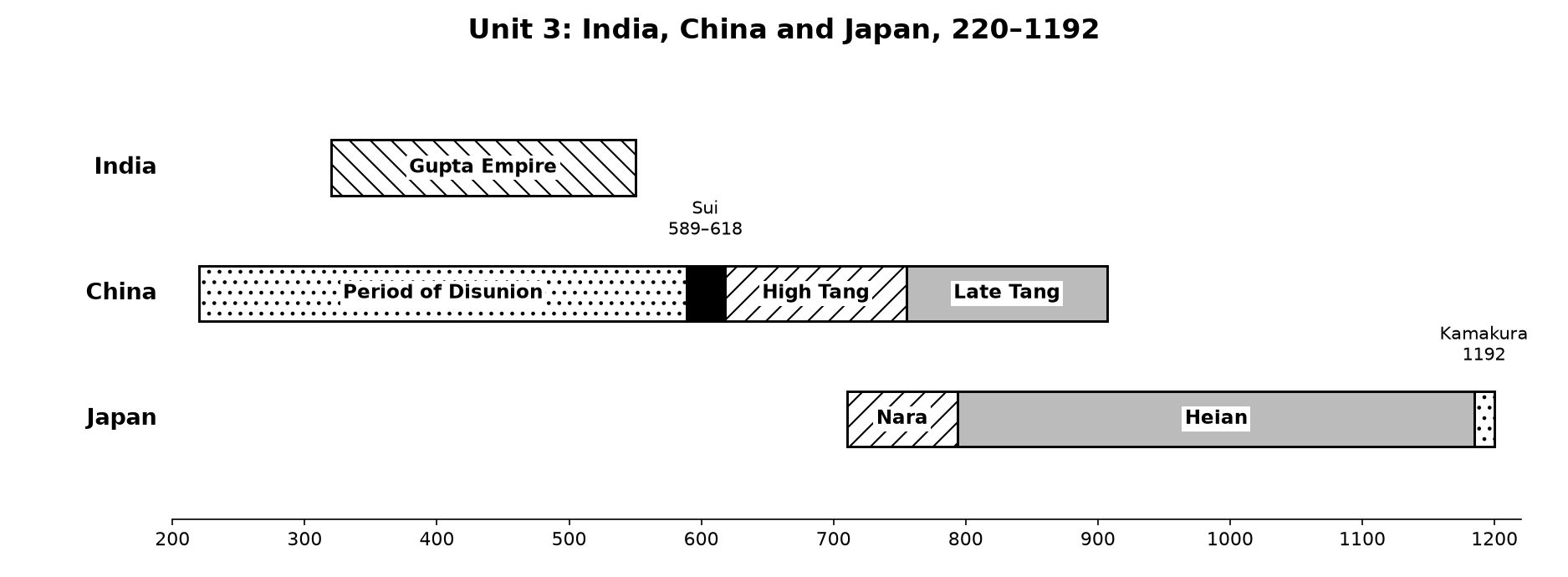
| Date | What happened |
|---|---|
| 220 | The Han ends; China's Period of Disunion begins |
| About 320 | The Gupta Empire begins in India |
| 399–412 | Fa Xian travels from China to India and back |
| 439 | The Northern Wei unites northern China |
| About 460 | The Yungang cave temples begin |
| About 550 | The Gupta Empire falls apart |
| 581 | Yang Jian founds the Sui |
| 589 | The Sui reunifies China |
| 605–610 | The Grand Canal's main sections are built |
| 618 | The Tang begins |
| 645 | Japan's Taika Reforms |
| 690–705 | Wu Zetian rules China as emperor |
| 710 | Nara becomes Japan's capital |
| 752 | The Great Buddha of Todai-ji is finished |
| 755 | The An Lushan Rebellion begins: High Tang → Late Tang |
| 794 | Japan's capital moves to Heian-kyo (Kyoto) |
| 868 | The Diamond Sutra is printed |
| 907 | The Tang ends |
| About 1010 | Murasaki Shikibu writes The Tale of Genji |
| 1180–1185 | The Genpei War: the Minamoto defeat the Taira |
| 1192 | Minamoto no Yoritomo becomes shogun |
6. How do we know what we know? Every evidence problem in this unit
| Civilization | The evidence problem |
|---|---|
| The Gupta | A court poet praised the king; a Buddhist visitor saw mostly Buddhist places |
| Period of Disunion | The famous version is a novel; check it against older histories |
| The Sui | Written by the Tang, who replaced them (like the Han writing about the Qin) |
| The Tang | Eyewitness poems show feelings, not numbers; death counts come from tax records |
| Nara and Heian Japan | The court wrote its own story; The Tale of Genji is fiction |
| The samurai | An epic story with a lesson; the shogunate's own chronicle |
A story is not the same as evidence. Three sources in this unit are stories: Romance of the Three Kingdoms, The Tale of Genji and The Tale of the Heike. A story can still be useful. Ask: what does it tell us about what people believed, valued or remembered?
7. Skills for the test
Know your question types
Read the question first. Find the key word. It tells you where the answer comes from.
| Key words in the question | Where the answer comes from | What to do |
|---|---|---|
| "historical context" | Your knowledge (outside the source) | Ask: when and where is this? Who made it, and when? |
| "best supported by the source" | The source only | Point to the words in the source. If you cannot point to it, it is not the answer, even if it is true. |
| "cause of" | Your knowledge | What happened before, and made this happen? |
| "effect of" | Your knowledge | What happened after, because of this? |
| "similar to" / "different from" | Your knowledge of both | It must be true of both sides (similar), or show a real difference (different). |
Written later: a history can be written long after the events. The time of the writer and the time of the events are two different contexts. (The Book of Sui was written by the Tang.)
The SAQ: how the points are scored
| Points | What you need |
|---|---|
| 1 | You are right, and the teacher can read it. |
| 2 | You used the task verb, wrote complete sentences, and answered all of the prompt. |
| 3 | (Explain only) Topic sentence + at least one specific piece of evidence + at least one sentence of analysis. |
| Verb | What you must do |
|---|---|
| Identify | Name it, or give an example, in one complete sentence |
| Describe | Say what it was like: its characteristics |
| Explain | Give the reasons why or how. Use "because" and "so". |
| Compare | Describe or explain similarities or differences |
A model TEA paragraph
Prompt: Explain why the Tang Dynasty declined.
(T) The Tang Dynasty declined because the An Lushan Rebellion made the central government weak. (E) In 755, the general An Lushan rebelled against Emperor Xuanzong and captured Chang'an, and the war lasted eight years. (A) Even after the rebellion was defeated, the emperor depended on generals in the provinces to keep order, so those generals became powerful and the central government lost control. This shows that one rebellion started a decline the Tang could not stop.
Sentence starters: One reason ___ was . · For example, . · This shows that ___ because . · As a result, .
The five multiple-choice traps
| Trap | Unit 3 example |
|---|---|
| True but not supported | "Fa Xian proves the Gupta was a golden age" (true, but his record shows gentle rule, not achievements) |
| Too strong | "Everyone in the Tang could take the exam"; "Japan copied everything from China" |
| Plausible invention | "The Sui fell because the Grand Canal flooded" |
| Yesterday's trap in costume | "The Gupta kings had a strong central government with spies" (that was the Mauryans) |
| The similarity in disguise | On a difference question: "both kept the emperor" is true of the Fujiwara and the shogun |
8. Where students lose marks in Unit 3
| Mistake | Fix |
|---|---|
| "The Tang reunified China" | The Sui did, in 589. |
| "The Gupta kings were Buddhist" | They were Hindu, and supported Buddhists. |
| "Buddhism began in China" | It began in India. |
| "Steppe nomads ruled all of China" | Only the north. The south was Han Chinese. |
| "The Grand Canal ran east to west" | North to south: Huang He to Chang Jiang. |
| "The Tang ended in 755" | The rebellion began in 755. The Tang ended in 907. |
| "China conquered Japan" | Japan chose to copy China. |
| "Japan used the civil service exam" | No. Japanese officials came from noble families. |
| "Genpei was a clan" / "the Taira won" | Genpei was the war. The Minamoto won. |
| "The shogun replaced the emperor" | The emperor stayed in Kyoto. The shogun held real power. |
9. Self-check
Cover the answers. Can you answer these in complete sentences?
- Describe the pattern of disunion and reunification in China from 220 to 907.
- Compare the Gupta golden age with the High Tang golden age.
- Explain how the Grand Canal helped unify China.
- Compare how the Fujiwara and the shogun held power.
- Describe the journey Buddhism took through the places in this unit.
- Explain why a story like The Tale of the Heike can still be useful evidence.
Check your answers (click to open)
- After the Han fell in 220, China was divided for more than 350 years. The Sui reunified China in 589. The Tang followed in 618 and had a golden age, but the An Lushan Rebellion in 755 weakened it, and it fell in 907.
- Both came after a time of division, and both had stability and prosperity that led to great achievements. The Gupta had the Nine Jewels, like Aryabhata and Kalidasa, while the High Tang had poets like Li Bai and Du Fu. The Gupta was less centralized, while the Tang had a strong central government and the civil service exam.
- The Grand Canal joined the Huang He and the Chang Jiang, so rice from the rich south could reach the capital and the army in the north. This made the two regions depend on each other, which held China together.
- Both the Fujiwara and the shogun kept the emperor and ruled through him. The Fujiwara used marriage and regency, while the shogun used military force.
- Buddhism began in India, where the Hindu Gupta kings supported it. It travelled along the Silk Road to China, where it spread during the Period of Disunion and was very influential in the Tang. It then reached Japan, where Emperor Shomu built Todai-ji.
- The Tale of the Heike is a story, not a record, but it shows what Japanese people remembered about the Genpei War and what they believed: that the proud do not last.