Home › East Asian Civilization › Unit 3
China's Period of Disunion (220–589 C.E.)
East Asian Civilization · Unit 3 · Civilization Packet
1. At a glance
| Question | Answer |
|---|---|
| When? | 220–589 C.E.: from the fall of the Han to the Sui reunification. China was not unified for more than 350 years. |
| Where? | China, split into a north and a south. The Chang Jiang (Yangtze River) helped divide them. |
| Who ruled? | North: many kingdoms, most ruled by steppe nomad peoples. The strongest was the Northern Wei (the Xianbei people). South: Han Chinese dynasties, with their capital at Jiankang (today's Nanjing). |
| Known for | War and division; Buddhism spreading across China; great cave temples (Yungang and Longmen); steppe rulers and Han Chinese mixing |
| How did it end? | Yang Jian founded the Sui in the north in 581. In 589 he conquered the last southern dynasty and reunified China. |
| How do we know? | Chinese histories, many written later, often by the winners; the Buddhist cave temples themselves; Fa Xian's own record of his journey |
Unit 3's big question: why do empires fall apart, and how do they come back together? China's Period of Disunion shows the falling apart, and what people did when life became dangerous.
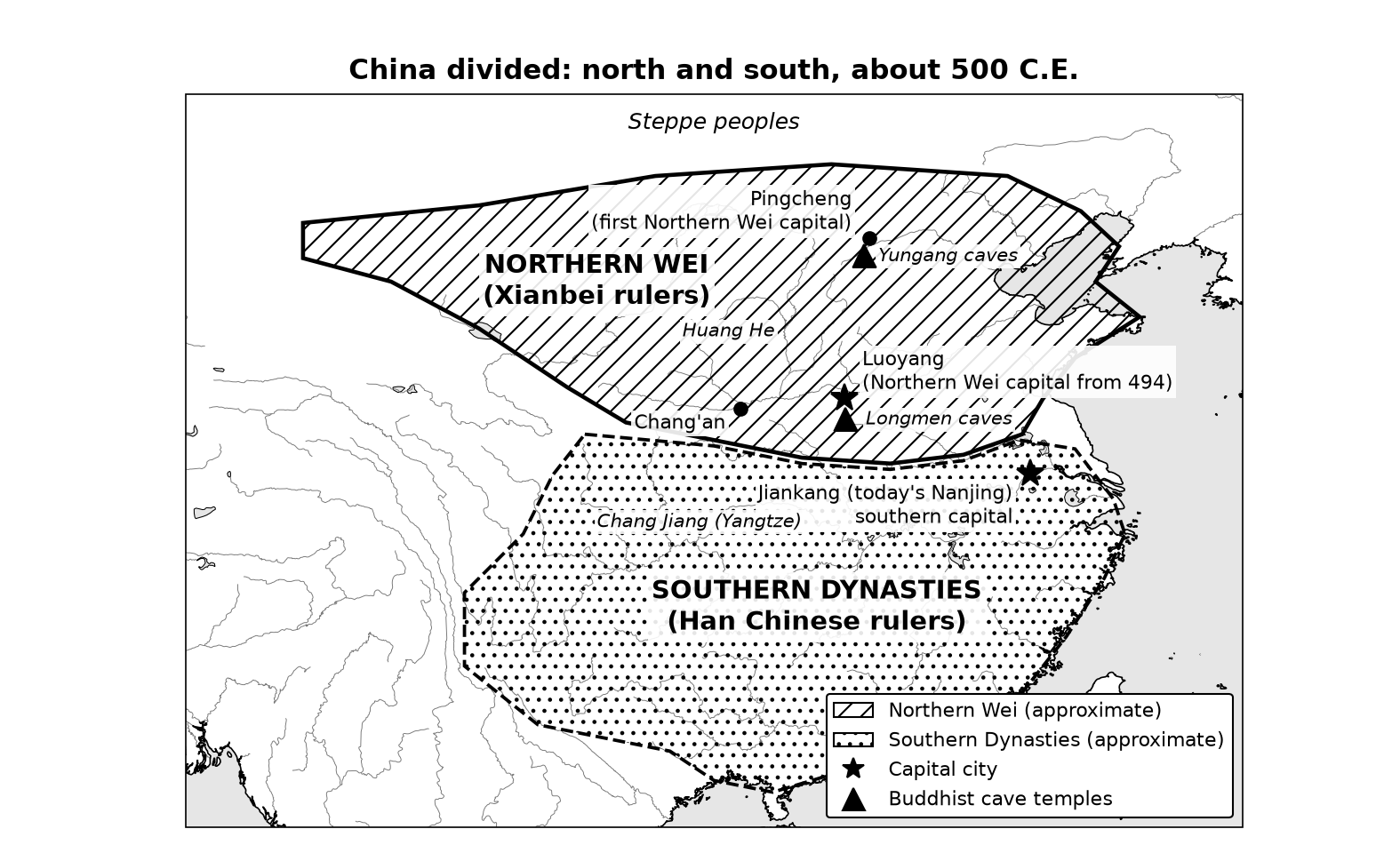
Map notes: Around 500 C.E., the Northern Wei ruled the north. A Han Chinese dynasty ruled the south from Jiankang. Notice where the great cave temples are: in the north, the part of China ruled by steppe peoples.
Do not confuse: the Three Kingdoms of China (Wei, Shu and Wu, 220–280) are not the Three Kingdoms of Korea (Goguryeo, Baekje and Silla) from Unit 2.
2. How China fell apart
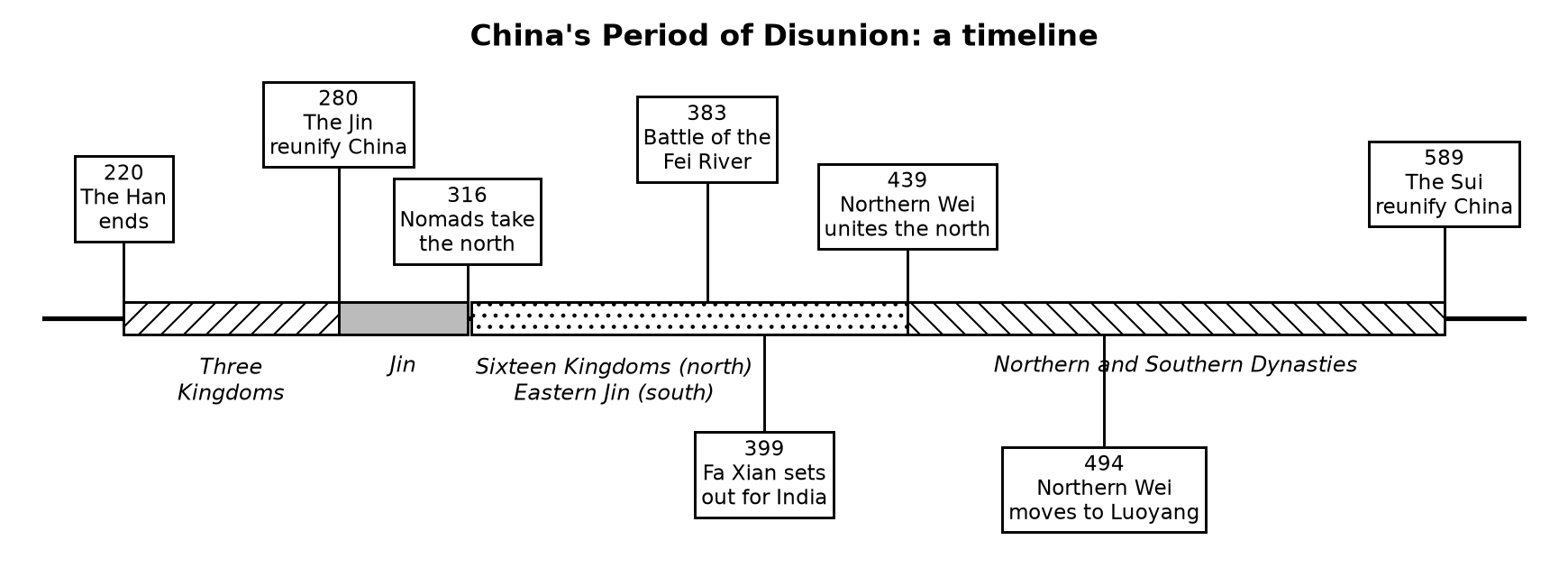
China broke apart in three stages. Learn them in order:
- The Three Kingdoms (220–280). The Han collapsed in 220. Three generals' families each ruled part of China: Wei in the north, Shu in the west, Wu in the south. They fought for 60 years.
- The Jin (280–316), then the Sixteen Kingdoms in the north. The Jin reunified China for a short time. Then Jin princes fought each other, and steppe nomad armies took the north. The Jin family fled south and ruled from Jiankang as the Eastern Jin (317–420). The north broke into the Sixteen Kingdoms, most of them ruled by steppe peoples.
- The Northern and Southern Dynasties (420–589). The Northern Wei united the north in 439. The south was ruled by four Han Chinese dynasties, one after another, all from Jiankang.
Why did China stay divided? The Han government was weak before it fell. Warlords fought each other. Steppe nomad peoples conquered the north. Many Han Chinese families fled south. Each side had a strong army, and neither could defeat the other.
3. SPICE-T: the Period of Disunion
SPICE-T = Social, Political, Interactions, Cultural, Economic, Technology.
S — Social
- Life was dangerous. War, hunger and disease killed millions of people.
- Millions of Han Chinese moved south, away from the fighting. The south grew in population.
- Great families became very powerful. They owned huge estates and had their own private soldiers.
- In the north, steppe peoples and Han Chinese lived side by side and slowly mixed.
P — Political
- No single ruler controlled China for more than 350 years.
- Rulers claimed the Mandate of Heaven, but none could hold it for long.
- The Northern Wei (386–534) was the strongest northern kingdom. Its rulers were Xianbei, a steppe people.
- Emperor Xiaowen of the Northern Wei moved his capital to Luoyang in 494. He ordered his people to wear Chinese clothes, take Chinese names and speak Chinese at court.
- The southern dynasties claimed to be the true heirs of the Han.
I — Interactions
- War between north and south. In 383, the northern kingdom of Former Qin tried to conquer the south. It lost the Battle of the Fei River, and the north broke apart again.
- Steppe nomads ruled northern China. They brought their horses and fighting skills. They took on Chinese ways of governing.
- Buddhism arrived from India along the Silk Road, carried by monks and merchants.
- The monk Fa Xian walked from China to India in 399 to collect Buddhist books, and came home by sea about 412.
C — Cultural
- Buddhism spread fast. Life was dangerous, and Buddhism offered comfort and hope: it taught that suffering could end.
- Daoism grew too. Many people turned away from Confucianism, which seemed to have failed: it had not kept the Han together.
- Northern rulers paid for huge Buddhist cave temples: Yungang (from about 460) and Longmen (from about 493).
- In the south, Emperor Wu of Liang was so devoted to Buddhism that he tried to become a monk.
- Calligraphy (beautiful handwriting) became a great art. Wang Xizhi (300s) is still called the "Sage of Calligraphy".
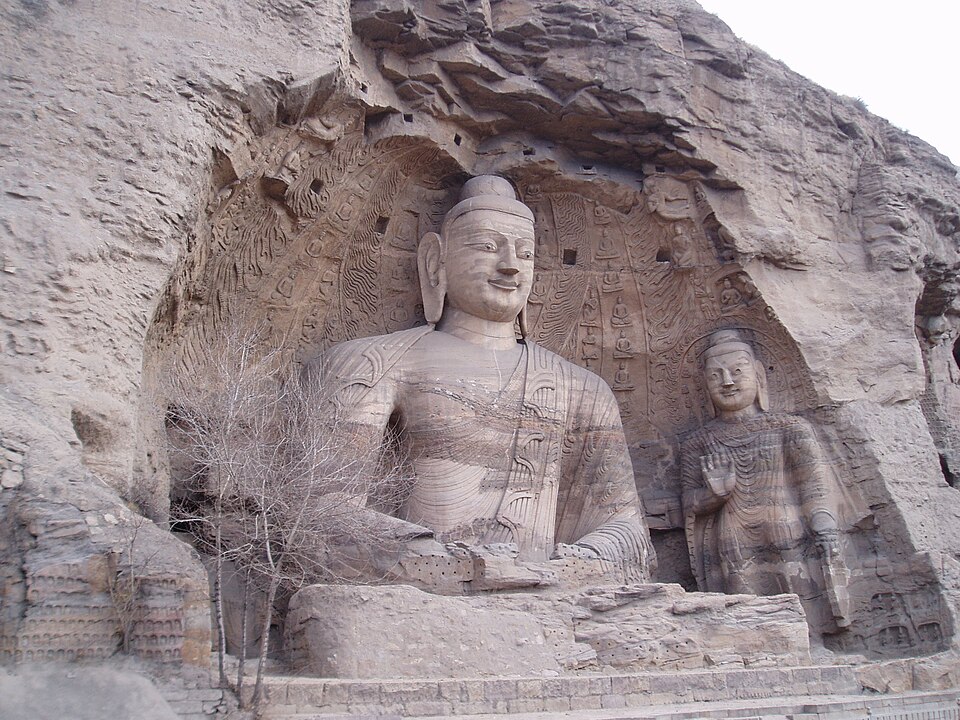
Credit: Steve Cadman, Wikimedia Commons, CC BY-SA 2.0
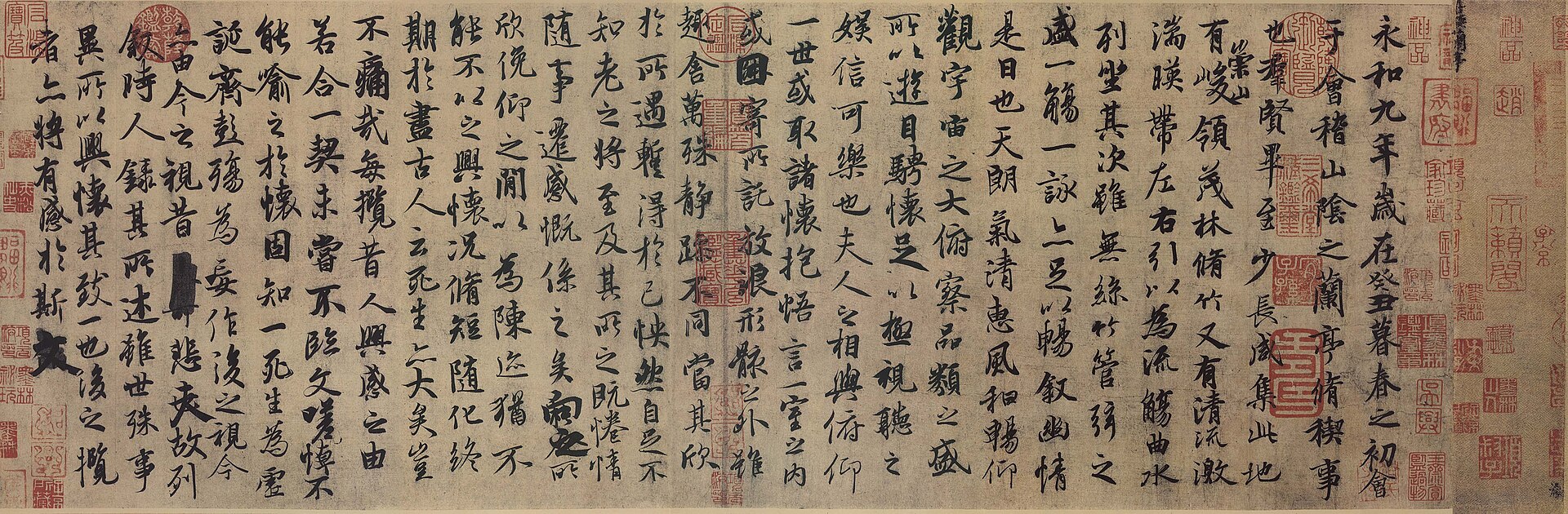
Credit: Feng Chengsu, after Wang Xizhi, Wikimedia Commons, public domain
E — Economic
- War damaged the north: farms were burned, and cities were destroyed.
- The south grew richer. Farmers who fled south cleared new land and grew rice in the warm, wet Chang Jiang valley.
- Trade on the Silk Road continued, even during the wars. Merchants and monks travelled together.
- Buddhist monasteries owned land and became rich.
T — Technology
- Stirrups: riders in China began using stirrups in the 300s. Stirrups made it much easier to fight on horseback.
- Math: around 480, Zu Chongzhi calculated pi (π) to 7 decimal places (3.1415926). No one in the world did better for almost 1,000 years. (Compare Aryabhata in Gupta India.)
- Building: Chinese builders learned to make pagodas: tall towers for Buddhist relics. The Songyue Pagoda (523) is the oldest brick pagoda still standing in China.
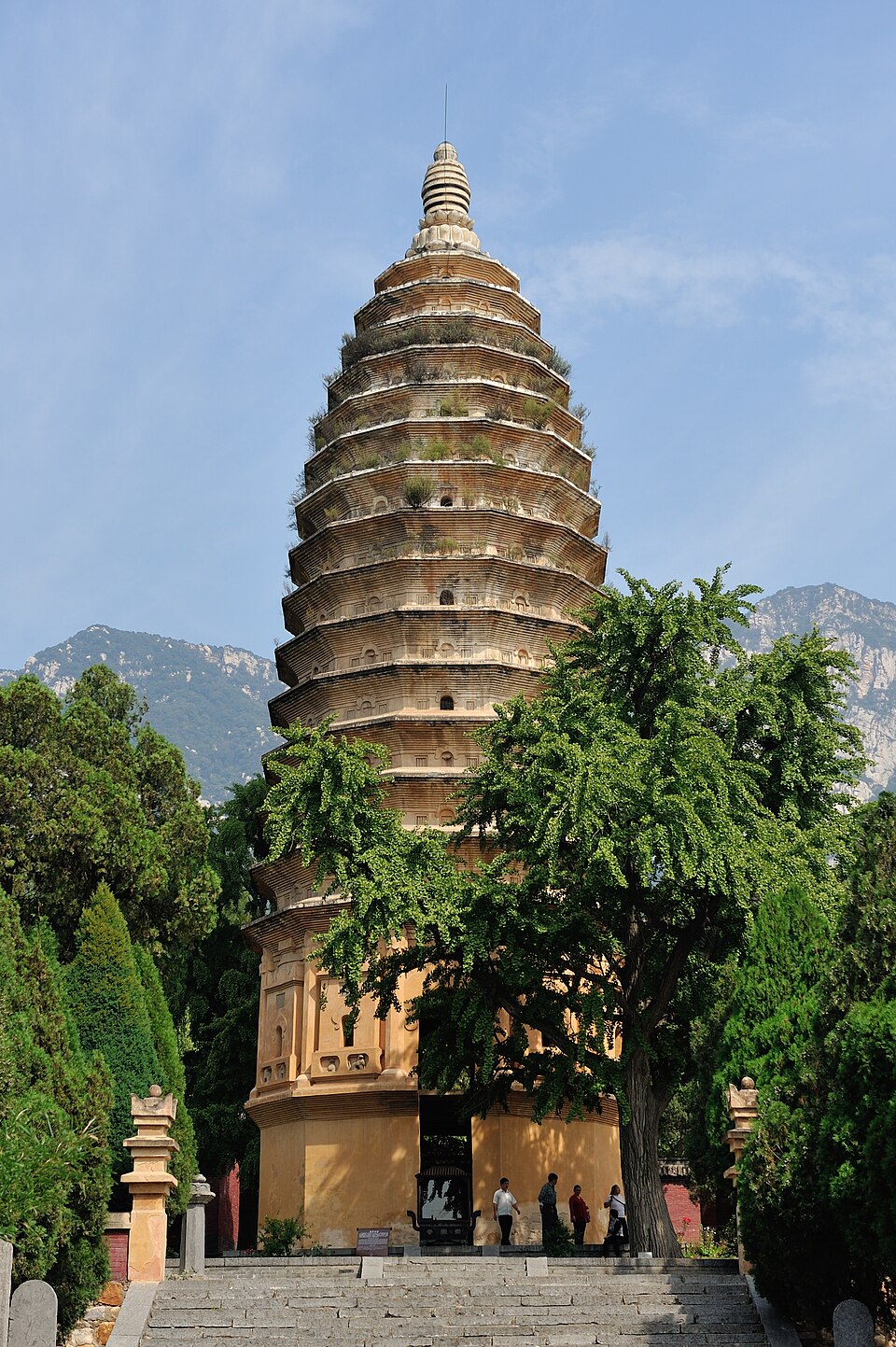
Credit: Siyuwj, Wikimedia Commons, CC BY-SA 4.0
4. Big ideas
- China fell apart after the Han. For more than 350 years, there was no single ruler. Remember the order: Three Kingdoms → Jin → Sixteen Kingdoms (north) and Eastern Jin (south) → Northern and Southern Dynasties.
- North and south were different. The north was ruled by steppe nomad peoples. The south was ruled by Han Chinese dynasties from Jiankang.
- Danger turned people to Buddhism. When life was dangerous, Buddhism offered comfort. It came from India along the Silk Road.
- Mixing, not just conquering. Steppe rulers like the Northern Wei took on Chinese clothes, names and government. Chinese culture changed too: it became more Buddhist.
- Opposite of India. At the same time, Gupta India was unified and in a golden age. China was divided and at war. Same years, opposite stories.
5. Key sources: how do we know what we know?
| Source | Who made it? When? | Insider or outsider? | What it tells us | Be careful! |
|---|---|---|---|---|
| Records of the Three Kingdoms | Chen Shou, a historian, about 280–290 | Insider (Chinese, writing soon after) | The wars and rulers of Wei, Shu and Wu | Chen Shou worked for the Jin, who took power from Wei. He had reasons to make Wei look legitimate. |
| Yungang and Longmen cave temples | Northern Wei rulers and Buddhist artists, from about 460 | Insider (artefact) | Steppe rulers paid for Buddhist art, so Buddhism was strong in the north | They show what rulers paid for, not what ordinary farmers believed. |
| A Record of Buddhist Kingdoms | Fa Xian, a Chinese monk, about 414 | Insider for China; outsider in India | Why Chinese monks went to India: to bring back Buddhist books | Fa Xian was a Buddhist, writing for Buddhists. |
| Songyue Pagoda | Northern Wei builders, 523 | Insider (artefact) | Buddhism was supported by northern emperors | A building cannot tell us why people built it. |
| Romance of the Three Kingdoms | Luo Guanzhong, a novelist, about 1,100 years later (1300s) | Outsider (much later) | The famous stories everyone knows today | It is a novel. Many of its stories are made up. Do not use it as evidence for what really happened. |
Says vs. knows: the most famous version of this period is a novel written 1,100 years later. Historians check it against the older Records of the Three Kingdoms. A good story is not the same as good evidence.
Source questions to ask every time: Who made it? When? Why did they make it? What can it tell us? What can it not tell us?
6. Timeline and vocabulary
| Word | Meaning |
|---|---|
| disunion | The breaking apart of a land that was once unified |
| reunify | To join a divided land back together under one government |
| warlord | A military leader who controls land with his own army, not for the government |
| steppe nomads | Herding peoples of the grasslands north and west of China, who moved with their animals and fought on horseback |
| Northern Wei | The strongest northern dynasty (386–534), ruled by the Xianbei people |
| Jiankang | The capital of the southern dynasties; today's Nanjing |
| Mandate of Heaven | The Chinese belief that Heaven gives a ruler the right to rule, and can take it away |
| Buddhism | A religion that began in India and teaches that suffering can end |
| Daoism | A Chinese belief that teaches people to live simply and in harmony with nature (the Dao, or "the Way") |
| cave temple | A Buddhist temple cut into a cliff, with statues and paintings inside |
| pagoda | A tall, many-roofed Buddhist tower |
| pilgrim | A person who travels to a holy place for religious reasons |
| calligraphy | The art of beautiful handwriting |
7. Connections
Before: the Han Dynasty (Unit 2)
| SPICE-T | Han Dynasty | Period of Disunion |
|---|---|---|
| Political | Unified under one emperor | Divided: north and south |
| Cultural | Confucianism was the official philosophy | Many turned to Buddhism and Daoism |
| Interactions | The Han fought the Xiongnu and kept them out | Steppe peoples ruled the north |
At the same time: the Gupta Empire in India (about 320–550)
| SPICE-T | China (Period of Disunion) | India (Gupta Empire) |
|---|---|---|
| Political | Divided: many kingdoms at war | Unified: one mostly peaceful empire |
| Cultural | Buddhism spread fast | Hindu rulers supported Buddhists too |
| Technology | Zu Chongzhi calculated pi | Aryabhata calculated pi |
The link: Buddhism. Chinese monks like Fa Xian travelled to India to collect Buddhist books. Read the Gupta packet.
Coming next: the Sui (581–618)
Disunion ends when the Sui reunifies China in 589. Read the Sui packet.
8. Where students lose marks on this topic
| Mistake | Fix |
|---|---|
| Mixing up China's Three Kingdoms (Wei, Shu, Wu) with Korea's Three Kingdoms | China's: 220–280, after the Han. Korea's: Goguryeo, Baekje, Silla (Unit 2). |
| Saying Buddhism began in China | Buddhism began in India. It came to China along the Silk Road. |
| Saying the south was ruled by steppe nomads | The north was ruled by steppe peoples. The south was Han Chinese. |
| Saying "China was conquered by nomads" | Only the north. And the steppe rulers took on Chinese ways. |
| Saying nothing good happened because there was war | Buddhism, cave temples, calligraphy and Zu Chongzhi's pi all came from this period. |
| Getting the order of periods wrong | Three Kingdoms → Jin → Sixteen Kingdoms + Eastern Jin → Northern and Southern Dynasties |
Self-check
Cover the answers. Can you answer these in complete sentences?
- Why was China not unified after the Han fell?
- Name ONE dynasty in the Period of Disunion that was ruled by steppe nomads.
- What was the capital of the southern dynasties, and what is it called today?
- Why did Buddhism become popular during the Period of Disunion?
- How did the Northern Wei show that steppe rulers took on Chinese ways?
- Why is Romance of the Three Kingdoms weak evidence for what really happened?
Check your answers (click to open)
- China was not unified because the Han government was weak, warlords fought each other, steppe nomad peoples conquered the north, and neither the north nor the south could defeat the other.
- The Northern Wei was ruled by the Xianbei, a steppe people. (Also correct: the Former Qin.)
- The capital of the southern dynasties was Jiankang, which is called Nanjing today.
- Buddhism became popular because life was dangerous, and Buddhism offered comfort and taught that suffering could end.
- Emperor Xiaowen of the Northern Wei ordered his people to wear Chinese clothes, take Chinese names and speak Chinese at court.
- Romance of the Three Kingdoms is weak evidence because it is a novel written about 1,100 years later, and many of its stories are made up.