Home › East Asian Civilization › Unit 3
The Sui Dynasty (581–618 C.E.)
East Asian Civilization · Unit 3 · Civilization Packet
1. At a glance
| Question | Answer |
|---|---|
| When? | 581–618 C.E.: only 37 years |
| Where? | All of China. The Sui began in the north and reunified China in 589. |
| Capital | Daxing (the Sui name for Chang'an); later also Luoyang |
| Rulers | Yang Jian (Emperor Wendi), the founder; his son Yangdi, who lost everything |
| Known for | Reunifying China after more than 350 years; the Grand Canal; starting the civil service exam; forced labour; failed wars against Korea |
| How did it end? | People were exhausted by hard labour and expensive wars. Rebellions broke out. Yangdi was killed in 618, and the Tang took over. |
| How do we know? | The Book of Sui, written by Tang historians, the dynasty that replaced the Sui; the Grand Canal itself, still in use today |
Unit 3's big question: why do empires fall apart, and how do they come back together? The Sui's answer: one strong government, one shared exam, and one great canal joining north and south.
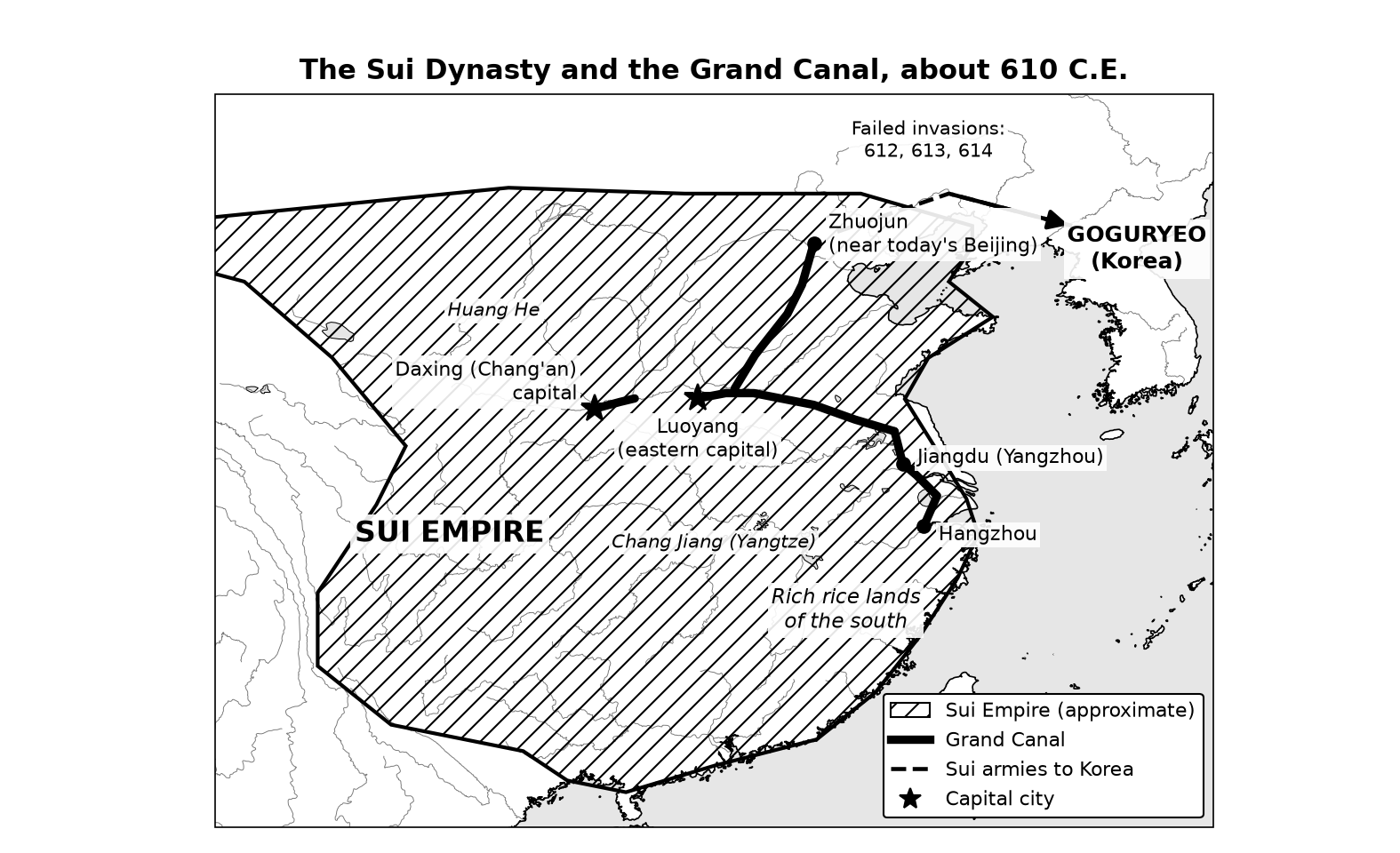
Map notes: The Grand Canal joined China's two great rivers, the Huang He (Yellow River) in the north and the Chang Jiang (Yangtze River) in the south. Rice from the rich south could now travel by boat to the capital and the army in the north.
Do not confuse: the Sui (581–618) and the Qin (221–206 B.C.E.) were both short dynasties that reunified China with harsh rule. Both were followed by a long, famous dynasty: the Qin by the Han, the Sui by the Tang.
2. How the Sui reunified China
- Yang Jian was a powerful general in the north. In 581, he took the throne and founded the Sui.
- In 589, his armies crossed the Chang Jiang and conquered Chen, the last southern dynasty. China was reunified after more than 350 years.
- To hold China together, the Sui used three tools:
| Tool | What it did | Why it helped unity |
|---|---|---|
| One government | A centralized government with one law code for the whole empire | The emperor's rules reached every part of China |
| The civil service exam | Officials were tested on Confucian books | Officials across China shared the same ideas |
| The Grand Canal | A waterway joining the north and the south | Grain, soldiers and news could move quickly between them |
3. SPICE-T: the Sui Dynasty
SPICE-T = Social, Political, Interactions, Cultural, Economic, Technology.
S — Social
- Forced labour: millions of farmers were made to dig canals, rebuild walls and build palaces. Many died.
- Men were sent to fight long wars far from home. Families lost their workers.
- The north and the south, apart for centuries, began to mix again.
P — Political
- Yang Jian (Wendi) ruled 581–604. He was careful with money. He wrote one law code for the whole empire.
- He brought back Confucian government and the idea of choosing officials by merit (ability).
- His son Yangdi ruled 604–618. He spent huge amounts on building projects and wars.
- The Sui used force to make people obey. People began to say the Sui had lost the Mandate of Heaven.
I — Interactions
- War with Korea: Yangdi invaded the Korean kingdom of Goguryeo in 612, 613 and 614. All three invasions failed. Hundreds of thousands of soldiers died.
- The Sui fought the Turks, steppe nomads in the north.
- Japan sent envoys (official visitors) to the Sui court to learn from China.
C — Cultural
- Buddhism was strongly supported. Wendi was a Buddhist and built Buddhist temples across China.
- Confucianism returned as the philosophy of government.
- The north and south began to share one culture again.
E — Economic
- The south grew most of the rice. The north had the capital and the army. The Grand Canal linked them.
- The Sui built huge granaries (grain stores) to feed the army and prevent famine.
- Wars and building projects cost far more than the empire could pay. Taxes and labour demands grew heavier and heavier.
T — Technology
- The Grand Canal: more than 1,700 km (about 1,100 miles) of waterways. Parts of it are still in use today, about 1,400 years later.
- Locks and dams controlled water levels so boats could move between rivers.
- The Anji Bridge (about 605): a stone arch bridge so well designed that it still stands today.
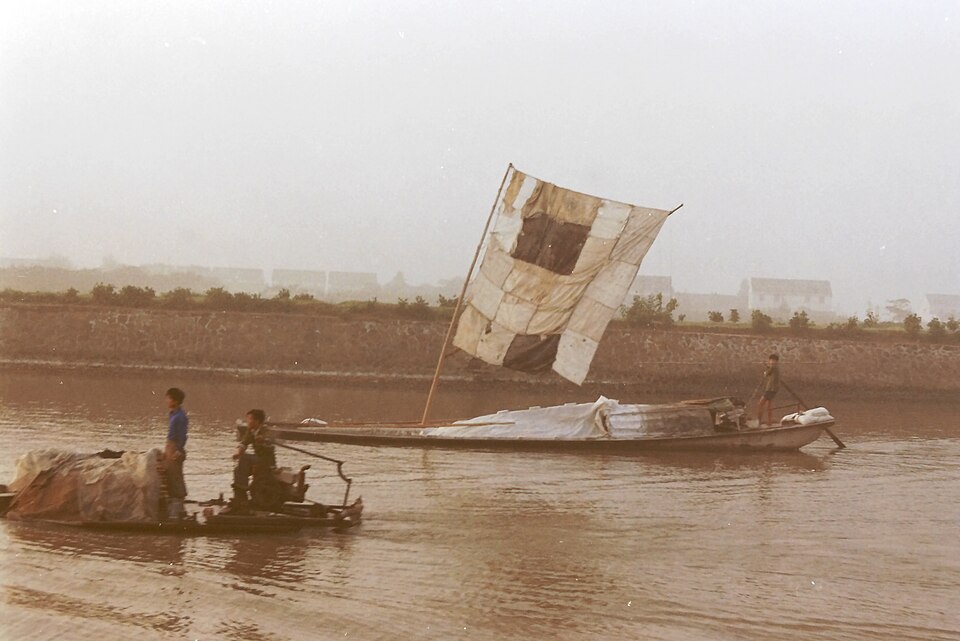
Credit: BabelStone, Wikimedia Commons, CC BY-SA 4.0
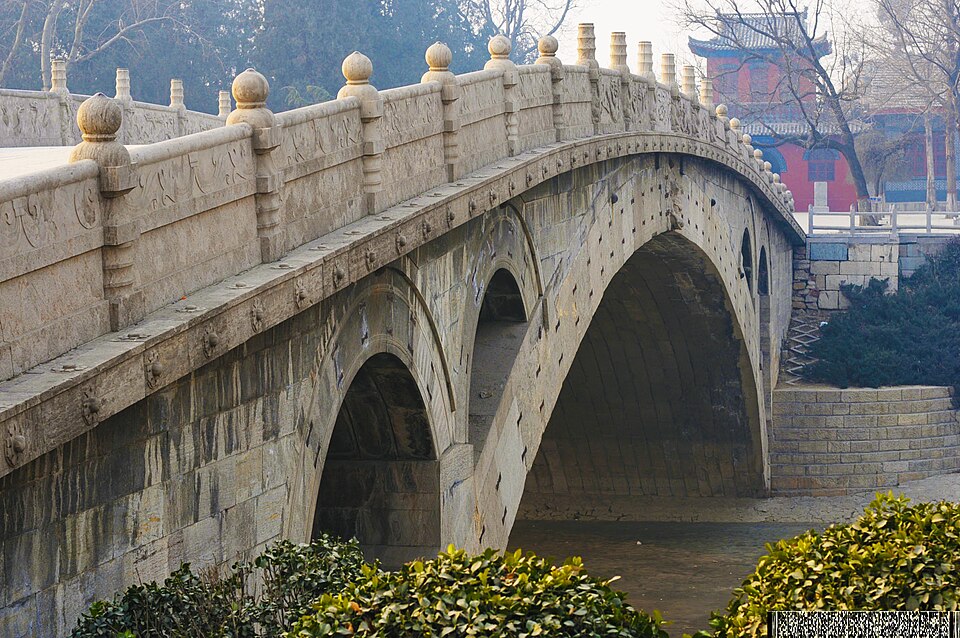
Credit: crazlei, Wikimedia Commons, CC BY 2.0
4. Big ideas
- The Sui reunified China. In 589, the Sui ended more than 350 years of disunion.
- Unity needs tools. The Sui held China together with one government, a shared exam in Confucian ideas, and the Grand Canal.
- The Grand Canal was a cause of unity. It joined the rich south to the political north. (Cause → effect: canal → trade and food move north → north and south depend on each other → unity.)
- Too much, too fast. Forced labour and failed wars against Goguryeo exhausted the people. Rebellions ended the Sui after only 37 years.
- A short dynasty, a long legacy. Like the Qin, the Sui fell quickly, but the Tang kept what the Sui built.
5. Key sources: how do we know what we know?
| Source | Who made it? When? | Insider or outsider? | What it tells us | Be careful! |
|---|---|---|---|---|
| Book of Sui | Tang historians led by Wei Zheng, finished in 636 | Outsider (the dynasty that replaced the Sui) | The Sui's laws, wars and building projects; the cruelty of Yangdi | The Tang needed the Sui to look bad, so the Tang would look good. Possible bias. |
| The Grand Canal | Sui workers, mostly 605–610 | Artefact | The size and skill of Sui engineering; the power to force millions to work | It shows what was built, not how the workers felt. |
| Imperial China: A Definitive Visual History | DK Books, 2020 | Secondary source (a modern book) | Yangdi's projects and his failed wars against Korea | It was written 1,400 years later, using older sources. Ask which sources it used. |
| The Anji Bridge | The builder Li Chun, about 605 | Artefact | Sui skill in stone engineering | One bridge cannot tell us about daily life. |
Says vs. knows: the Book of Sui says Yangdi was cruel and wasteful. The canal and the records of the Korean wars show that the costs really were huge. When an enemy's story and the evidence agree, we can be more confident.
Remember the pattern: the Han wrote the story of the Qin. The Tang wrote the story of the Sui. Each time, the dynasty that replaced the old one wrote its history.
6. Timeline and vocabulary
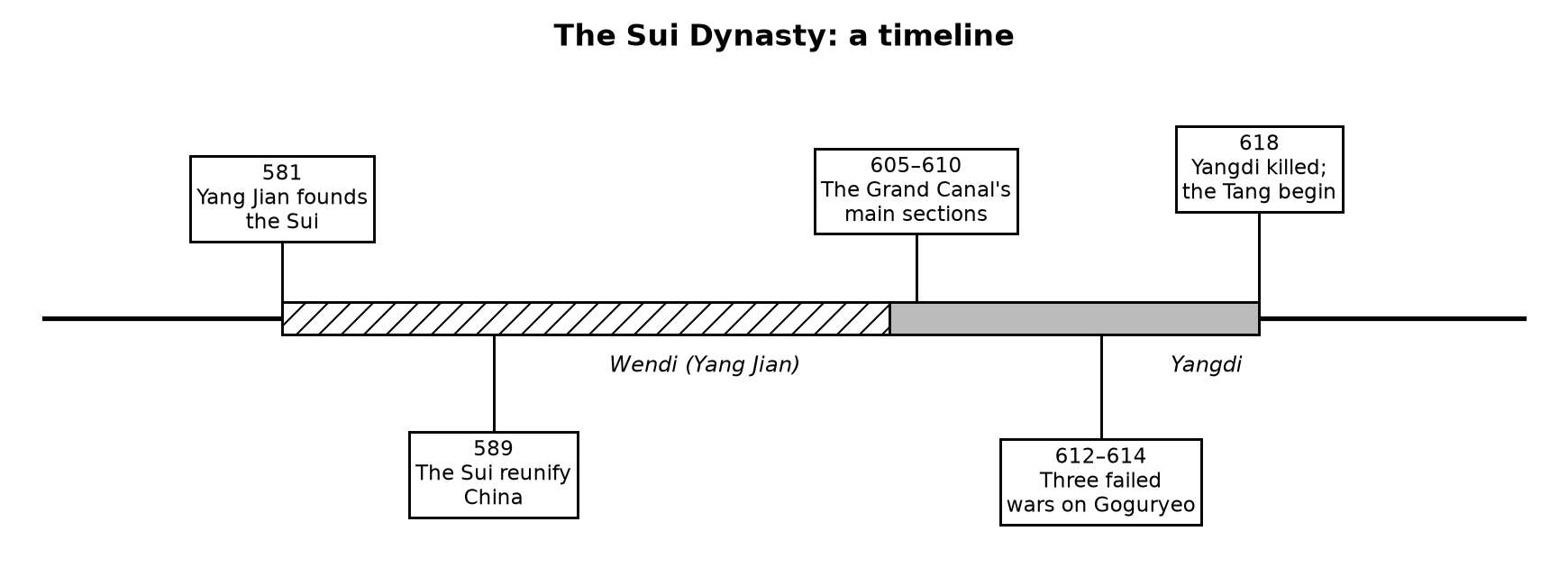
| Word | Meaning |
|---|---|
| reunify | To join a divided land back together under one government |
| Grand Canal | A long waterway joining the Huang He and the Chang Jiang, begun by the Sui |
| canal | A waterway dug by people for boats |
| lock | A section of a canal with gates, where the water level is raised or lowered to move boats up or down |
| civil service exam | A test on Confucian books that people took to get government jobs |
| merit | Ability and knowledge (not family) |
| centralized | Power held by one central government |
| forced labour | Work people must do for the government, without choice |
| granary | A building for storing grain |
| Goguryeo | A Korean kingdom that defeated three Sui invasions |
| Mandate of Heaven | The Chinese belief that Heaven gives a ruler the right to rule, and can take it away |
7. Connections
Before: the Period of Disunion (220–589)
The Sui ended more than 350 years of division. Read the Period of Disunion packet.
Across time: the Qin (Unit 2)
| SPICE-T | Qin (221–206 B.C.E.) | Sui (581–618 C.E.) |
|---|---|---|
| Political | Unified China with harsh law | Reunified China with harsh rule |
| Social | Forced labour: walls, roads, a tomb | Forced labour: the Grand Canal, walls, palaces |
| Economic | Standardized money, writing and weights | Joined north and south with a canal |
| How it ended | Rebellions after 15 years | Rebellions after 37 years |
| Who came next | The Han: long and famous | The Tang: long and famous |
Across Asia: the Gupta Empire (about 320–550)
| Gupta Empire (India) | Sui Dynasty (China) | |
|---|---|---|
| What it ended | A time of small, fighting kingdoms | The Period of Disunion |
| How long it lasted | About 230 years | Only 37 years |
| The golden age | The Gupta was the golden age | The golden age came next, under the Tang |
Coming next: the Tang (618–907)
The Tang kept the Sui's government, exam and canal, and built China's golden age on them. Read the Tang packet.
8. Where students lose marks on this topic
| Mistake | Fix |
|---|---|
| Saying the Grand Canal ran east to west | It ran north to south, joining the Huang He and the Chang Jiang. |
| Saying the Sui was a golden age | The Sui was short and harsh. The golden age came after, under the Tang. |
| Saying the Sui fell because of one cause | Give both: forced labour at home and expensive, failed wars in Korea. |
| Mixing up Wendi and Yangdi | Wendi (the father) reunified China. Yangdi (the son) overspent and lost it. |
| Trusting the Book of Sui completely | It was written by the Tang, who replaced the Sui. Say this in your answer. |
| Writing "it" or "they" | Use the exact name: "the Sui Dynasty", "Emperor Yangdi". |
Self-check
Cover the answers. Can you answer these in complete sentences?
- When did the Sui reunify China, and what did that end?
- How did the Grand Canal help unify China?
- How did the civil service exam help unify China?
- Give TWO reasons the Sui fell after only 37 years.
- Why should we be careful when we read the Book of Sui?
- How was the Sui similar to the Qin?
Check your answers (click to open)
- The Sui reunified China in 589, which ended the Period of Disunion after more than 350 years.
- The Grand Canal joined the Huang He and the Chang Jiang, so rice from the rich south could travel to the capital and the army in the north. This made the north and south depend on each other.
- The civil service exam tested officials on Confucian books, so officials across China shared the same ideas about government.
- The Sui fell because forced labour on projects like the Grand Canal exhausted the people, and three expensive invasions of Goguryeo in Korea failed.
- We should be careful because the Book of Sui was written by Tang historians, and the Tang replaced the Sui. They had reasons to make the Sui look bad.
- Both the Sui and the Qin unified China with harsh rule and forced labour, both fell quickly after rebellions, and both were followed by a long, famous dynasty.