Home › East Asian Civilization › Unit 3
Nara and Heian Japan (710–1185 C.E.)
East Asian Civilization · Unit 3 · Civilization Packet
1. At a glance
| Question | Answer |
|---|---|
| When? | Nara period: 710–794. Heian period: 794–1185. |
| Where? | Japan. The capital was Nara, then Heian-kyo (today's Kyoto). |
| Who held power? | Nara: the emperor, with powerful Buddhist monks close by. Heian: the Fujiwara family, who ruled through the emperors. |
| Known for | Copying Tang China (Nara); then a new Japanese culture (Heian): kana writing, The Tale of Genji, women writers |
| How did it end? | Warrior families grew stronger than the court. After the Genpei War (1180–1185), a military government took over. |
| How do we know? | Japan's own histories and poems; diaries and novels written by court women; Chinese records of Japanese visitors; buildings and treasures that still survive |
Unit 3's big question: why do empires fall apart, and how do they come back together? Japan asks a different question: who really holds power? The emperor never disappears, but the people controlling him change.
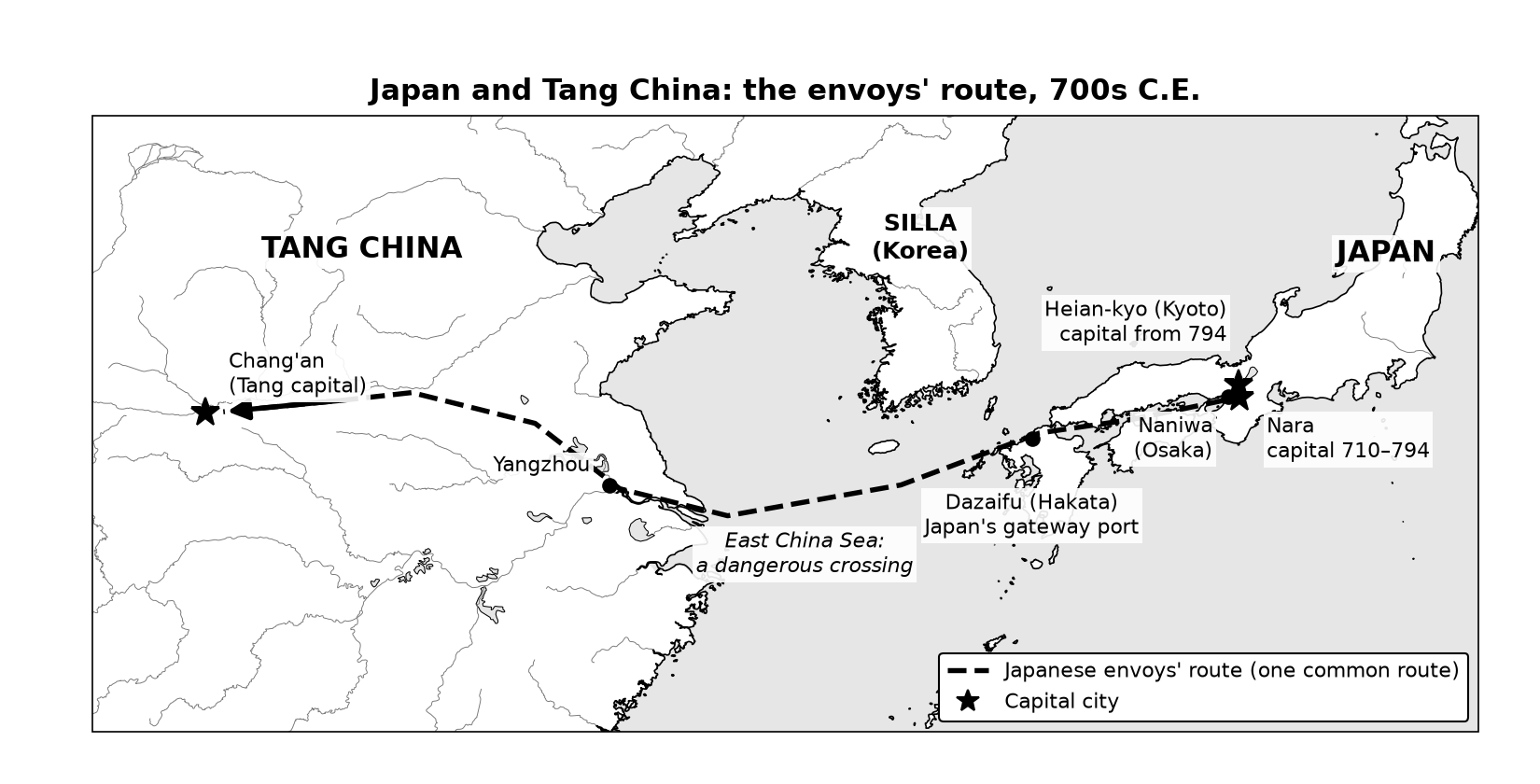
Map notes: Japanese envoys (official visitors) crossed the sea to Chang'an, the Tang capital. They brought back Chinese ideas. Nara and Heian-kyo are close together, about 40 km apart.
Do not confuse: Japan was never conquered by China. Japanese leaders chose to copy Chinese ideas because those ideas were powerful and useful.
2. From copying to creating
Japanese history in this unit has two steps. Learn them in order:
| Nara period (710–794) | Heian period (794–1185) | |
|---|---|---|
| Big idea | Imitation: Japan copies Tang China | Innovation: Japan makes its own culture |
| Capital | Nara, built like Chang'an | Heian-kyo (Kyoto) |
| Writing | Chinese characters (kanji) | Japanese kana, alongside kanji |
| Who held power | The emperor (and Buddhist monks grew powerful) | The Fujiwara family, as regents |
| Famous for | Todai-ji and its Great Buddha | The Tale of Genji and The Pillow Book |
Before Nara: the Taika Reforms (645). Japanese leaders saw that China was the most powerful state in East Asia. In 645, they began the Taika Reforms: all land would belong to the emperor, and farmers would pay taxes to the state, as in Tang China.
3. SPICE-T: Nara and Heian Japan
SPICE-T = Social, Political, Interactions, Cultural, Economic, Technology.
S — Social
- A small noble class lived at court in the capital. Most Japanese people were farmers.
- Court life followed strict rules about rank, clothing and manners.
- Women at the Heian court could own property, and some became great writers.
- Your family decided your job. Japan did not choose officials by exam.
P — Political
- Nara: the government was organized like Tang China: the emperor at the top, with ministries and officials below.
- Selective copying: Japan did not adopt the civil service exam. Officials came from noble families.
- Buddhist monks in Nara grew very powerful. In 794, Emperor Kammu moved the capital to Heian-kyo, partly to get away from them.
- Heian: the Fujiwara family married their daughters to emperors. When a young emperor took the throne, a Fujiwara ruled for him as regent. The Fujiwara had real power without being emperors.
- The most powerful Fujiwara was Fujiwara no Michinaga (966–1028). Four of his daughters married emperors or future emperors.
I — Interactions
- Japan and China: Japan sent official embassies to Sui and Tang China. Students and monks lived in Chang'an for years.
- Korea was the bridge: Buddhism and Chinese writing first reached Japan through Korea (Unit 2).
- In 894, Japan stopped sending embassies to the Tang, which was in decline. Japanese culture became more Japanese.
- Not isolated: Chinese books, goods and Buddhist teachers kept arriving.
C — Cultural
- Buddhism spread with government support. Emperor Shomu built Todai-ji in Nara. Its Great Buddha (752) is about 15 metres tall.
- Japan's first histories, the Kojiki (712) and Nihon Shoki (720), were written in Chinese characters.
- Kana: Japanese writers made simple sound-symbols from Chinese characters, called kana (hiragana and katakana). Kana made it much easier to write Japanese.
- Women writers used kana. Murasaki Shikibu wrote The Tale of Genji (about 1010), often called the world's first novel. Sei Shonagon wrote The Pillow Book.
- Yamato-e: a Japanese style of painting, often on long picture scrolls.
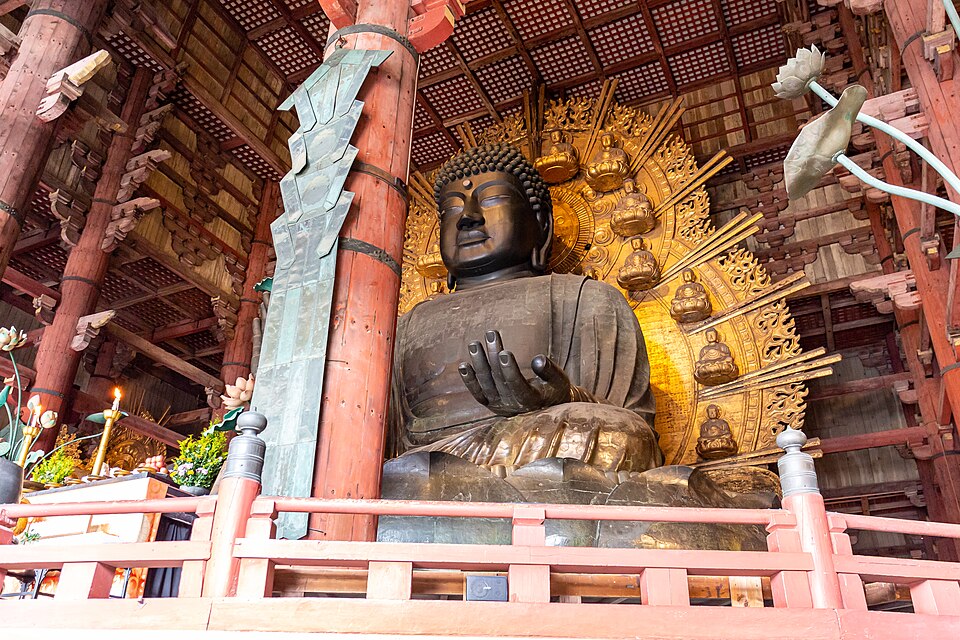
Credit: Balon Greyjoy, Wikimedia Commons, CC0 (public domain)
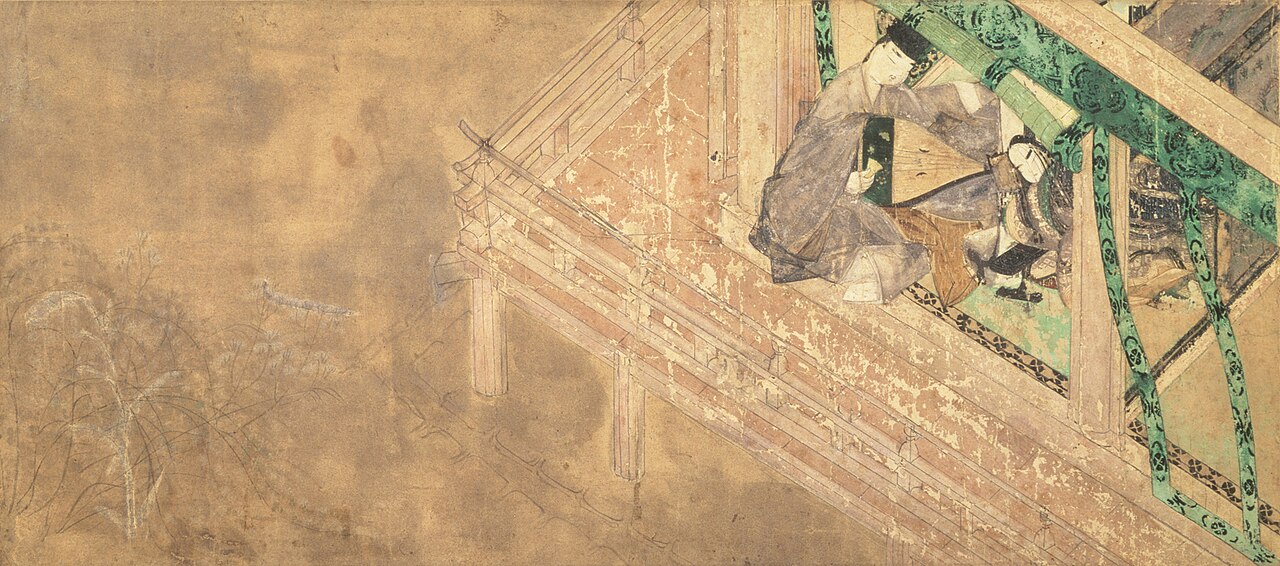
Credit: Tokugawa Art Museum, Wikimedia Commons, public domain
E — Economic
- Rice farming was the base of the economy.
- The Taika Reforms tried to give land to farmers and collect taxes for the state.
- Over time, nobles and temples built up private estates called shoen that did not pay taxes. The government grew poorer. (This leads to the samurai.)
T — Technology
- City planning: Nara and Heian-kyo were built on a grid of straight streets, copied from Chang'an.
- Bronze casting: the Great Buddha of Todai-ji used hundreds of tonnes of bronze.
- Wooden buildings: Japanese builders made huge wooden temple halls. The Byodo-in Phoenix Hall (1053) still stands today.
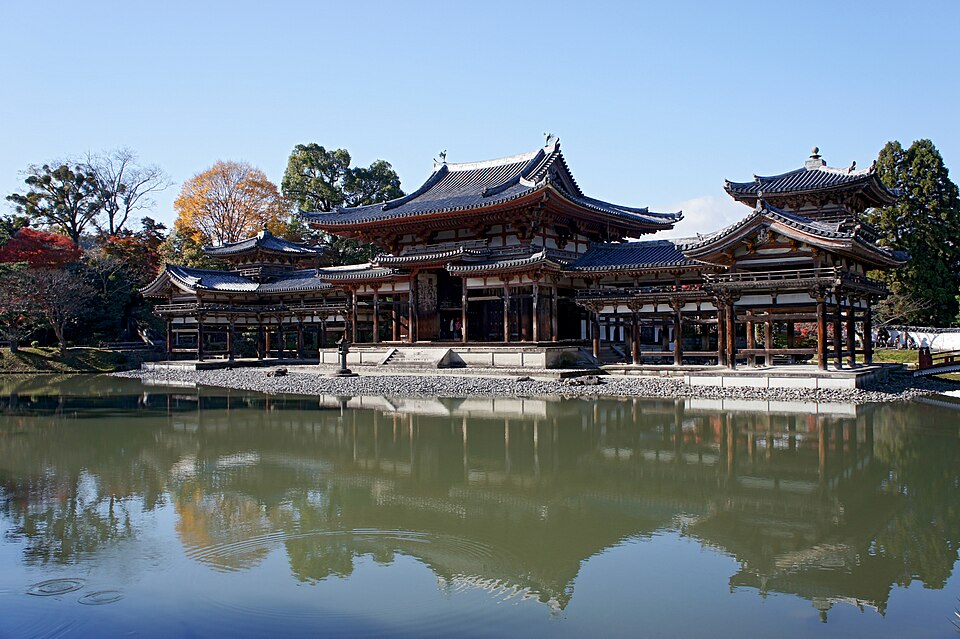
Credit: 663highland, Wikimedia Commons, CC BY 2.5
4. Big ideas
- Japan chose to copy. Japan was never conquered. Leaders copied Tang China's government, Buddhism, writing and city plans because they made the ruler look powerful and legitimate.
- Selective copying. Japan copied a lot, but not everything. It did not use the civil service exam. Noble families kept their power.
- From imitation to innovation. In the Heian period, Japan created kana, The Tale of Genji and its own art. Japanese culture built on Chinese foundations, then grew in its own way.
- Power behind the throne. The Fujiwara controlled emperors through marriage and regency. The emperor stayed, but others held the real power.
- Ideas travel, and change. Buddhism went from India → China → Korea → Japan, and changed at every step.
5. Key sources: how do we know what we know?
| Source | Who made it? When? | Insider or outsider? | What it tells us | Be careful! |
|---|---|---|---|---|
| Nihon Shoki | The Japanese court, 720 | Insider | Japan's history as the emperors wanted it told, including the Taika Reforms | Written to show the emperor's family was meant to rule. |
| The Book of Sui on Japan | Tang historians in China, 636 | Outsider | In 607, a Japanese letter to the Sui emperor began: "The Son of Heaven where the sun rises, to the Son of Heaven where the sun sets". The Sui emperor was not pleased. | A Chinese view of Japan. It shows China expected Japan to act as a junior partner. |
| The Tale of Genji | Murasaki Shikibu, a court lady, about 1010 | Insider | Life, love, manners and beauty at the Heian court | It is a novel. The characters are made up, and it shows only the rich court. |
| The Pillow Book | Sei Shonagon, a court lady, about 1000 | Insider | Her own opinions and lists about court life | One person's opinions. She often looks down on ordinary people. |
| The Shosoin treasures | Emperor Shomu's belongings, stored at Todai-ji in 756 | Artefacts | Glass and objects from Persia and China reached Nara: Japan was connected to the Silk Road | They belonged to an emperor, not to ordinary people. |
Says vs. knows: the Nihon Shoki says Japan's emperors descend from the sun goddess Amaterasu. That tells us what the court wanted people to believe. It is not proof of where the emperors came from.
Source questions to ask every time: Who made it? When? Why did they make it? What can it tell us? What can it not tell us?
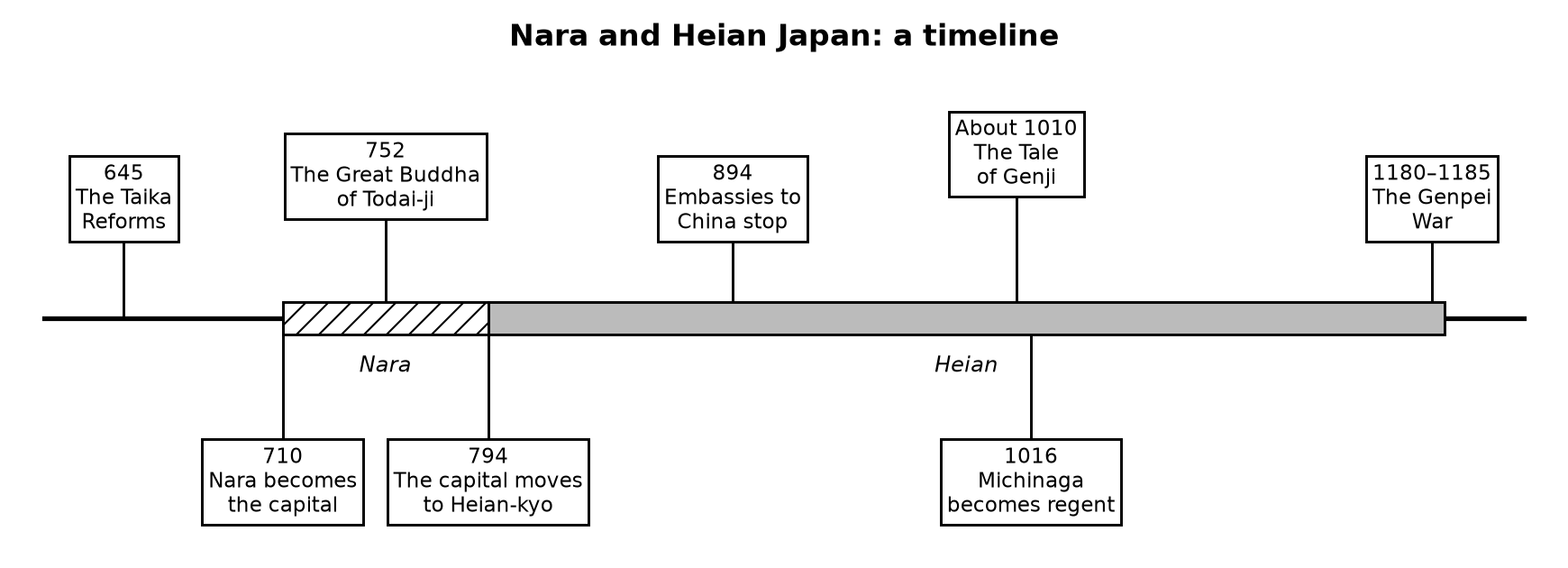
6. Timeline and vocabulary
| Word | Meaning |
|---|---|
| Taika Reforms | Changes from 645 that copied Chinese government: land belonged to the emperor, and farmers paid taxes to the state |
| Nara | Japan's capital, 710–794, built like Chang'an |
| Heian-kyo | Japan's capital from 794; today's Kyoto |
| Todai-ji | A huge Buddhist temple in Nara, home of the Great Buddha |
| regent | A person who rules for a young or weak monarch |
| Fujiwara | The noble family that ruled through the emperors in the Heian period |
| kanji | Chinese characters used to write Japanese |
| kana | Japanese sound-symbols (hiragana and katakana), made from Chinese characters |
| The Tale of Genji | A novel about the Heian court by Murasaki Shikibu, about 1010 |
| selective copying | Copying some ideas from another culture, but not all of them |
| shoen | Private estates that did not pay taxes to the government |
| envoy | An official visitor sent by a government |
7. Connections
Before: Yamato Japan and Korea (Unit 2)
The Yamato family became Japan's emperors. Korea's kingdoms passed Buddhism and Chinese writing to Japan. See Yamato Japan and Korea's Three Kingdoms.
At the same time: Tang China
| SPICE-T | Tang China | Nara and Heian Japan |
|---|---|---|
| Political | Officials chosen by exam | Officials chosen by family |
| Political | Who held power: the emperor (High Tang); then generals in the provinces (Late Tang) | Who held power: the emperor (Nara); then the Fujiwara (Heian) |
| Cultural | Buddhism very influential | Buddhism very influential |
| Cultural | Famous writing: poetry by Li Bai and Du Fu | Famous writing: The Tale of Genji and The Pillow Book, in kana |
| Technology | Chang'an built on a grid | Nara and Heian-kyo copied that grid |
Read the Tang packet.
Coming next: the rise of the samurai
Tax-free shoen estates needed warriors to protect them. Those warriors became the samurai. Read the Rise of the Samurai packet.
8. Where students lose marks on this topic
| Mistake | Fix |
|---|---|
| Saying China conquered Japan | Japan was never conquered. Japanese leaders chose to copy China. |
| Saying Buddhism is Chinese | Buddhism began in India, then went to China, Korea and Japan. |
| Saying Japan copied everything, including the exam | Japan did not use the civil service exam. Officials came from noble families. |
| Saying the Fujiwara overthrew the emperor | The Fujiwara kept the emperor and ruled through him, as regents. |
| Saying kana replaced kanji | Japanese uses both, still today. |
| Mixing up Nara and Heian | Nara (710–794) = copying China. Heian (794–1185) = Japan's own culture. |
Self-check
Cover the answers. Can you answer these in complete sentences?
- Why did Japan copy Tang China?
- Give ONE thing Japan copied from China, and ONE thing it did not.
- How did the Fujiwara hold power without being emperors?
- Why was kana important?
- Who wrote The Tale of Genji, and what can it tell us?
- Why should we be careful with the Nihon Shoki?
Check your answers (click to open)
- Japan copied Tang China because China was the most powerful state in East Asia, and copying its systems made Japan's ruler look powerful and legitimate.
- Japan copied the Chinese style of government and built Nara like Chang'an. It did not copy the civil service exam.
- The Fujiwara married their daughters to emperors. When a young emperor took the throne, a Fujiwara ruled for him as regent.
- Kana was important because it made it much easier to write Japanese, and court women used it to write great books like The Tale of Genji.
- Murasaki Shikibu, a court lady, wrote The Tale of Genji in about 1010. It shows us life, manners and beauty at the Heian court.
- We should be careful because the court wrote the Nihon Shoki to show that the emperor's family was meant to rule.